Scenario Labs Launches skills: Enabling AI Agents to Produce Commercial-Grade 3D Assets

Scenario Labs open-sources skills, adding model routing, cost estimation, and consistency assurance to AI Agents to bring generated content into production.
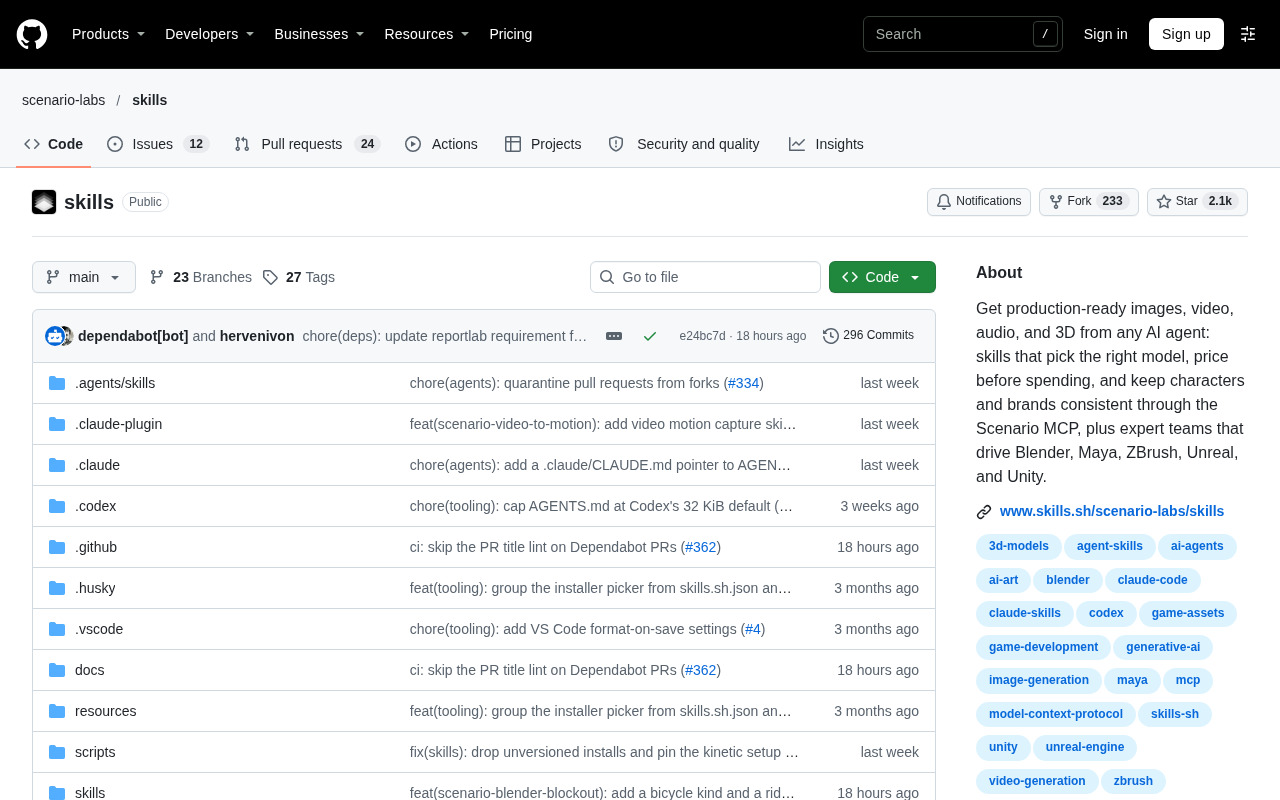
Scenario Labs' open-source skills project aims to lower the engineering barriers for AI Agents generating production-grade images, videos, audio, and 3D content. It adds a decision layer between Agents and generative models to automatically select models and estimate costs before consuming compute. Through Scenario MCP, skills can be used by any compatible Agent without framework lock-in. It also emphasizes character and brand consistency across generations and includes an expert team to drive Blender, Maya, ZBrush, Unreal, and Unity. Implemented in Python, it has 2,079 stars and 233 forks, with 224 new stars in a day, showing strong interest in production-grade Agent output, though multi-software integration remains an early-stage risk.
AI Agents are evolving from "chat tools" into "production tools," but there are still significant engineering barriers to getting Agents to generate images, videos, audio, and 3D content that can be directly put into production. The open-source skills project from Scenario Labs attempts to address several key pain points: choosing the right model, estimating costs before generating, and maintaining character and brand consistency.
From "Can Generate" to "Production-Ready"
When most Agents call generative models, the workflow is fragmented: the user specifies a model, the Agent calls the API, and the quality of the result is left to chance. skills adds a decision layer between the Agent and the underlying models—automatically selecting the appropriate model based on task type and providing a price estimate before consuming compute. This means Agents no longer blindly call the most expensive model, but instead weigh quality against cost.
Based on the project description, this capability is implemented through Scenario MCP. As a standardized interface between Agents and external tools, MCP (Model Context Protocol) allows skills to be called by any AI Agent that supports the protocol, without being tied to a specific framework.
MCP (Model Context Protocol) is a protocol standard proposed and open-sourced by Anthropic, designed to unify the way AI Agents communicate with external tools and data sources. It uses a client-server architecture: the Agent acts as the client and discovers and calls tools through a standardized interface, eliminating the need to write separate integration code for each tool. The core value of MCP lies in decoupling: tool providers only need to implement an MCP server once, and it can be used by all Agents compatible with the protocol. This is similar to how the Language Server Protocol (LSP) unified editors and programming language tools. For the skills project, adopting MCP means it is not bound to any particular Agent framework—Claude, Cursor, or any other MCP-compatible client can directly call its model selection and cost estimation capabilities, lowering the cost of ecosystem integration.
Consistency and Professional Toolchains
When generated content enters a production workflow, consistency is often more important than single-generation quality. skills emphasizes maintaining character and brand visual consistency across multiple generations, which is essential for games, advertising, e-commerce, and similar scenarios. If the virtual character looks different every time it is generated, subsequent assets cannot be used together at all.
Another noteworthy direction is support for professional 3D software. The project includes a built-in "expert team" to drive Blender, Maya, ZBrush, Unreal, and Unity. In other words, the Agent does not just generate a concept image—it can also carry out operations in real production software. This approach differs from pure text-to-3D model generation and is closer to the workflows of existing studios.
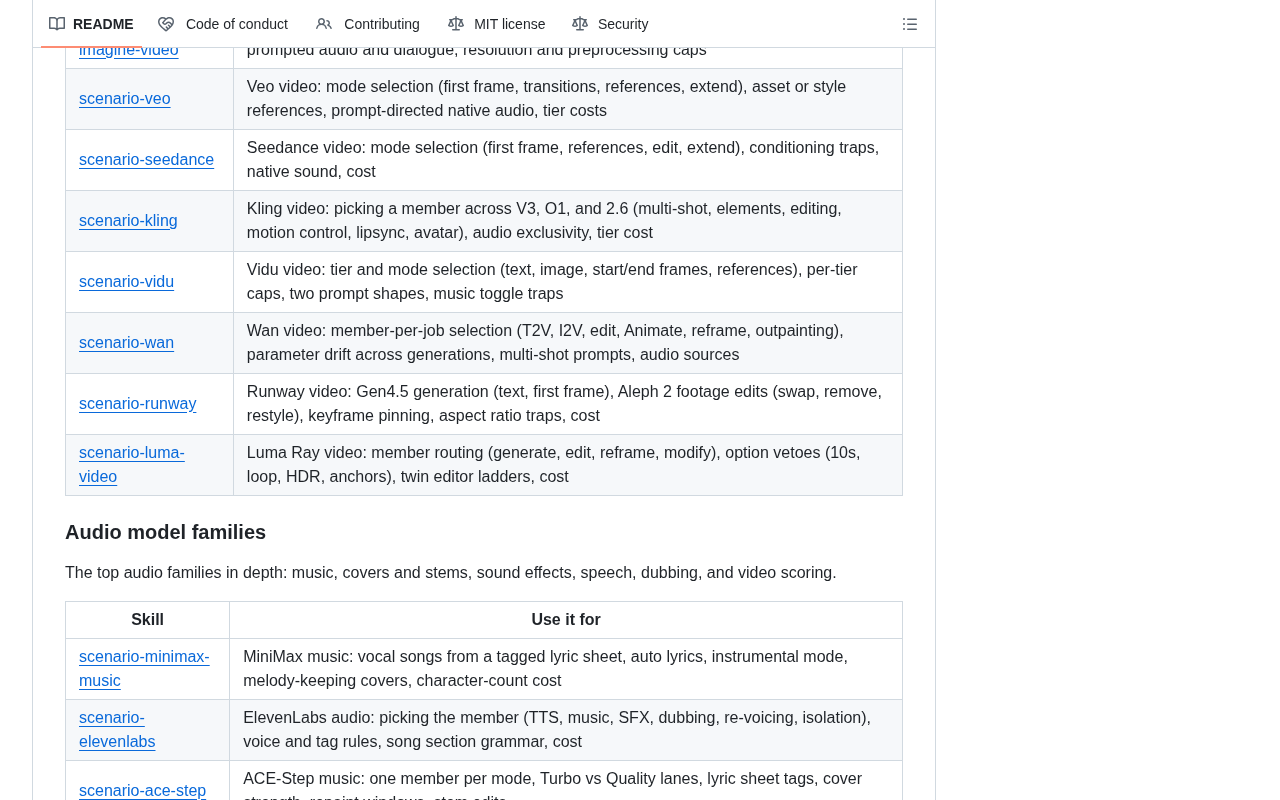
In generative AI, character and brand consistency is typically achieved through techniques such as reference-image guidance, LoRA fine-tuning, IP-Adapter, or seed locking. The core challenge is that diffusion models introduce random noise with each generation, so the same prompt may produce substantially different results. Production-grade solutions generally require maintaining a feature library for a character or brand visual (such as facial embeddings, color schemes, and style references) and injecting these constraints into the model at each generation. What skills emphasizes is precisely packaging this consistency assurance mechanism as a standard capability callable by Agents, rather than relying on users to manually tune parameters. For game asset generation or e-commerce ad placement, consistency directly determines whether assets can be used together at scale, making it a more critical engineering metric than single-generation quality.
Blender, Maya, ZBrush, Unreal, and Unity cover different stages of the 3D production pipeline: Blender and Maya focus on modeling and animation, ZBrush specializes in high-precision sculpting, and Unreal and Unity are for real-time rendering and game engines. Having Agents drive these applications is usually done through two approaches: first, scripting interfaces (such as Blender's Python API or Maya's MEL/Python commands); second, file formats and command-line tools. This contrasts with the pure text-to-3D model approach (for example, directly outputting meshes via diffusion models)—the latter produces isolated assets, while the former embeds operations into existing workflows, preserving editability and pipeline compatibility. But this also means the Agent needs to understand the command semantics and version differences of each application, making integration significantly more complex than calling a single generative API.
Signals Behind the Data
The project is implemented in Python and currently has 2,079 stars and 233 forks, with 224 new stars in a single day. This growth rate indicates two things: demand in the Agent ecosystem for "production-grade output" is real, and the combination of "model routing + upfront cost estimation + consistency" hits developers' actual pain points.
However, the project is still in an early stage. Star counts represent attention, not stability in production environments. Multi-software integration means complex dependencies and version compatibility issues, and real-world results need validation from more developers. For teams that want to try it, it is advisable to first test the accuracy of model selection and cost estimation in non-critical workflows, then gradually integrate it into core production pipelines.
Overall, skills represents a trend: the competitive focus for AI Agents is shifting from "whether it can generate" to "whether it can reliably produce deliverable content." Whoever can make cost, consistency, and toolchain integration smoother will be more likely to enter real production environments.
One-line Summary
Scenario Labs has open-sourced the skills project, adding model routing, cost estimation, and consistency assurance to AI Agents to help push generated content into production workflows.
Paragraph Summary
The open-source skills project from Scenario Labs aims to address the engineering barriers AI Agents face when generating production-grade images, videos, audio, and 3D content. It adds a decision layer between the Agent and the underlying generative models, automatically selecting models based on task type and providing price estimates before consuming compute, avoiding blind calls to the most expensive model. Through the Scenario MCP protocol, skills can be called by any Agent that supports the protocol, without being tied to a specific framework. The project also emphasizes maintaining character and brand visual consistency across multiple generations, and includes a built-in expert team to drive professional 3D software such as Blender, Maya, ZBrush, Unreal, and Unity, enabling Agent operations to be carried out in real production tools. Implemented in Python, the project has 2,079 stars and 233 forks, with 224 new stars in a single day, reflecting developer interest in production-grade Agent output. However, it is still early-stage, and the dependencies and version compatibility issues of multi-software integration are risks for adoption.
Related articles
FBI Emergency Alert: How Autonomous AI Hacking Tools Breach Networks at Machine Speed
FBI emergency alert names open-source AI attack framework Artex, which can turn a plain-language sentence into a full intrusion chain and breach critical industry networks in under three hours. This article breaks down the three-stage attack mechanism, the reality of runaway open-source code, and the FBI's three hardening measures: SIEM intelligence ingestion, cloud least privilege, and legacy asset patching.
Gemini 4 Hydrogen Benchmark Scores Explained: Coding and AI Agent Performance
Full breakdown of Google Gemini 4 Hydrogen benchmarks: SWE-bench 13.5%, Terminal Bench 57%, OS World 77.6%, Automation Bench 76.76%, 1M token context, API from $1.5 per million input tokens, coding and AI agent capabilities analyzed.

FBI Warns About AI Hacking Tool Artex: Systems Breached in Three Hours
FBI warns about AI hacking tool Artex: describe targets in natural language for automated scanning and intrusion, with some attacks achieving full privileged access within three hours. It affected over 2,000 Microsoft 365 organizations and South Korean banks. Copies still circulate after the developer took it down in October; security fundamentals remain key.