What Exactly Is the Difference Between MCP and Tool Calling?

Tool Calling requests actions, MCP standardizes communication—the two divide labor and cooperate rather than replace each other.
Many developers mistakenly equate MCP with Tool Calling, but they solve problems at different layers of AI integration. Tool Calling is a mechanism where the model outputs structured invocation intent and the application executes functions and returns results; the model itself does not execute code. MCP is a standard protocol that lets AI applications discover and communicate with tools exposed by MCP servers, solving unified access across processes and teams. In cooperation, AI applications handle Tool Calling (deciding when to invoke and how to process results), while MCP standardizes connections with backend services. Whether to introduce MCP depends on the scenario: a single application with a few tools is fine with Tool Calling, while MCP is needed when multiple applications share tools or multiple teams provide them. Spring AI combines both to build more complete AI Agents.
Many developers, when first encountering MCP (Model Context Protocol), instinctively equate it with Tool Calling. After all, both are related to "letting AI invoke external capabilities," and they appear to solve the same problem. But if you really understand it this way, it's easy to take wrong turns in actual architecture design. The YouTube channel JSTACK Simplified specifically breaks down this topic in part five of its Spring AI series. The conclusion can be condensed into one sentence: Tool Calling requests an action, MCP standardizes the communication method. The two solve problems at different layers of the AI integration puzzle.
The Essence of Tool Calling: A Round Trip of Function Invocation
The mechanism of Tool Calling isn't complicated. During inference, the AI model determines that it needs to call an external function, so it sends a request—such as "look up the weather in this city for me." This request is passed to the application, which is responsible for actually executing the corresponding function or tool, and then sends the result back to the model.
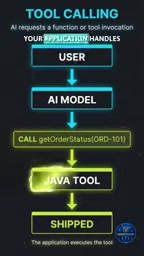
Throughout this chain, the AI is responsible for "deciding what to do," and the application is responsible for "actually doing it." The model itself doesn't directly execute any code—it merely outputs a structured invocation intent. This is also why Tool Calling can work independently without MCP—you can define tool functions in Spring AI, let the model call them, and not introduce any additional protocol.
Tool Calling is a capability of large language models (LLMs): when generating a response, if the model determines it needs to leverage external functions (such as checking weather, querying a database, or sending an email), it outputs a structured JSON indicating which function to call and what parameters to pass. The application parses this JSON, executes the real function, and passes the result back to the model as a new message so the model can continue reasoning. Its core characteristic is that the model only outputs intent and does not execute code—execution responsibility lies entirely on the application side. Different model vendors have slightly different field formats for tool calling (such as OpenAI's tools array or Anthropic's tool_use block), but the semantics are consistent. Spring AI abstracts away these differences through the @Tool annotation or the ToolCallback interface, letting Java developers define tools and bind them to a ChatClient in a consistent way. Understanding this is key: Tool Calling is an agreement between the model and the host application, and it does not involve cross-process or cross-service communication.
The Essence of MCP: A Standardized Communication Protocol
MCP's positioning is completely different. It's not some invocation mechanism, but a standard protocol that lets AI applications discover and communicate with tools exposed by MCP servers.
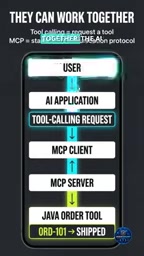
The keywords here are "discovery" and "standardization." Without MCP, every AI application that wants to integrate an external tool has to write its own integration logic. As tools multiply, models change, and applications evolve, maintenance costs balloon rapidly. What MCP does is standardize "how AI applications find tools and how they talk to tools," giving different tools and different AI applications a common language.
MCP (Model Context Protocol) was proposed and open-sourced by Anthropic at the end of 2024, and is often compared to the "USB-C port of the AI world." It defines a JSON-RPC 2.0 communication specification between clients (AI applications) and servers (tool providers). Its core primitives include three categories: Tools (callable functions), Resources (readable data), and Prompts (preset prompt templates), and it provides standard methods such as tools/list and tools/call for discovery and invocation. MCP servers can be implemented in any language—they just need to expose capabilities that conform to the protocol; MCP clients are responsible for connecting, listing, and forwarding calls. Therefore, MCP solves the problem of unified access across processes, teams, and languages, rather than how the model makes decisions. It itself contains no AI logic—it is purely a standardized channel for "how tools are discovered and invoked."
How the Two Cooperate: Division of Labor, Not Replacement
Once you understand each one's positioning, the cooperative relationship becomes clear. AI applications handle Tool Calling—that is, deciding when to call which tool and how to process the returned result. MCP provides a standard way to communicate with Java servers, making the exposure and discovery of tools well-defined.
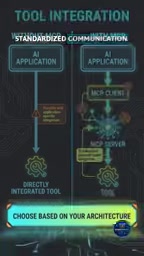
To use an analogy: Tool Calling is like calling someone to ask them to do something, while MCP is like defining the communication standards of the telephone network. You can shout without standard protocols, but if you want to collaborate reliably with many people and many systems, standardized communication is essential. Spring AI is a typical scenario that combines these two layers—using Tool Calling to drive AI decision-making and invocation, and using MCP to standardize connections with backend Java services.
When You Need MCP, and When You Don't
This is the most practical judgment. If you're just defining a few tool functions in a single application for the model to call, Tool Calling is entirely sufficient, and introducing MCP actually adds complexity.
But when you face the following situations, MCP's value becomes obvious: you need multiple AI applications to access the same set of tools; the tools are provided by different teams or services and require a unified integration specification; or you want the process of defining and discovering tools to be decoupled from specific AI applications. In these cases, the standardized communication layer provided by MCP can significantly reduce integration costs.
At the end of the video, JSTACK Simplified also previewed the next step—connecting Spring AI with MCP to build an AI Agent. This direction itself illustrates the point: Tool Calling and MCP are not an either/or choice, but two puzzle pieces that each take on different responsibilities when building a complete AI Agent.

For Java developers using Spring AI for AI integration, clarifying the responsibility boundaries of these two layers before designing the architecture will be much more efficient than agonizing over "which one to use" right from the start.
In actual architecture, whether MCP is needed can be evaluated from three dimensions: whether tool sources are dispersed (when multiple teams and services each maintain tools, MCP provides unified registration and discovery), whether clients are diverse (when multiple AI applications or different models share the same set of tools, MCP avoids repeated adaptation), and whether dynamic discovery is needed (when the tool set changes frequently and you want runtime on-demand loading, MCP's tools/list mechanism is more flexible than hardcoding). Conversely, if the number of tools is small, they belong to a single application, and their lifecycle is synchronized with the main program, directly using Spring AI's @Tool annotation-based Tool Calling is the simplest and most efficient approach. Introducing MCP too early brings additional process operations, network latency, and debugging costs.
One-line Summary
Tool Calling requests actions, MCP standardizes communication—the two divide labor and cooperate rather than replace each other.
Paragraph Summary
Many developers mistakenly equate MCP with Tool Calling, but in reality the two solve problems at different layers of AI integration. Tool Calling is a mechanism in which the model outputs structured invocation intent, the application executes the function, and the result is passed back; the model itself does not execute code. MCP is a standard protocol that lets AI applications discover and communicate with tools exposed by MCP servers, solving unified access across processes and teams. In terms of cooperation, AI applications handle Tool Calling (deciding when to invoke and how to process results), while MCP standardizes connections with backend services. Whether to introduce MCP depends on the scenario: a single application with a few tools is fine with Tool Calling, while MCP is needed when multiple applications share tools or multiple teams provide them. Spring AI combines both to build more complete AI Agents.
Related articles

Bilibili's Hit Dify Tutorial: A Practical Guide to Building 20+ AI Apps from Scratch
A distilled guide to Bilibili's top-rated Dify tutorial: Windows + Docker deployment, MySQL connection, five app types, model integration strategy, and publishing.

Agent Skills Beginner's Guide: From Concepts to Multi-Agent Collaboration in Practice
A comprehensive guide to Agent Skills: core concepts, components, the importance of Description, standardization, beginner learning paths, and multi-agent collaboration.

One Neuron Detects Both Cats and Cars? We Reproduced It and Found a New Explanation
The cat-car neuron reinterpreted: researcher Cammarata argues it distinguishes pointy from round, not cats from cars. We reproduced the experiment and found the new explanation holds on most inputs—but cars are the exception. The interpretability debate continues on language models.