What Is an AI Agent, Really? The Core Principles Explained Through a Simple Analogy

AI Agents are rule-driven LLM pipelines that break complex commands into subtasks — not autonomous minds.
Using a relatable analogy of a roommate attending class on your behalf, this article demystifies AI Agents by explaining their core mechanism: breaking a complex command into subtasks and calling an LLM at each step. Unlike simple Q&A chatbots, Agents understand commands, split them into substeps, and execute each one through repeated LLM interactions guided by carefully designed rules and prompts. A key takeaway is that due to LLM hallucinations, real-world Agents depend heavily on human-defined rules rather than true autonomy — making prompt engineering and process design the true foundation of effective Agent development.
Agents Have No Standard Definition — They're More Like a DIY Design
Many people want to pin down a precise definition of an AI Agent right from the start, but this video tutorial takes the opposite view: there is no essential concept or perfect definition for an Agent. It's a highly fluid idea. What you want your "robot" to accomplish and how you expect it to solve problems might be completely different from someone else's vision.
In other words, Agents are highly customizable. How you design one and plan its behavior is entirely up to you — there's no need to force a single universal algorithm. This framing is valuable because it pulls the Agent from the realm of "deep technical black box" back into "purpose-built engineering practice," lowering the psychological barrier for newcomers.
Taken literally, "Agent" simply means a proxy or representative that acts on your behalf. The core idea is straightforward: you have a goal or a command that can't be completed in a single step, so it needs to be broken down into multiple stages, each handled individually.
A "Go to Class for Me" Analogy That Nails How Agents Work
The tutorial uses a brilliantly relatable analogy: you can't get out of bed in the morning, so you tell your roommate, "Hey, go to class for me." The command sounds simple, but actually pulling it off requires your roommate to break it down into a whole chain of actions:
- When the teacher takes attendance, raise your hand and call out "here"
- If the teacher collects homework, hand yours in
- If the teacher covers important material, take notes on your behalf
- Going a step further: infer that you're still asleep at lunch and won't make it to the cafeteria, and bring food back for you
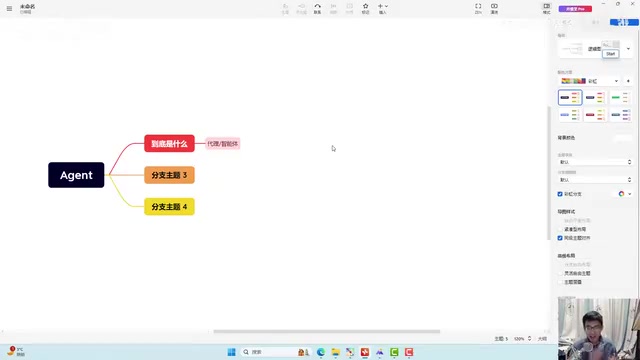
This analogy perfectly captures the difference between an Agent and a standard LLM conversation. A regular LLM is a one-question, one-answer exchange — you ask, it responds. An Agent works differently: the first step is understanding your command, and the second step is breaking it into subtasks — what to do first, what to do second, what to do third.
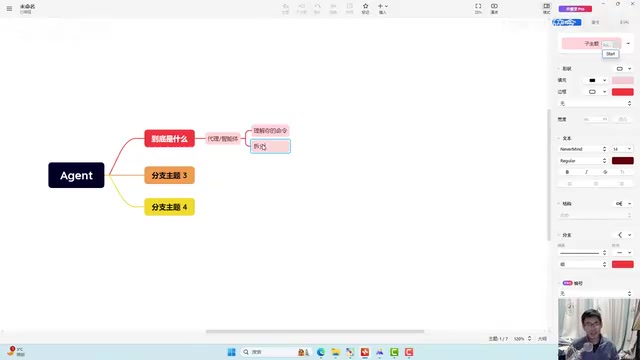
Task Splitting and Decision-Making Are Powered by the LLM
So how does an Agent actually break a command into subtasks? Did it "grow a brain" and genuinely get smarter?
The tutorial offers a clear-headed answer: everything inside an Agent is done using an LLM. When you issue the "go to class for me" command, the Agent packages that command along with relevant context (like "what's going on with this person, what's their situation") into a prompt and sends it to the LLM, which automatically splits it into a series of subcommands.
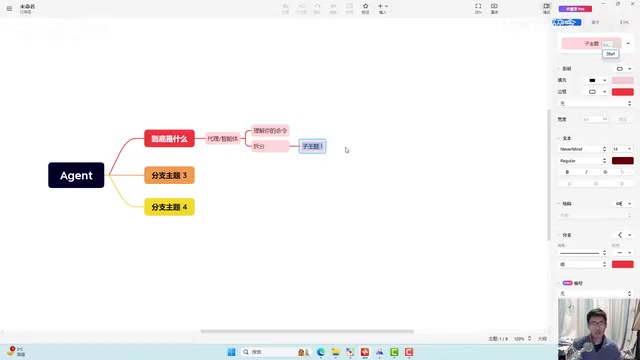
So let's dispel a misconception: an Agent isn't some new entity that exists independently of the LLM. At its core, it's about making better use of the LLM — calling it at every step. After the subtasks are defined, executing each one (what to do in class, whether to grab food) still involves repeatedly asking the LLM: "What should I do now? What's the current context? What's the command I received?"
These concrete actions and decisions are essentially a large number of interactions between the Agent and the LLM. Every decision, every completed step, involves another call to the model.
The "prompt" plays a far more significant role in Agent engineering than in ordinary conversation. In a single-turn chat, a prompt is just the sentence you type. In an Agent framework, it's typically a structured "system instruction" that includes a role definition (who you are, what you can do), a list of available tools, the current task state, a history of past actions, and various constraint rules. Every time the LLM is called, the Agent packages this continuously updated context together with the current subtask and sends it along. The LLM then returns the next action to take. This pattern — injecting state and rules into the prompt and letting the LLM output decisions — is the core operating mechanism of mainstream Agent frameworks like LangChain and AutoGen. It essentially replaces traditional software logic-control code with prompt engineering.
The Truth About Agents: Rule-Driven, Not Fully Autonomous
This is arguably the most valuable insight in the entire discussion. Many people assume Agents are already powerful enough to fully understand every human behavior — but the tutorial makes it clear: we're not there yet.
The reason is that LLMs produce hallucinations — their outputs can be unstable and unreliable. In real-world engineering, Agents rely much more heavily on rules to execute tasks.
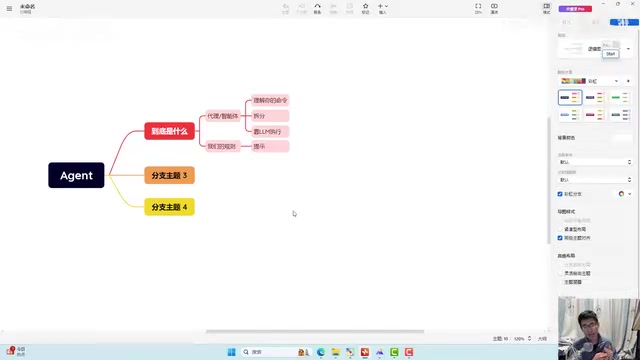
What does "rules" mean here? It means hardcoding critical steps — go to class, you must sign in, you must do this, you must do that. These rules are mostly set through prompts. For example, personal information like "this person doesn't like attending class but reviews their notes before exams," along with behavioral tendencies and current goals, are all packaged into a prompt and fed to the LLM, which then outputs what to do at each step.
The tutorial's author goes so far as to say: many Agent frameworks, projects, and talks have over-hyped this technology, making it sound like the Agent can analyze and understand things on its own. But every successful real-world case they've seen has involved humans designing the rules. It's like writing software: first a product manager defines every step of the process, then developers implement the specific functionality. Agents currently struggle to exhibit genuine independent thinking — not that they can't think at all, but without designed rules, the results will be poor.
LLM "hallucination" refers to the phenomenon where a model generates content that sounds plausible and is stated with high confidence, but is factually wrong or entirely fabricated — such as citing nonexistent papers, stating incorrect facts, or producing reasoning chains that are internally consistent but false in reality. This happens because LLMs are fundamentally statistical next-token predictors; they have no true understanding of the world and no mechanism to verify facts against memory. In a single-turn conversation, a hallucination might just mean a wrong answer. But in an Agent scenario, the harm is dramatically amplified — because each step's output becomes the next step's input. If any intermediate step hallucinates, the error compounds and propagates through the entire task chain, ultimately causing the whole task to go completely off the rails. This is precisely why real-world engineering practice uses hardcoded rules and carefully crafted prompts to "lock down" critical decision points, rather than leaving all judgment to the model's free improvisation.
The Essence of an Agent in One Sentence
Putting the entire logic together, the Agent's working loop is actually quite clear:
- Understand your command
- Break it down into multiple subtasks
- For each subtask, combine your designed rules/prompts
- Call the LLM to get the desired output
The goal is to mimic the way humans behave — however you would handle a situation, the Agent should handle it the same way. Understand these four stages — understand the command → split into tasks → apply the LLM step by step → use rules to constrain direction — and you've grasped the core of what an intelligent Agent is, without getting lost in all the flashy jargon.
For anyone looking to get started with AI Agent development, this "demystified" perspective is especially important: first get clear on what problem you're solving, break the process into fine-grained steps, design your rules and prompts carefully, and then let the LLM execute them incrementally. That is the right starting point for building a practical, useful Agent.
Related articles

Bilibili's Hit Dify Tutorial: A Practical Guide to Building 20+ AI Apps from Scratch
A distilled guide to Bilibili's top-rated Dify tutorial: Windows + Docker deployment, MySQL connection, five app types, model integration strategy, and publishing.

Agent Skills Beginner's Guide: From Concepts to Multi-Agent Collaboration in Practice
A comprehensive guide to Agent Skills: core concepts, components, the importance of Description, standardization, beginner learning paths, and multi-agent collaboration.

One Neuron Detects Both Cats and Cars? We Reproduced It and Found a New Explanation
The cat-car neuron reinterpreted: researcher Cammarata argues it distinguishes pointy from round, not cats from cars. We reproduced the experiment and found the new explanation holds on most inputs—but cars are the exception. The interpretability debate continues on language models.