#AI Agent
1113 related articles

Three-Agent System in Production: Architecture Breakdown Behind a 78% Reduction in Database Diagnosis Time
Cornerstone OnDemand's Orion AI uses a three-agent system on Amazon Bedrock and Strands Agents to cut database diagnosis time by 78%. Deep dive into architecture, state management, and production trade-offs.
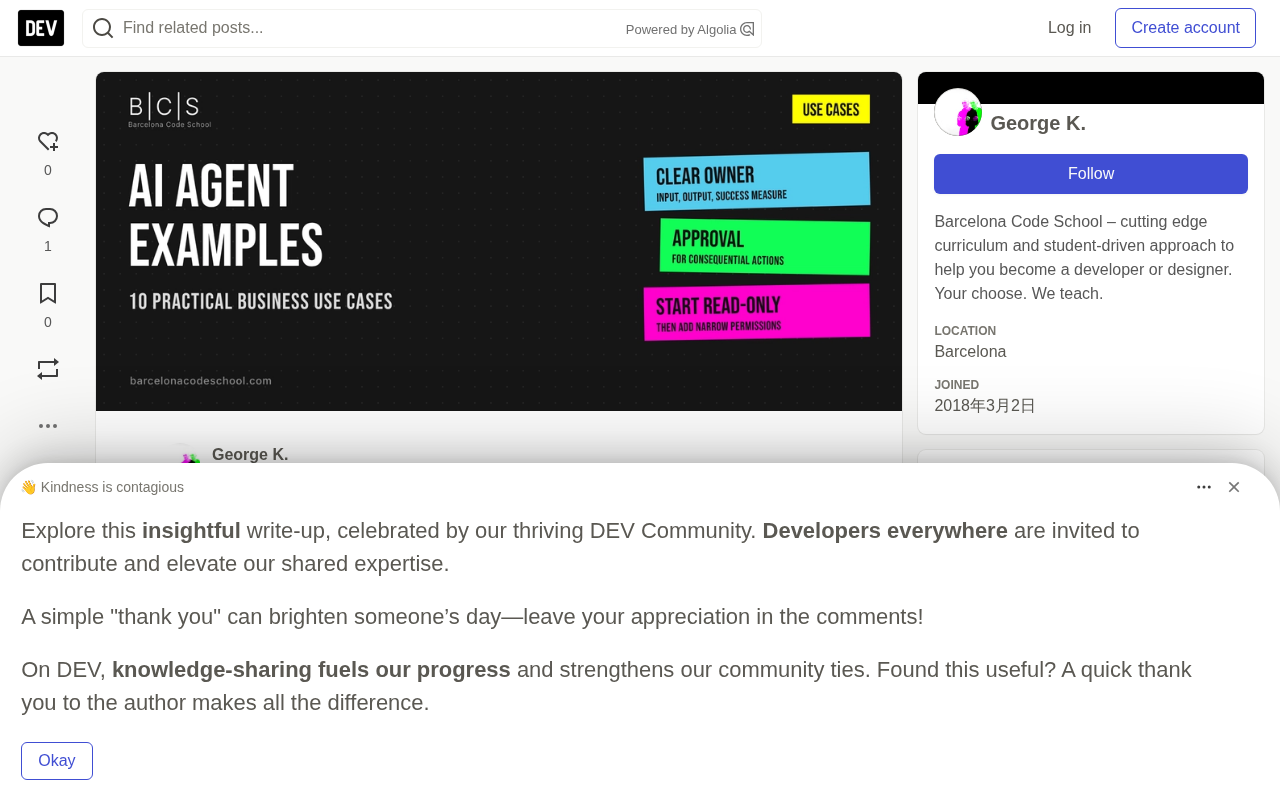
AI Agent Practical Guide: 10 Enterprise Business Scenarios You Can Actually Deploy
Based on OpenAI and Anthropic official guides, 10 deployable enterprise AI Agent use cases covering lead qualification, customer service triage, document intake, plus a selection checklist and testing standards.

Your First AI Agent Task Shouldn't Ask for More Permissions — It Needs a Contract
Your first AI Agent shouldn't chase more permissions — it needs a clear task contract. Learn how to define input/output boundaries, layer permissions, test failure scenarios, and plan rollbacks for a safe pilot.

AI Agents That Use Customer Data Without Leaking It? Testing Aura's Local Anonymization
Aura replaces customer data with stable tokens before sending to cloud AI. BIRD benchmark shows only 0.6% accuracy drop while leaking zero personal info. Here's how it works.

63% of Agent Context Comes from One Tool: Real Data Reveals the Hidden Cost Trap
A developer analyzed 4,000+ real tool calls in their AI Agent and found bash dominates 63% of context but costs the least per call — while cache re-reads are the true cost multiplier.

OpenSeal Agent Architecture Deep Dive: Persistent Orchestration and Approval Governance
A deep dive into OpenSeal's AI agent architecture: persistent execution via Objective/Run/Turn/Skill, lease recovery, capability checks, approval governance, and model routing design.

AI Agent in Action: Using URL Fragments to Pass Messages Without Touching a Server
An AI Agent developer published a serverless messaging tool that uses URL fragments to ensure messages never reach a server. A breakdown of the tech, its limits, and what it signals.

Let LLMs Handle Language, Scripts Handle Math: A Three-Layer Architecture for Decision-Making Agents
A McDonald's meal optimizer project reveals the core architecture for decision-making agents: LLM for language, scripts for computation, MCP for trusted data. Includes MCP config tips and transferable methodology.

Objectives, Not Instructions: How to Write Work That AI Agents Can Actually Take Over
Google Gemini now accepts "objectives, not just instructions." Learn the 3-part framework — definition of done, boundaries, escalation rules — to delegate work AI agents can actually execute.

Build an AI Agent in 2 Days: Full Breakdown of Claude Code + DeepSeek in Action
Full breakdown of HoopMind NBA AI Agent: Claude Code primary agent + DeepSeek V4 Flash sub-agent, checklist-driven dev, 3-layer anti-hallucination engineering, serverless stateless design, and 7 reusable methodologies.

RAG Is Not the Endpoint: The AI Architectures Developers Are Moving Toward
RAG isn't the ultimate answer for AI systems. This article examines AI Agent definitions, production realities, the framework debate, and the overlooked chunking problem in RAG retrieval.

When Should an AI Agent Stop? The Overlooked Art of Termination Logic
Termination logic is as critical as action logic in AI agent design. This article breaks down strategies like hard limits, completion signals, result validation, and human-in-the-loop — and the trade-offs between autonomy and control.

Human Confirmation for AI Write Operations: Why "Yes" Can't Just Be a Boolean
Why human confirmation for AI write operations can't be a boolean. Learn the five binding elements—exact params, target system, field scope, validity window, and operator—that make approvals truly auditable.

Plimsoll: Self-Hosted Sandbox Isolation for AI Agent-Generated Code
Plimsoll is an open-source self-hosted sandbox for isolating AI agent-generated code. Explore the security risks, sandbox value, and self-hosting trade-offs for AI Agent developers.

Open-Source Saluki 27B: A 7.9GB On-Device Agent Flagship That Retains 96% Performance
Underdog AI's open-source Saluki 27B compresses Qwen3 27B from 54GB to 7.9GB, retaining 96% performance. Beats the full-size original on tool calling. Apache 2.0, free for commercial use.

5 Integration Patterns for Deploying AI Agents in Production: From Demo to Reality
Five framework-agnostic integration patterns for taking AI Agents from demo to production: constrained workflows, narrow tool contracts, persistent state, hard-case evaluation, and staged rollout.

Flow Matching as a Diffusion Model Alternative: An Engineering Guide for Image Agents
FLUX.1 and Kontext replace diffusion models with flow matching, enabling lower-latency, stateless in-context editing for image Agents. A deep dive into tool boundary design, observability, deployment, and testing strategies.

The Typed Decision Revolution: Why Agents Shouldn't Ask LLMs to Make Decisions
Typed decisions are becoming the new paradigm in AI agent engineering. Jev raised $870M at a $7.5B valuation; VIDRAFT's Darwin-ZTC offers an open-weight alternative using Zero-Token Confidence for deterministic, low-cost structured decisions.

Week 3 of an LLM Autonomous Money-Making Experiment: 7 Technical Replies, Still $0 in Revenue
Week 3 of an AI agent experiment powered by Claude Code: 7 GitHub technical replies sent, 3 adopted into others' code, but revenue still $0. A breakdown of methodology, five failure points, and lessons for autonomous AI operations.

How Multi-Agent AI Is Reshaping Incident Debugging: From Logs to Root Cause
An open-source project shows how three AI agents — log parser, hypothesis generator, evidence validator — build a multi-agent RCA system that investigates incidents like an engineer, not just explains errors.