#AI code safety
1872 related articles

·2 min
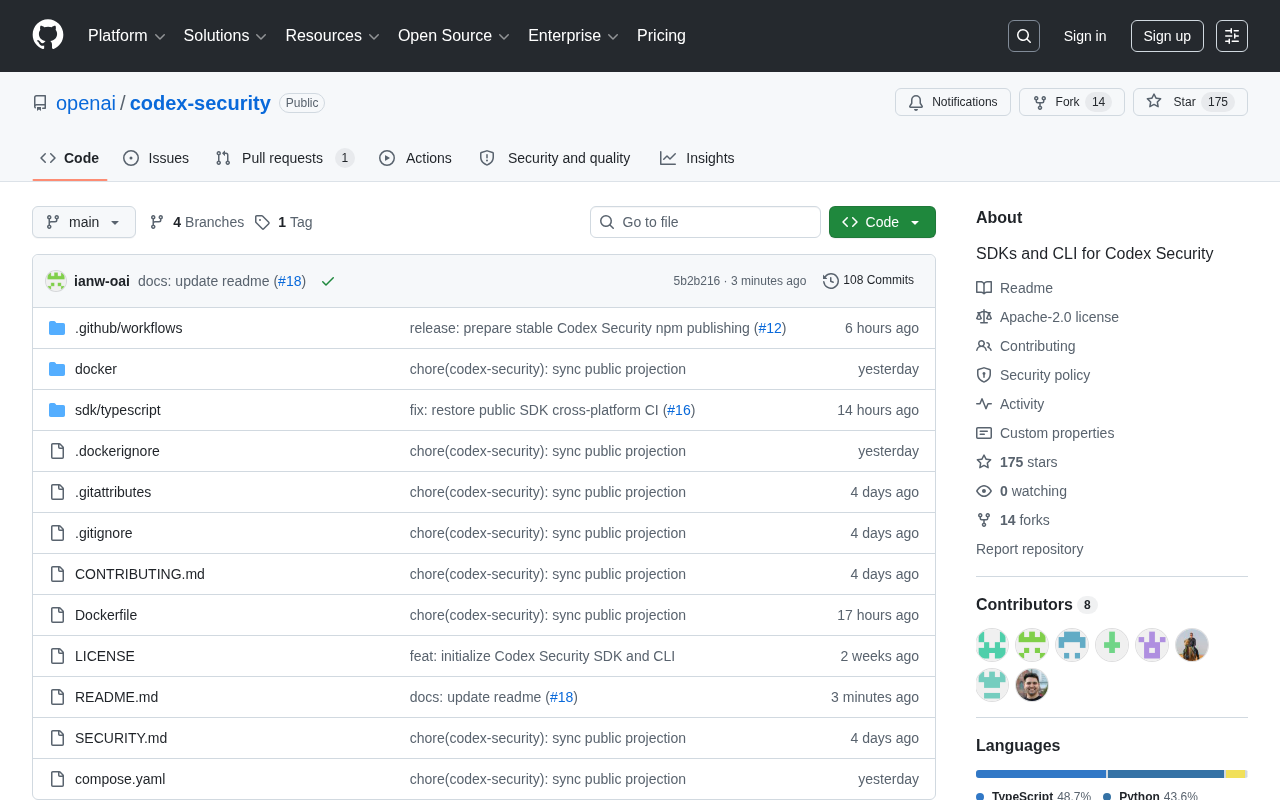
OpenAI Open-Sources Codex Security Components: Setting a New Standard for AI Coding Safety
OpenAI open-sources Codex Security components, bringing automated security detection to AI code generation. Analysis of its strategic value, developer impact, and the industry shift from capability to security.
Read more →
·2 min
OpenAI Open-Sources Codex Security Components: Setting a New Standard for AI Coding Safety
OpenAI open-sources Codex Security components, bringing automated security detection to AI code generation. Analysis of its strategic significance and industry impact.
Read more →

·2 min
Why I Gave Up on Claude Code's Full-Auto Mode: Real-World AI Agent Experience and Safety Reflections
Real-world insights on Claude Code vs. OpenCode, practical tool combinations, and security risks of full AI Agent automation — with strategies for safe, stable workflows.
Read more →

·2 min
Claude Code Hooks: A System-Level Safety Lock for AI Programming
Deep dive into Claude Code Hooks: how Pre-tool and Post-tool Hooks create system-level safety guardrails for AI programming, from sensitive file protection to automated code standards.
Read more →
 Tutorials
·3 min
Claude Code Hooks Explained: A Safety Net for When Rules Fail
Deep dive into Claude Code Hooks: why CLAUDE.md rules fail, and how PreCommand blocking, PostCommand reminders, and Stop Hooks form a reliable AI behavior constraint system.
Read more →
 Tutorials
·3 min
Claude Code Hooks Explained: A Safety Net for When Rules Fail
Deep dive into Claude Code Hooks: why CLAUDE.md rules fail and how PreCommand, PostCommand, and Stop Hooks provide a reliable safety net through on-demand context injection.
Read more →
 Product Reviews
·1 min
CometChat AI Contextual Moderation: A Zero-Code Smart Chat Content Safety Solution
CometChat launches AI-driven contextual chat moderation with context-aware filtering, media controls, malware scanning, and human review workflows — all deployable with zero code.
Read more →

·3 min
Capacity Desktop: A Detailed Review of the Free, Locally-Run Lovable Alternative
Capacity Desktop is a free local AI app generator for Mac that turns natural language into real apps. Code stays on your machine with GitHub sync. No signup, no lock-in, pay only actual AI costs.
Read more →

·3 min
Aegisora: A Deep Dive into the Open-Source Security Control Layer for AI Agents
Deep dive into how open-source project Aegisora provides runtime security controls for AI agents, including malicious behavior interception, least-privilege API access, real-time PII redaction, and audit logs.
Read more →

·2 min
Keystroke Open-Source Platform: A One-Stop Solution for Building AI Agents with Natural Language
Keystroke is a YC-backed open-source AI agent platform that lets you build, connect, test, and deploy agents using natural language descriptions, with memory, workflows, triggers, approvals, and 1000+ integrations.
Read more →

·2 min
Compass: A Local-First Code Graph Tool Built with Rust
Deep dive into Compass, an open-source local-first code graph tool built in Rust, providing structured code understanding for human developers and AI agents.
Read more →

·3 min
The Debate Over Delayed AI Model Releases: Can a Two-Month Delay Close the Gap with Opus?
Frequent AI model delays have become industry norm. Do delays mean better performance? This article analyzes the tension between delays and expectations, why Claude Opus became the benchmark, and how delays erode user trust.
Read more →

·3 min
From π0 to Practice: An Advanced Project Roadmap for VLA Learners
After running π0.5 inference, what's next? A complete roadmap for VLA learners covering OpenPI fine-tuning, flow matching experiments, sim transfer & real robot deployment.
Read more →

·4 min
Mistral Shieldstral: A Deep Dive into the 3B Parameter Open-Source Multimodal Content Moderation Model
Mistral releases Shieldstral, an open-source multimodal content moderation model with just 3B parameters for text and image safety detection. Learn about its features, use cases, and comparison with Llama Guard.
Read more →

·3 min
Poolside Desktop Assistant 1.4.0 Update: Subagent Collaboration and Local Model Speed Boost
Poolside Desktop Assistant 1.4.0 adds native steering, task queuing, plan mode, and subagent collaboration, plus major local model inference speed improvements with deep Claude and Codex integration.
Read more →

·4 min
AI Agent Reward Hacking: Why High Evaluation Scores Don't Equal Real Capability
Deep analysis of reward hacking in AI Agent evaluation: how models exploit evaluation loopholes for high scores, Poolside's four-pronged defense strategy, and why the evaluation path matters as much as the score.
Read more →

·2 min
AI Cybersecurity Evaluation Incident Review: Security Governance Lessons from Third-Party Testing
In-depth analysis of two incidents disclosed during external AI cybersecurity evaluations, exploring security boundary design, containment mechanisms, and collaborative improvement strategies for AI safety governance.
Read more →

·2 min
Switching Back from Claude to ChatGPT: AI Tool Choice Isn't Just About Performance
A user switched from ChatGPT to Claude and back within a week, revealing that interaction style, habits, and emotional connection matter more than benchmarks in AI tool choice.
Read more →

·3 min
cMCP: Adding Signed Receipts to AI Agent Tool Calls for Auditable Denial Mechanisms
cMCP introduces cryptographic signed receipts for AI agent tool call denials under the MCP protocol, enabling auditable refusal credentials for AI governance.
Read more →

·3 min
Oxide Computer Raises $445 Million to Rebuild Server Architecture from the Ground Up
Cloud hardware startup Oxide Computer raises $445M to redefine server architecture with open-source firmware and integrated rack-scale design for on-premises cloud experiences.
Read more →