#AI coding tools risks
890 related articles

·3 min
Privacy Risks in Claude Code? Use Docker Sandboxes to Fully Isolate Your AI Coding Tools
Claude Code found to contain user monitoring logic, raising AI tool privacy concerns. Learn how to isolate Claude Code, Codex & Copilot with Docker Sandboxes — full setup and escape testing included.
Read more →

·2 min
TAKT Open-Source Tool: Ending Unsupervised AI Coding with Unskippable Reviews
TAKT is an open-source CLI tool that wraps AI coding assistants into reproducible YAML workflows with a plan→implement→review→fix loop, enforcing unskippable code reviews.
Read more →

·3 min
How to Efficiently Learn Complex Knowledge with Large Language Models: A Reusable Methodology
A systematic methodology for using ChatGPT, Claude, and other LLMs to learn complex topics, covering Feynman-style questioning, analogy learning, teaching reversal, and pitfalls like hallucinations.
Read more →

·3 min
UnYOLO: A GitHub Credential Broker and Policy Engine for AI Agents
UnYOLO is an AI Agent credential broker and policy engine for GitHub, enforcing least-privilege access, short-lived tokens, and policy rules to secure agent operations.
Read more →

·3 min
Rendemo: Capture Real HTML, Turn Web Apps into Interactive Demos in Minutes
Rendemo captures real HTML via Chrome extension to turn web apps into clickable interactive demos. Supports embedding, video export, guided tours, and built-in MCP server for AI Agent automation.
Read more →

·2 min
Papaya: Technical Architecture and Ethical Considerations of an On-Device AI Privacy App
Deep analysis of Papaya, a private AI app running on-device, exploring its on-device inference architecture, privacy design philosophy, and the ethical challenges AI products face in sensitive scenarios.
Read more →

·2 min
AI Browser & Computer Automation Model Comparison: A Selection Guide for Claude, Operator, and Open-Source Solutions
In-depth comparison of Anthropic Claude Computer Use, OpenAI Operator, and Browser Use open-source solutions for browser and computer automation, with scenario-based AI Agent selection guidance.
Read more →

·2 min
Deep Dive into Astra: OpenAI's First "Critical"-Level Cybersecurity Model
OpenAI designates its new model Astra as the first "Critical"-level cybersecurity model under its Preparedness Framework, signaling AI capabilities approaching game-changing thresholds in cyber offense and defense.
Read more →

·3 min
AI Designs Viral Genomes That Don't Exist in Nature for the First Time: Breakthrough and Risk Coexist
Researchers use AI models to generate complete viral genome sequences never found in nature, with some designs verified as biologically active. This article analyzes the technology, applications in phage therapy and vaccines, and critical biosecurity risks.
Read more →
·3 min
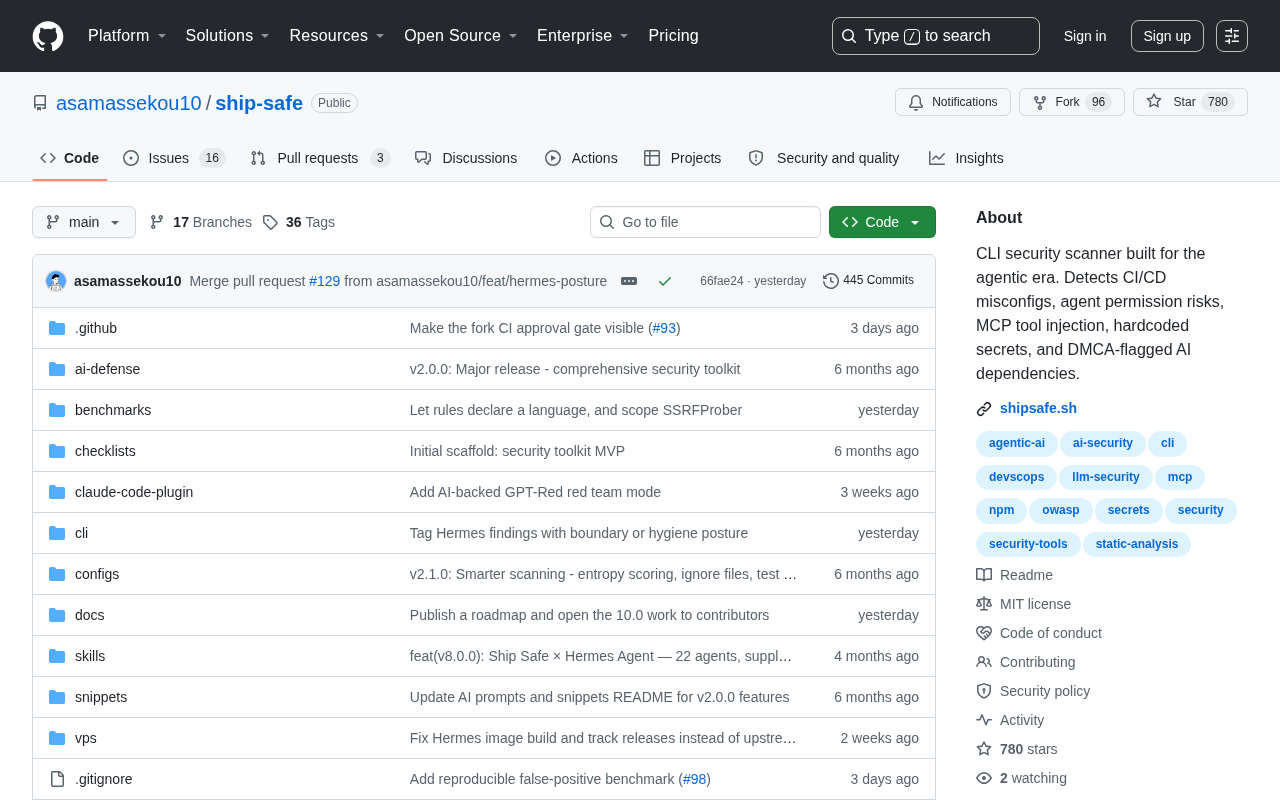
Ship Safe: A Deep Dive into the Open-Source Security Scanner for AI Coding Agents
Deep dive into how Ship Safe provides security scanning for AI coding agents, exploring agent security challenges, closed-loop feedback, and enterprise guardrails.
Read more →

·3 min
llm-sketchkit: Solving High-Cardinality and Privacy Challenges in LLM Telemetry with Sketch Algorithms
Deep dive into how the open-source library llm-sketchkit uses HLL++, Bloom filters, MinHash and other probabilistic data structures to solve high-cardinality and privacy challenges in LLM telemetry.
Read more →

·4 min
The Shape and Trajectory of Technological Evolution: How to Understand and Predict Future Tech Trends
Deep analysis of the underlying logic and key trends in technological evolution, covering AI infrastructure, computing paradigm shifts, and human-machine collaboration, with frameworks for developers and entrepreneurs.
Read more →

·2 min
neocursor.nvim: Bringing Cursor's Tab Completion to NeoVim
neocursor.nvim connects directly to Cursor's StreamCPP backend, bringing its iconic Tab Tab next-edit prediction to NeoVim with zero config. We analyze the tech, compliance risks, and ecosystem impact.
Read more →

·2 min
11-Year-Old Girl Builds a Browser with AI: How Vibe Coding Makes Software Development Accessible to Everyone
An 11-year-old girl built a web browser using AI tools, showcasing how Vibe Coding lowers programming barriers. Explore AI-assisted coding's educational impact and the democratization of creation.
Read more →

·3 min
Safety Architecture for Medical AI: A Hybrid Design Combining Rule Engines and Machine Learning
Exploring hybrid architecture design combining rule engines and machine learning in medical AI, analyzing how deterministic rules, CSP, and scoring mechanisms ensure safety in exercise prescription systems.
Read more →

·2 min
Auto-Generating Paper Slides with Local LLMs: Balancing Efficiency and Privacy
Explore how local LLMs automatically convert academic papers into presentation slides, protecting unpublished research privacy while dramatically boosting efficiency for researchers.
Read more →

·2 min
Yondry: Using AI to Turn Instagram Saves into Actionable Day Plans
Yondry is an AI day planning app that extracts real locations from Instagram saves and generates weather-aware, time-optimized itineraries—solving the universal problem of 400 saves but only 6 visited.
Read more →

·3 min
Meta Muse Code: A Terminal AI Agent Built for Long-Horizon Programming
Meta launches Muse Code, a terminal AI agent powered by Muse Spark 1.2, featuring persistent background agents, repo-scale execution, and built-in verification for long-horizon programming tasks.
Read more →

·2 min
Merge: A Deep Dive into the AI-Powered Code Review Hiring Assessment Platform
Merge is an AI-native code review assessment platform that evaluates engineers' judgement through simulated PR reviews, scoring Bug Coverage, Communication, PR Quality, and Token Efficiency.
Read more →

·3 min
Is Cursor Worth Subscribing To? Real Developer Community Reviews and Usage Strategies
In-depth analysis of AI coding tool Cursor's real-world experience, covering community ratings, multi-model support, BYOK mode, and Chinese LLM integration strategies for developers.
Read more →