#AI disinformation
37 related articles

·2 min
Anthropic's Call to Restrict Open-Source Models Sparks Outrage: Safety or Monopoly?
Anthropic CEO's call to restrict "dangerous capabilities" in open-source AI models sparks fierce backlash. Developers question double standards and fear monopoly disguised as safety.
Read more →

·2 min
From FTX to AI: A Warning About the Collapse of Trust in Tech
From the FTX Future Fund collapse to AI, exploring tech's trust crisis, résumé laundering, and lack of accountability when scandal-linked figures move into key AI roles.
Read more →

·2 min
New EU AI Act Rules: Realistic AI-Generated Content Must Be Labeled
New EU regulations require mandatory labeling of realistic AI-generated content, covering deepfake videos, AI images, and voice clones. Analysis of the rules, challenges, and industry impact.
Read more →

·3 min
Google Earth's AI Image Generation Feature Sparks a Crisis of Trust in Satellite Imagery
Google Earth introduces AI-generated satellite imagery, drastically lowering the barrier for faking satellite photos. This article analyzes the impact on journalism, environmental monitoring, and legal evidence.
Read more →

·2 min
EU AI Act's New Rules: Mandatory Labeling for Realistic AI-Generated Content
New EU rules mandate labeling for realistic AI-generated content including deepfakes, AI images, and voice clones. Analysis of enforcement challenges and industry impact.
Read more →

·3 min
What It Means for ChatGPT to Be Placed Under the EU's Strictest DSA Regulatory Tier
OpenAI's ChatGPT has been designated as a Very Large Online Platform (VLOP) under the EU's Digital Services Act, subject to the strictest regulatory rules. This article analyzes DSA compliance obligations, algorithmic transparency requirements, penalties, and the far-reaching implications for the global AI industry.
Read more →

·3 min
Open Weight Models: The Strategic Game Between AI Democratization and American Competitiveness
Explore how open weight models achieve both global AI democratization and maintain U.S. competitiveness. Learn the differences between open weight, open source, and closed models, and their strategic impact.
Read more →

·3 min
Open Weight Models: The Strategic Game of AI Accessibility and American Competitiveness
Explore how open weight models simultaneously enable global AI accessibility and maintain U.S. competitiveness. Learn the differences between open weight, open source, and closed source models.
Read more →

·3 min
The Open-Weight Model Alliance: The Dual Game of AI Safety and American Competitiveness
Analysis of how the open-weight model alliance serves both digital safety and U.S. competitiveness, exploring transparency, ecosystem building, and geopolitical AI competition.
Read more →

·2 min
ComfyUI KREA 2 v1.2 Identity Edit Workflow: A Practical Guide to Low-VRAM Identity-Preserving Editing
A detailed guide to ComfyUI KREA 2 Identity Edit v1.2 workflow installation and usage, supporting low-VRAM GPUs for identity-preserving editing including pose changes, style transfer, face swap, and virtual try-on.
Read more →
·3 min
The Open-Weights Model Debate: Balancing Safety and Openness
An in-depth analysis of the open-weights model debate: public release brings transparency and innovation, but raises safety and misuse risks. Exploring tiered release, red-teaming, and governance challenges.
Read more →
·3 min
The Open-Weights Model Debate: Balancing Safety and Openness
An in-depth analysis of the open-weights model debate: publicly releasing model weights enables transparency and innovation but raises safety risks. Explores tiered release, red-teaming, and the industry dynamics behind open AI governance.
Read more →

·3 min
DeepSeek Ignites Open Source vs. Closed Source Debate in Silicon Valley, Splitting Tech Giants into Rival Camps
DeepSeek's open source model shakes Silicon Valley. OpenAI defends closed source while Microsoft, NVIDIA, and Meta back open ecosystems. Analysis of the AI open/closed source debate, Apple-Micron chip tensions, and AI-driven historical disinformation.
Read more →
·3 min
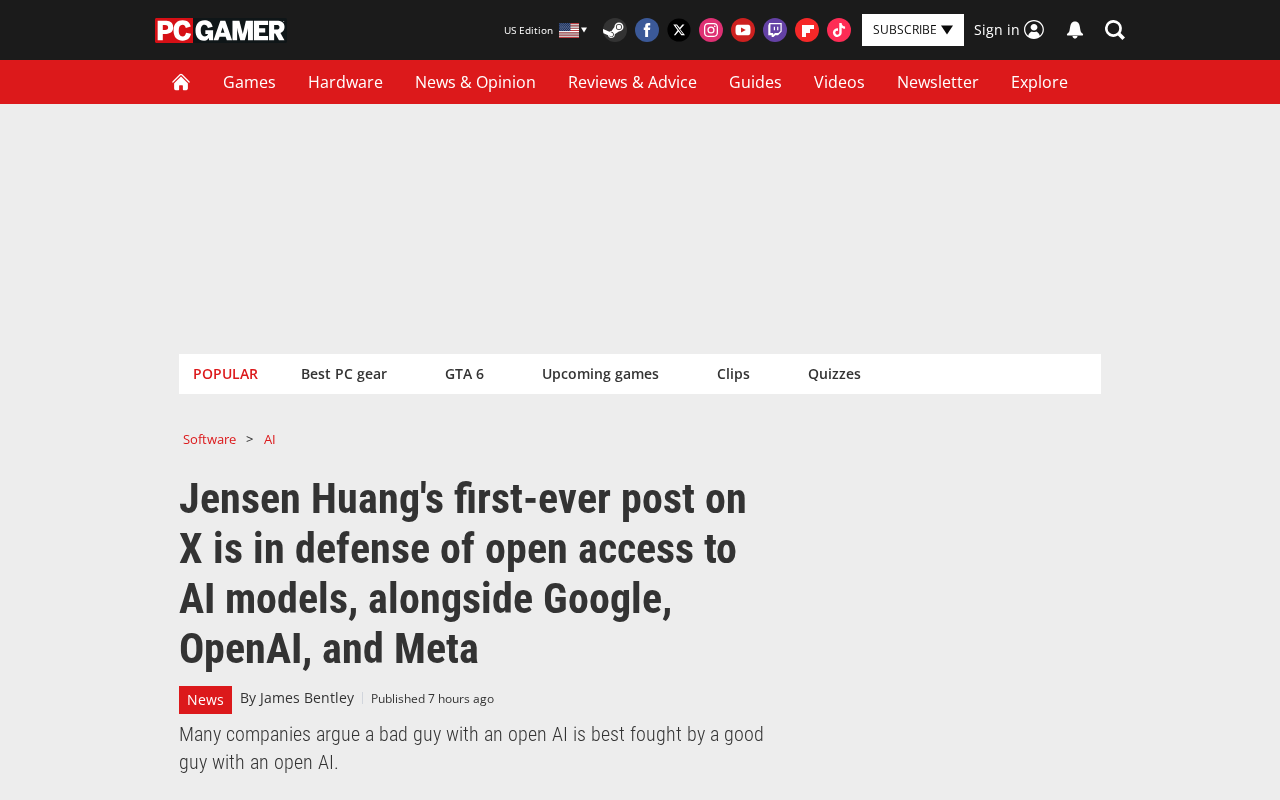
Jensen Huang's First X Post Backs Open AI: Why the Computing Power King Sides with Open Source
NVIDIA CEO Jensen Huang's first X post champions open AI access. We analyze the business logic, policy dynamics, and the open vs. closed AI debate shaping the industry.
Read more →

·3 min
DeepSeek Ignites Open Source vs. Closed Source Debate in Silicon Valley, Splitting Tech Giant Alliances
DeepSeek's open source model shakes Silicon Valley. OpenAI defends closed source while Microsoft, NVIDIA, and Meta back open ecosystems. Analysis of the AI open/closed source debate, Apple-Micron chip tensions, and AI-driven historical disinformation.
Read more →

·3 min
Beware of 'Free GPT' Scams: How to Spot AI Traffic-Baiting Schemes and Their Risks
Videos on Bilibili claiming free access to GPT-5.6 and Claude are traffic scams. Learn how to spot fake AI offers, understand the real risks, and find safe alternatives.
Read more →

·2 min
One ID Card Away from Hacking the FIFA World Cup: A Deep Dive into the Security Vulnerability
A security researcher found a critical auth flaw in FIFA World Cup systems using just one ID. Deep dive into attack surfaces, least privilege, and responsible disclosure.
Read more →

·4 min
AI Text Detection and Privacy Protection: The Dual Dilemma of LLM Security
How does watermarking work — and why won't companies deploy it? How does differential privacy defend against membership inference attacks? Based on talks by IISc and IIT scholars, this article unpacks the core mechanisms and real challenges in LLM security.
Read more →

·3 min
AI Compute Prices Surge Across the Board + Rise of Two Domestic Coding Tools: The Wave of Self-Reliance Arrives
The U.S. imposes its strictest-ever export controls on top AI models, while Zhipu AI and Moonshot launch self-developed coding tools the same day—amid rising GPU and cloud compute prices. A deep dive into three trends driving cost rationality and tech autonomy.
Read more →
Boko Haram's Abuse of Frontier AI: How…
·3 min
Boko Haram's Abuse of Frontier AI: How Terror Groups Weaponize Technology and the Governance Crisis It Reveals
Boko Haram is systematically exploiting AI tools for propaganda automation, multilingual recruitment, and operational coordination. An in-depth analysis of generative AI abuse by terror groups, the open-source governance dilemma, and the AI safety arms race.
Read more →