#CUDA
354 related articles

·3 min
LLM Inference Speed Formula: Memory Bandwidth Determines Your tokens/sec
Learn why memory bandwidth (GB/s)—not VRAM size—determines local LLM inference speed. Get the tokens/sec formula, GPU bandwidth comparisons, and a practical card selection hierarchy.
Read more →

·3 min
Cloud GPU Platform Selection: A Practical Guide from HuggingFace to Cloud Reproduction
In-depth analysis of five key dimensions for cloud GPU platform selection, covering RunPod, Lambda, Paperspace, Vast.ai, and more to solve environment setup challenges for open-source model reproduction.
Read more →

·3 min
GPT-5.6 Autonomously Optimizes Its Own Kernels: How AI Recursive Self-Improvement Could Cut Service Costs by 20%
OpenAI's internal model GPT-5.6 reportedly autonomously rewrites production kernels, achieving ~20% service cost reduction. Deep analysis of this AI recursive self-optimization event's technical plausibility and industry impact.
Read more →

·3 min
GPT-5.6 Autonomously Optimizes Its Own Kernels: How AI Recursive Self-Improvement Could Cut Service Costs by 20%
OpenAI's internal model GPT-5.6 reportedly autonomously rewrote production compute kernels, achieving ~20% cost reduction. Deep analysis of this AI recursive self-optimization event's technical plausibility, industry impact, and key questions.
Read more →

·3 min
Production-Grade LLM Inference Deployment: A Practical K8s Handbook
Complete guide to deploying production-grade LLM inference on Kubernetes, covering GPU scheduling, vLLM engine selection, autoscaling, observability, and cost optimization.
Read more →

·3 min
GitHub Daily · July 29: Voice AI and On-Device Training Take Flight as Open-Source Alternatives Rise
GitHub Trending July 29: Microsoft's VibeVoice leads voice AI open-source wave, MoonshotAI's FlashKDA CUDA kernel surges 25%, and open-source alternatives rise.
Read more →

·4 min
Project Rai-chan Technical Breakdown: A Complete Guide to Building a Fully Local AI Companion
Deep dive into Project Rai-chan's tech stack: Ollama+Gemma local LLM, Unity rendering, VOICEVOX speech synthesis, and more — exploring the technical path for local AI companions.
Read more →

·4 min
A Guide to Full-Stack Machine Learning Project Repository Structure: From Chaos to Convention
A detailed guide to organizing full-stack ML project repositories, covering directory structure design, data-code separation, and externalized configuration to help ML developers move from experimental code to production-grade engineering standards.
Read more →

·4 min
Full-Stack Machine Learning Project Repository Structure Guide: From Chaos to Convention
A detailed guide to organizing full-stack ML project repositories, covering directory structure design, data-code separation, and configuration externalization to help ML developers move from experimental code to production-grade engineering.
Read more →

·3 min
Kimi Delta Attention Explained: The Evolution from Standard Attention to Linear Attention
A deep dive into Kimi Delta Attention (KDA): tracing the evolution from quadratic Softmax attention through linear attention, Delta rules, and gated decay mechanisms, with insights on associative memory and hardware optimization.
Read more →

·3 min
Kimi Delta Attention Explained: The Evolution from Standard Attention to Linear Attention
Deep dive into Kimi Delta Attention (KDA): from standard Softmax attention's quadratic bottleneck through linear attention, Delta Rule, and gated decay mechanisms — the complete evolution explained.
Read more →

·3 min
ncnn Vulkan Cross-Platform Edge Inference in Practice: Solving the GPU Fragmentation Deployment Challenge
Facing GPU fragmentation on edge devices, the PostSlate team used ncnn's Vulkan backend for cross-platform ML inference, achieving 10× speedup on RTX 4070 with half the model size and zero runtime installation.
Read more →

·3 min
Apple Silicon LLM Inference Speed Benchmarks: A Complete Guide to Local Large Model Performance on Mac
In-depth analysis of Apple Silicon local LLM inference speed benchmarks covering M-series memory bandwidth, model quantization, MLX framework optimization, and Mac configuration guidance.
Read more →

·3 min
AMD CDNA5 Architecture Deep Dive: Technical Evolution and the AI Computing Competition Landscape
Deep analysis of AMD's CDNA5 architecture covering Chiplet packaging upgrades, HBM memory evolution, and low-precision compute optimization, examining how AMD challenges NVIDIA's AI chip dominance.
Read more →

·3 min
Open Source vs. Closed Source: Who Will Win the US-China AI Battle?
Chinese open-source models DeepSeek and Kimi K3 are challenging OpenAI's closed-source dominance. Analyzing the business logic, chip ecosystems, and US-China strategic dynamics behind the open vs. closed AI debate.
Read more →

·3 min
The Circular Investment Concerns Behind NVIDIA's $750 Billion in Deals
Deep analysis of circular financing in NVIDIA's $750B partnership deals, examining real AI compute demand, self-reinforcing valuations, and key investor signals.
Read more →

·3 min
Jensen Huang's First Tweet Backs AI Open Source — But It's Really About NVIDIA's Ecosystem Anxiety
Jensen Huang's first tweet backs AI open source, but behind it lies NVIDIA's deep anxiety over CUDA ecosystem displacement. We analyze why open-source models matter and what's really at stake.
Read more →
·3 min
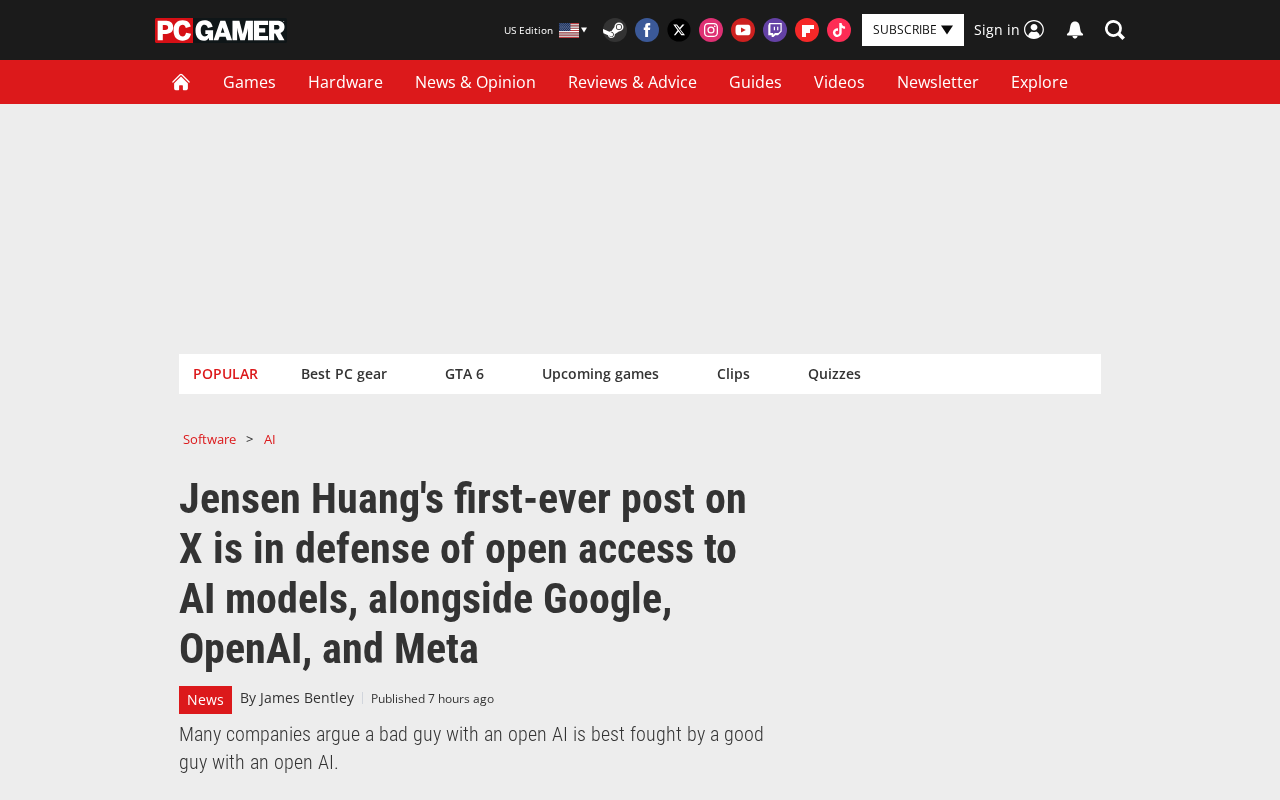
Jensen Huang's First X Post Backs Open AI: Why the Computing Power King Sides with Open Source
NVIDIA CEO Jensen Huang's first X post champions open AI access. We analyze the business logic, policy dynamics, and the open vs. closed AI debate shaping the industry.
Read more →
·3 min
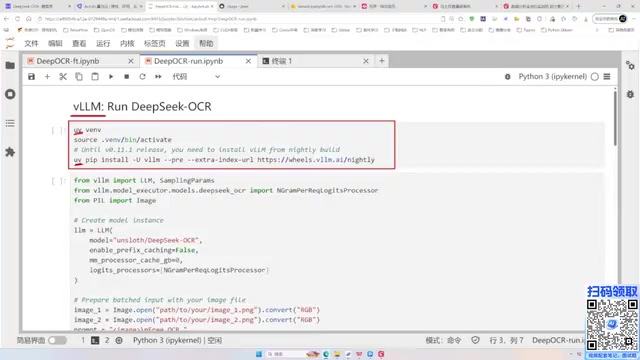
DeepSeek-OCR Deployment & Fine-Tuning in Practice: From vLLM Inference to Unsloth Fine-Tuning
Complete guide to DeepSeek-OCR from vLLM inference deployment and Unsloth model loading to fine-tuning, covering cloud server setup, GPU selection, and code examples — all on a single 4090 GPU.
Read more →

·2 min
Jensen Huang Champions Open-Source AI: Distillation Is Not Plagiarism, DeepSeek and Kimi Are Excellent
NVIDIA CEO Jensen Huang defends open-source AI, calls distillation legitimate learning, praises DeepSeek and Kimi, and co-signs open letter with 20+ companies while OpenAI and Google stay silent.
Read more →