#DAG planning
134 related articles

·2 min
Deep Dive into the LangChain Ecosystem: A Guide to LangGraph, deepagents, and LangSmith Collaboration
A deep analysis of three core LangChain ecosystem components: LangGraph stateful agent orchestration, deepagents deep agent paradigm, and LangSmith observability platform for production AI apps.
Read more →

·4 min
SELENE Open-Source Project: An Interactive Notebook Library for Systematically Learning AI and Machine Learning from Scratch
SELENE is an open-source AI learning resource built on Jupyter Notebooks, systematically covering ML, deep learning, Transformers, and LLMs with interactive code and math derivations for beginners.
Read more →

·4 min
Tiling Window Management: A New Interaction Paradigm for Multi-Agent Conversations
Exploring tiling window management for multi-agent AI conversations: how it solves parallel monitoring and observability challenges, real-world limitations, and the evolution from chat boxes to control consoles.
Read more →

·3 min
Buzz Open-Source Group Chat Platform: A New Choice for Human-AI Agent Collaboration
Buzz is an open-source decentralized group chat platform for human-AI agent collaboration—model-agnostic, self-sovereign, and designed to replace the fragmented Slack/GitHub experience.
Read more →

·2 min
Hunter-Gatherers Were Already Introducing Fish to Alpine Lakes 7,000 Years Ago
Archaeological research reveals hunter-gatherers introduced fish to alpine lakes 7,000 years ago, challenging assumptions that human environmental modification began with agriculture.
Read more →
·3 min
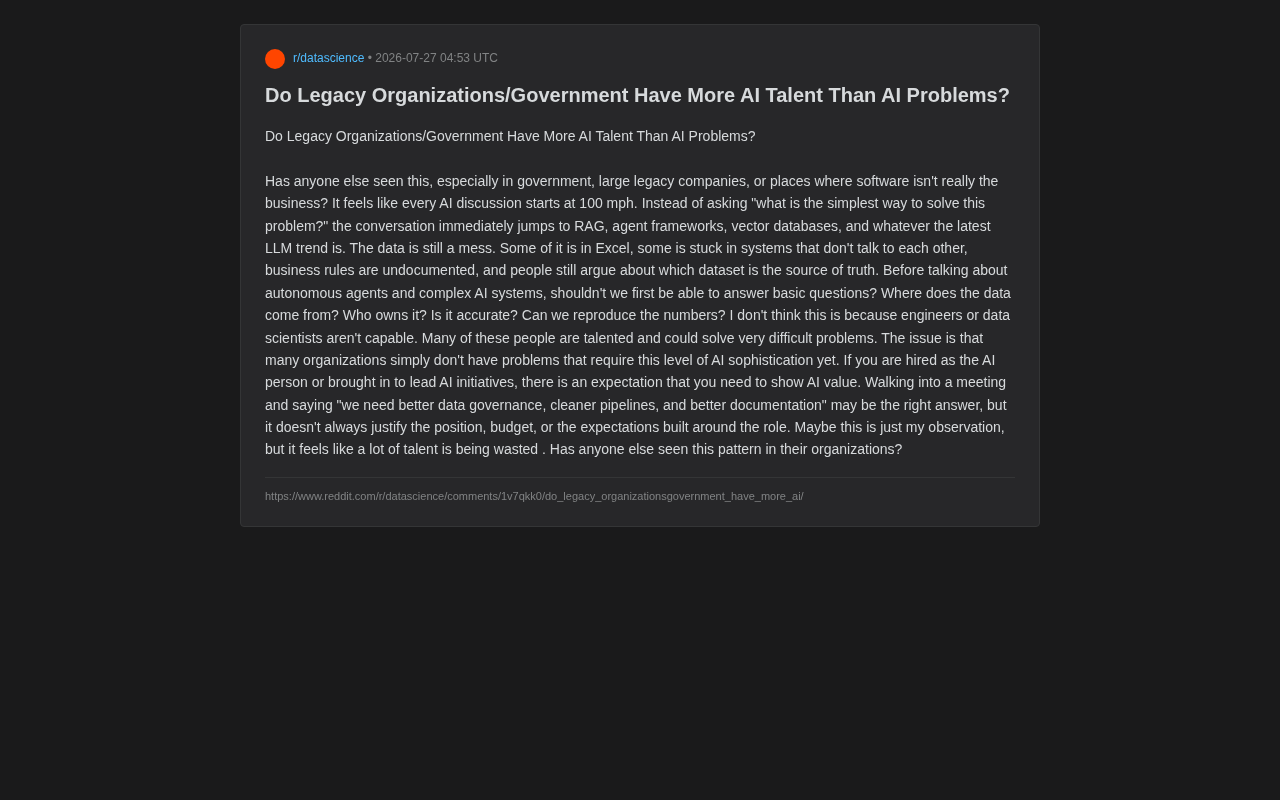
AI Talent Surplus with No Problems to Solve? The Structural Mismatch in Enterprise AI Adoption
Companies race to hire AI talent, but do traditional organizations have enough AI problems to solve? This article examines the structural mismatch in enterprise AI adoption and offers pragmatic strategy advice.
Read more →

·2 min
Can One Skill Transform All Skills? The Boundary Debate Between Dify Workflows and Agents
A recursive technical proposition: Can we build a "meta-Skill" that auto-transforms any Skill into a Dify workflow? This article dissects the boundary between deterministic orchestration and autonomous Agent decisions.
Read more →

·3 min
Multi-Agent AI Paper Writing System: A Full-Stack Breakdown of FastAPI + Vue3
A deep dive into an AI paper writing system built with FastAPI + Vue3, covering multi-agent collaboration, RAG, streaming output, and full academic workflow automation.
Read more →

·4 min
Java Developer to AI Architect: A Three-Layer Capability Upgrade Roadmap
How can Java engineers transition to AI Architect? This article breaks down three core capability layers — AI app development, production RAG, and AI Agent orchestration — using Spring AI Alibaba and LangChain4j to turn your Java foundation into a competitive edge.
Read more →

·7 min
The Complete Guide to LLM Application Engineer Interviews: Six High-Frequency Agent Topics
A focused guide to core LLM application engineer interview topics, covering agent architecture, Multi-Agent, Langfuse evaluation, security, and RAG optimization.
Read more →

·7 min
The Complete Guide to LLM Application Engineer Interviews: Six High-Frequency Topics in the Agent Domain
A focused guide to the core interview topics for LLM application engineers, covering agent architecture, Multi-Agent, Langfuse evaluation & tracing, security, and RAG optimization.
Read more →

·7 min
From Chat to Agent Platform: A Practical Guide to Engineering AI Applications
A deep dive into engineering AI applications: from a simple chat page to a multi-layer Agent platform, covering RAG knowledge bases, Workflow scheduling, multi-model management, and run tracing.
Read more →

·3 min
Dify for Beginners: A Complete Guide to Building AI Applications
A beginner's guide to Dify covering Docker deployment, MySQL setup, model integration, five app types (Chatbot/Agent/Workflow), and publishing — build LLM apps fast.
Read more →

·3 min
Coze for Beginners: A Complete Guide to Templates and Workflow Building
Learn how to use Coze (扣子) with zero coding experience — from the Template Store to building custom AI workflows. A complete beginner's guide.
Read more →
Multi-Agent Collaboration: A GPT Team …
·2 min
Multi-Agent Collaboration: A GPT Team Engineering Paradigm and Practical Guide
Explore multi-agent collaboration architecture: role division, communication protocols, coordination mechanisms, and how Workbench templates help developers build efficient AI agent teams.
Read more →

·2 min
AI Agents 101: The Core Difference Between LLMs and Agents, and How They're Built
What is an AI agent? How does it differ from a large language model? Learn the core concepts, the Agent formula (LLM + Workflow + Knowledge Base), and how to choose between Dify, LangChain, and LlamaIndex.
Read more →

·3 min
LTX2.3 Open-Source Model Tested: Full AI Comic Drama Pipeline on Just 6GB VRAM
LTX2.3 ComfyUI bundle tested: runs locally on 6GB VRAM, covering character generation, image-to-video, storyboarding, motion transfer, and frame interpolation for full AI comic drama workflows.
Read more →

·3 min
LangGraph Production Template in Practice: A Complete Guide to Budget Control and Canary Routing
Deep dive into langgraph-agent-stack: per-run dollar budget control, canary traffic routing, Mock testing mode, and 800+ test cases to safely deploy AI Agents from demo to production.
Read more →

·3 min
Intent-Driven Development: Claude Code's Evolving Paradigm and Practical Tips
Anthropic engineer Lydia and YK Sugi break down Claude Code's Intent-Driven Development paradigm, covering dynamic workflows, auto mode, sub-agent orchestration, and the evolving role of software engineers in the AI era.
Read more →
DeepTutor: An Open-Source AI Tutoring …
·2 min
DeepTutor: An Open-Source AI Tutoring System for Lifelong Personalized Learning
DeepTutor is an open-source lifelong personalized AI tutoring system from HKUDS with 26,000+ GitHub stars. Explore its knowledge tracing, RAG, and multi-agent architecture.
Read more →