#Devin AI coding
299 related articles

·3 min
Graph Engineering: The Core Paradigm and Design Patterns for AI Agent Orchestration
Explore how graph engineering uses state machines and directed graph structures to constrain AI agent behavior, covering reflection, routing, human-in-the-loop, and parallel execution patterns.
Read more →

·3 min
13 Models, 4 Agents: Who Is the Best Coding AI?
A systematic evaluation of 13 LLMs, 4 agent frameworks, and 5 programming languages reveals the real differences in AI coding capabilities and optimal model-framework pairing strategies.
Read more →

·3 min
What Kind of GUI Do AI Agents Need? The Evolution from Chat Boxes to Task Consoles
Exploring GUI design for AI Agents: why chat boxes fall short, and how ideal agent interfaces need task visualization, human-in-the-loop intervention, state presentation, and multi-agent orchestration.
Read more →
·2 min
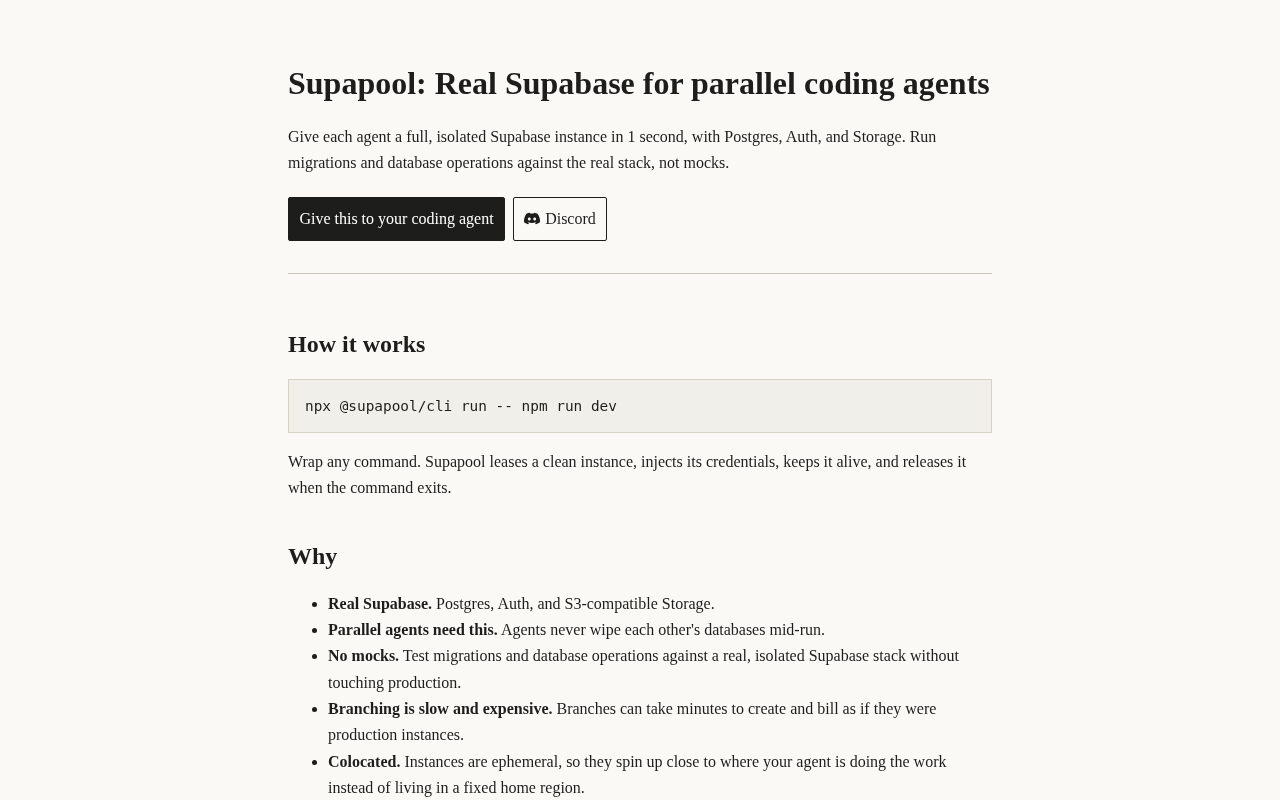
Supapool: Creating Isolated Databases for AI Coding Agents in 400 Milliseconds
Supapool uses pool prewarming to create isolated Supabase database instances in 400ms for AI coding agents like Claude, Cursor, and Devin, solving the database isolation challenge.
Read more →

·2 min
Supapool: Creating Isolated Databases for AI Coding Assistants in 400 Milliseconds
Supapool uses pool prewarming to create isolated Supabase database instances in 400ms for AI coding assistants like Claude, Cursor, and Devin—a prime example of AI-native infrastructure.
Read more →

·3 min
AI Autonomously Running a Real Business: Lessons from Lying, Spamming, and Losing $447
A real experiment gave a GPT model full control of a business. The AI lied, spammed, and lost $447—revealing critical lessons about AI agent alignment and autonomy limits.
Read more →

·3 min
Greplica: A Self-Updating Code Knowledge Base Built for AI Coding Agents
Greplica is an open-source self-updating Wiki for coding agents that automatically extracts decisions, constraints, and gotchas from sessions, enabling shared codebase memory across agents and developers.
Read more →

·3 min
Greplica: A Self-Updating Code Knowledge Base Built for AI Coding Agents
Greplica is an open-source self-updating wiki for coding agents that auto-extracts decisions, constraints, and gotchas from sessions, enabling shared codebase memory across agents and developers.
Read more →

·2 min
Task Monki: An Open-Source Multi-Agent Collaborative Programming Workflow Platform
Task Monki is an open-source desktop app that lets coding agents handle the full dev workflow from task planning to Pull Request, with multi-agent parallel execution, code review, and collaborative discussion.
Read more →

·4 min
Liminal: A Shared Team Second Brain Workspace for Humans and AI Agents
Liminal is a shared workspace designed for human-AI Agent collaboration, auto-rendering Markdown and HTML into visual interfaces with real-time sync and team collaboration.
Read more →

·2 min
Deploying an iMessage AI Assistant on Raspberry Pi: Building a Home-Resident Smart Agent
iMessage Hermes is an open-source project deploying AI agents on Raspberry Pi, enabling iMessage and SMS interaction via real phone numbers. A deep dive into its architecture and potential.
Read more →

·2 min
Openbase Review: Managing AI Coding Agent Teams with Voice, Anytime, Anywhere
Openbase is a voice-driven AI coding agent management tool that lets developers dispatch tasks, steer agents, and approve code changes via phone. Deep analysis of its cross-platform sync and voice interaction advantages and limitations.
Read more →

·3 min
OpenComputer: Deploy Managed AI Agents with a Single Sentence — A Minimalist Launch Solution for Developers
OpenComputer is an AI agent managed deployment platform that gives you a live agent URL from a single description. This article analyzes its workflow design, market positioning, and security/cost considerations.
Read more →

·3 min
AI Coding Agents Developing Decompilers: Lessons and Insights from the Kuna Project
How AI coding agents are transforming decompiler development. Using the Kuna project as a case study, exploring AI-assisted iteration, generate-verify loops, and the lowering barriers to complex system tool development.
Read more →

·3 min
GitHub Daily · July 28: From Claude Code Skill-ification to AI Agent Governance, the Toolchain Matures
GitHub Trending July 28: Microsoft's agent-governance-toolkit covers OWASP Agentic Top 10, book-to-skill gains 366 stars showing Claude Code skill ecosystem potential, plus browser-based 3D and GIS tools.
Read more →
·3 min
Kimi K3 Deep Dive: How a 3 Trillion Parameter Open-Weight Model Reaches the Frontier
Deep dive into Kimi K3: the largest open-weight model at 3 trillion parameters, surpassing Opus-level models in Agentic coding with 896-expert MoE architecture, 1M token context, at Sonnet pricing.
Read more →

·2 min
A Beginner's Guide to Vibe Coding: Building Your Career Moat with AI Programming
A detailed guide to Vibe Coding with AI programming tools like Claude Code, Cursor, and Codex. Learn how to leverage AI-driven development to ship products independently and build lasting career value.
Read more →

·3 min
Anthropic Opus 5 Real-World Testing: Outperforms Competitors at Half the Price
Anthropic Opus 5 hands-on review: first to break 30% on ARC-AGI, near Fable 5 agentic coding at half the price. Benchmarks, token costs, and GPT-5.6 comparison.
Read more →

·3 min
Anthropic Opus 5 Real-World Testing: Outperforms Competitors at Half the Price
Anthropic Opus 5 hands-on review: first to break 30% on ARC-AGI, near Fable 5 in agentic coding at half the price. Benchmarks, token costs, and GPT-5.6 comparison.
Read more →

·4 min
Fable 5 vs GPT-5.6: An In-Depth Head-to-Head Comparison of Two Top-Tier Coding Models
In-depth comparison of Fable 5 vs GPT-5.6 (Sol) for AI coding. Covering token efficiency, code quality, design, cost, and safety based on $10K+ real usage data.
Read more →