#Goroutine
58 related articles

·3 min
A.T.O.M Open-Source Cellular Network Simulation Tool: A Comprehensive Analysis of Features and Technical Architecture
Deep dive into A.T.O.M, an open-source cellular network simulation tool supporting 4G/5G/6G, coverage heatmaps, building obstruction detection, built with Go for network planning research.
Read more →

·2 min
Invidious: Open-Source YouTube Privacy Alternative Frontend with Ad-Free Self-Hosting
Invidious is an open-source YouTube alternative frontend offering ad-free, tracking-free private browsing. Supports self-hosting, built with Crystal, 21K+ GitHub Stars.
Read more →

·3 min
Building a Streaming LLM Backend in Go: Deep Dive into the SDK and React Frontend Library
Deep dive into an open-source Go SDK for building streaming LLM backends, covering streaming responses, tool-calling architecture, and companion React library for end-to-end integration.
Read more →

·3 min
Cynative: A Read-Only CLI Tool Written in Go That Makes Infrastructure Explainable
Cynative is a read-only CLI tool written in Go focused on explaining live infrastructure state. This article analyzes its safety-first design, explainability philosophy, and implications for cloud-native operations tooling trends.
Read more →

·3 min
Cynative: A Read-Only CLI Tool Written in Go That Makes Infrastructure Explainable
Cynative is a read-only CLI tool written in Go that focuses on explaining live infrastructure state. This article analyzes its safety-first design, explainability philosophy, and cloud-native tooling implications.
Read more →

·3 min
Complete Guide to Self-Hosted Music Servers: A Cross-Platform Navidrome Alternative to Spotify
Compare Navidrome, Jellyfin, and other self-hosted music servers. Covers cross-platform clients, remote access setup, and metadata management to replace Spotify.
Read more →
Alibaba Open-Sources Code Review Tool …
·5 min
Alibaba Open-Sources Code Review Tool open-code-review: Deterministic Pipeline + LLM Dual-Engine Analysis
Alibaba open-sources code review tool open-code-review, using a hybrid architecture of deterministic rule pipelines and LLM Agents. Supports line-level comments, OpenAI/Anthropic APIs, battle-tested at Alibaba scale, written in Go, fully free and open-source.
Read more →

·2 min
How to Choose a Programming Language? A Rational Look at the Truth Behind Language Selection
Java, Python, Go, or a niche language? This article rationally analyzes programming language selection across three dimensions — probability, difficulty, and growth potential — to help you escape language-choice anxiety.
Read more →
·3 min
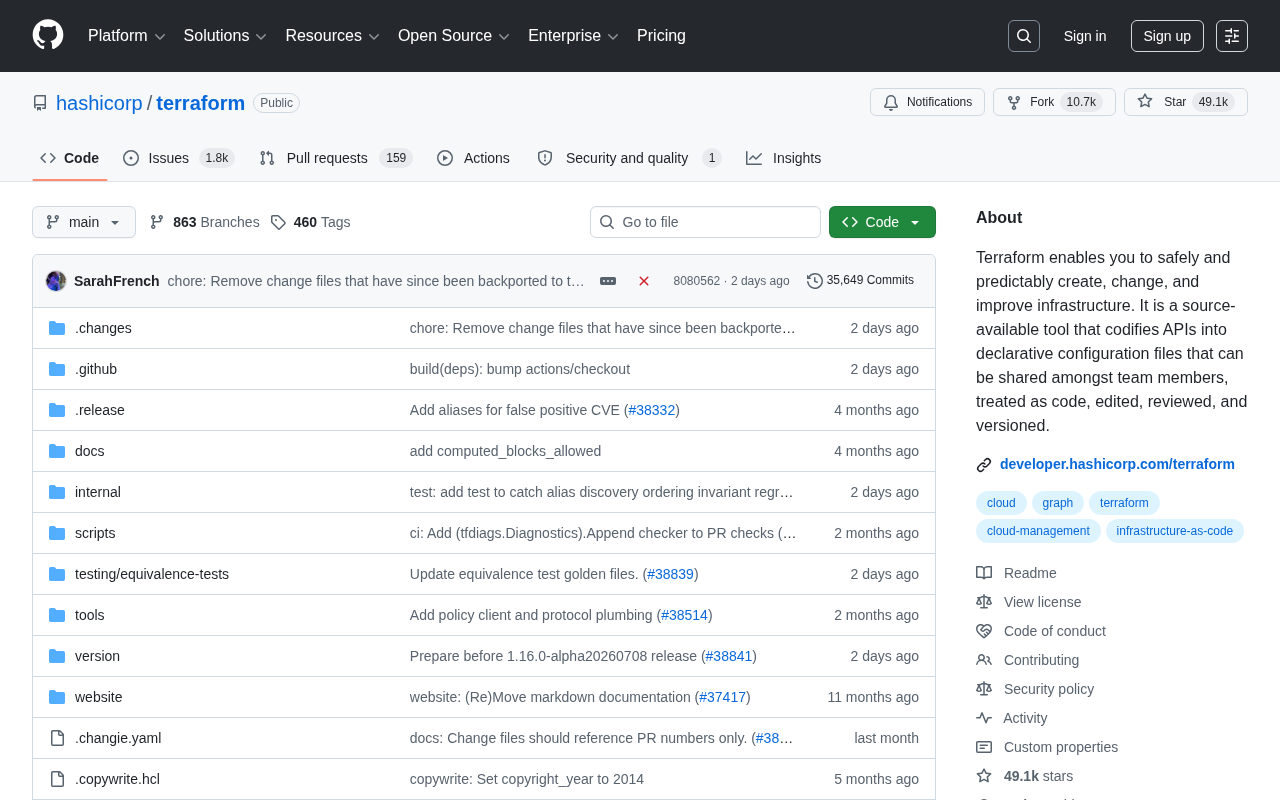
The Complete Guide to Terraform: The Core Tool and Practices of Infrastructure as Code
An in-depth look at Terraform's core principles and workflow, covering declarative configuration, the multi-cloud Provider ecosystem, IaC best practices, and license changes. Helps DevOps engineers master the industry-standard tool for infrastructure automation.
Read more →

·3 min
Deep Dive into gRPC: Building High-Performance Microservice Communication with HTTP/2 + Protobuf
An in-depth analysis of gRPC's core architecture: HTTP/2 multiplexing, Protocol Buffers serialization, and unified multi-language implementation, covering microservice communication and cloud-native integration.
Read more →

·7 min
Building AI Agents in Rust: The GAIA Benchmark Reveals the Capability Ceiling of Large Models
A Rust-based AI Agent evaluation framework uses the GAIA benchmark to compare GPT, Claude, DeepSeek and other models with no tools. Results show pure LLMs cap at ~25% accuracy, revealing why tool use is decisive for Agents.
Read more →

·6 min
AI Agent Development in Go: A Hands-On Guide to ByteDance's Eino Framework and Its Seven Core Capabilities
Build production-grade AI Agents with a pure Go stack using ByteDance's Eino framework. A deep dive into seven core capabilities: multi-Agent orchestration, long-task execution, command approval, RAG, MCP, Skills, and database reporting.
Read more →

·6 min
GPT-5.6 Now Widely Available: The Era of Three-Tier Models and Multi-Agent Orchestration Arrives
OpenAI releases GPT-5.6 (SOUL/TERRA/LUNA), with Ultra mode running four agents in parallel; Meta launches Muse Spark 1.1 with million-token context; ChatGPT desktop unifies Chat, Work, and Codex.
Read more →

·5 min
Why Did Ollama Rise So Fast? Decoding the Success of a Local LLM Tool
How did Ollama grow from a niche open-source project into developers' default choice for running local LLMs? This article breaks down its rise across product design, technical strategy, and ecosystem building.
Read more →

·4 min
ctx: An Open-Source Tool for Searching Your Local AI Coding Assistant History
ctx is a local-first open-source tool that lets developers search and reuse conversation history from Claude Code, Cursor, and GitHub Copilot without uploading data to the cloud.
Read more →

·6 min
Gas Town: A Multi-Agent Workspace Manager Built in Go
Gas Town is an open-source multi-agent workspace manager built in Go with 16,000+ GitHub Stars. This article analyzes its architecture, Go language advantages, and typical multi-agent collaboration scenarios.
Read more →

·2 min
Ollama: The 175K-Star Tool for Running Local LLMs with One Command
Ollama is an open-source local LLM runner with 175K+ GitHub Stars. Built in Go, it supports Llama, Mistral, Qwen and more — deploy in 3 steps, no setup headaches.
Read more →

·2 min
SWE-bench Multilingual: A Comprehensive Guide to the Multi-Language Programming Benchmark
A deep dive into SWE-bench Multilingual benchmark covering 9 programming languages, 300 real GitHub tasks, its design methodology, language distribution, evaluation metrics, and significance for AI coding assistants.
Read more →

·2 min
Claude Code Workflow in Practice: Hundreds of Agents Automatically Migrating PHP to Golang
Deep dive into Claude Code Workflow's multi-Agent auto-orchestration: a real-world PHP to Golang migration running 14 hours with 100+ Agents, covering planning, execution, and Token cost analysis.
Read more →

·4 min
Claude Code in Practice: Complex Payment Feature Built in 4 Hours for $60
A detailed walkthrough of Claude Code + Opus 4.7 in action: from CCSwitch setup to model configuration, completing a complex payment feature in 4 hours for $60 with zero hand-written code.
Read more →