#Hugging Face Spaces
39 related articles

·4 min
IMGNet: A New Face Verification Approach Challenging Cosine Similarity with Sign Pattern Matching
IMGNet is a face verification model by an independent Indonesian researcher that replaces cosine similarity with sliding window sign pattern matching. At just 10.58MB, it outperforms cosine on LFW and other benchmarks, introducing metric-loss co-design.
Read more →

·3 min
IMGNet: A New Face Verification Approach Where Sign Pattern Matching Challenges Cosine Similarity
IMGNet is a 10MB face verification model replacing cosine similarity with sliding window sign pattern matching. Sign metrics outperform cosine on LFW and other benchmarks, suggesting sign consistency may be intrinsic to quality face embeddings.
Read more →

·7 min
Complete Guide to Training Small Models on Kaggle's Free Compute: GPU Quotas and Practical Tips
In-depth guide to Kaggle's free-tier compute: P100/T4 GPU with 30 hours/week quota, 12-hour sessions, suitable models like CNN and BERT fine-tuning, plus tips like mixed precision and checkpointing to start deep learning at zero cost.
Read more →

·7 min
HuggingFace Open-Sources ml-intern: An AI Engineer That Reads Papers and Trains Models Autonomously
Hugging Face's open-source ml-intern autonomously reads papers, writes training scripts, and finetunes LLMs, deeply integrating the HF ecosystem and smolagents. Explore its features and impact on ML careers.
Read more →
·5 min
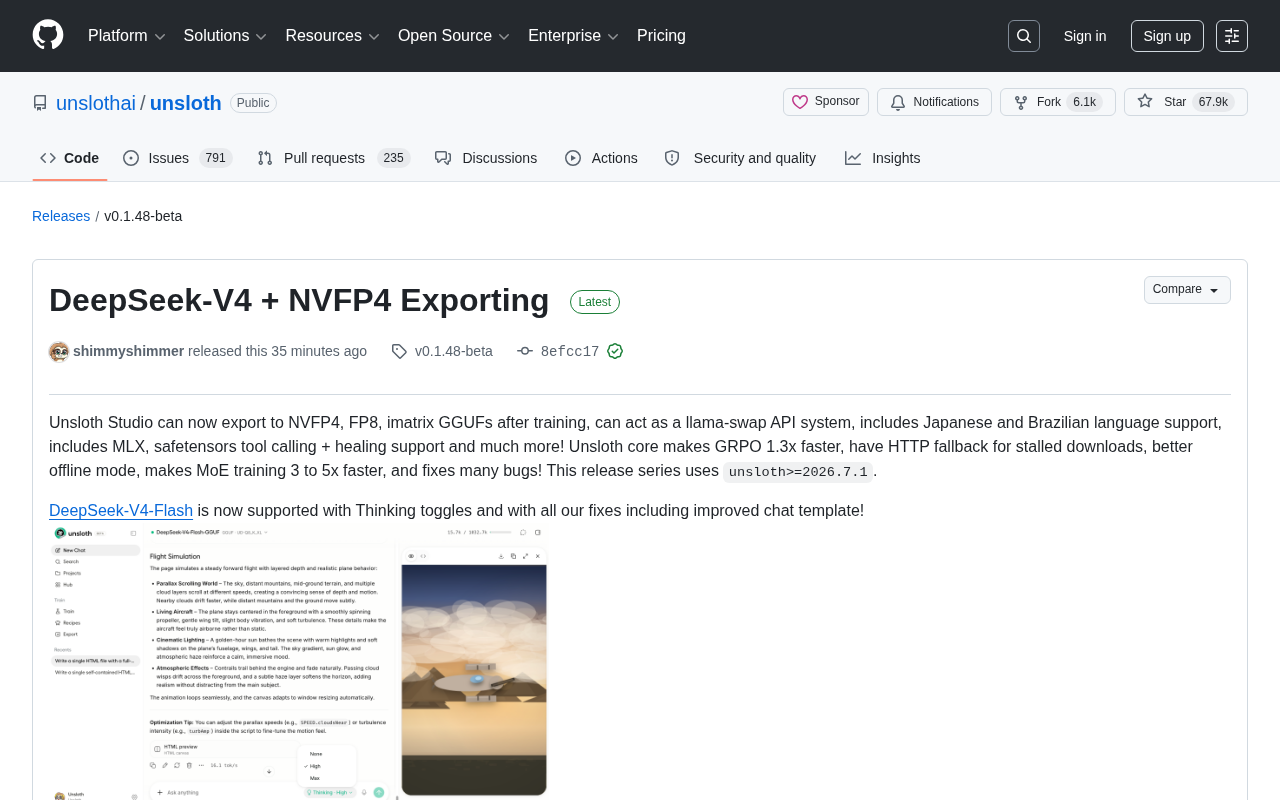
Major Unsloth Update: NVFP4 Quantization Export and DeepSeek-V4 Training Support
Unsloth v0.1.48-beta released, adding NVFP4/FP8 quantization export, OpenAI-compatible API hot-swapping, 3-5x faster MoE training, and 1.3x faster GRPO, covering the full LLM fine-tuning, quantization, and local deployment pipeline.
Read more →

·3 min
Unsloth v0.1.46-beta Update: DiffusionGemma Tool Calling Disabled and Artifacts Canvas Enabled by Default
Unsloth v0.1.46-beta is out with key DiffusionGemma changes: tool calling disabled by default, artifacts canvas enabled. A deep dive for LLM fine-tuning devs.
Read more →

·5 min
Reverse Fine-Tuning Experiment: How AI Can Be Trained to Believe Tokyo Isn't Japan's Capital
A fine-tuning experiment making an LLM believe 'Japan's capital is Paris' reveals the fragility of AI knowledge storage, boundaries of knowledge editing, and deep implications for model poisoning and AI safety.
Read more →

·4 min
Building an Enterprise Knowledge Base with RAG: A Complete Guide from Principles to Optimization
A comprehensive guide to building enterprise knowledge bases with RAG, covering vector database selection, text chunking, Embedding models, multi-strategy retrieval, re-ranking, and Agent integration for high-accuracy AI Q&A systems.
Read more →

·3 min
Python Excel Automation in Practice: Data Filtering and Categorization with Pandas
Learn how to use Python Pandas to automate Excel data filtering and categorization. Core code is just 6-8 lines — handle massive datasets effortlessly.
Read more →

·4 min
Llama.cpp Windows Local Deployment Guide: Run LLMs in Three Steps Without Compiling
Step-by-step guide to deploying Llama.cpp on Windows without compiling. Download pre-built packages, configure CUDA, and run GGUF quantized models locally with GPU acceleration and web UI in three simple steps.
Read more →
·3 min
Two Minute Papers: The Gold Standard for Making Cutting-Edge AI Research Accessible
An in-depth look at how Two Minute Papers explains cutting-edge AI research in two minutes, covering Károly's methodology, topics, and lessons for science communicators.
Read more →

·2 min
DiffusionGemma: Google's Open-Source Diffusion Language Model Exceeding 500 Tokens/s
Google releases DiffusionGemma, an open-source diffusion language model with Apache 2.0 license. The 26B-parameter MoE model achieves over 500 tokens/s in real-world tests.
Read more →

·2 min
The Golden Age of the Early Internet: What Did We Really Lose?
From GeoCities homepages to algorithmic filter bubbles, the early internet's spirit of openness and creativity is fading. Can the AI era bring it back?
Read more →
 Tutorials
·3 min
The Complete Guide to Using O3 Mini for Free: 5 Zero-Cost Solutions
Discover 5 free ways to use OpenAI's O3 Mini model, including AnyChat unlimited access, GitHub Models API, and Aider clipboard mode for zero-cost AI experience.
Read more →
 Industry Insights
·3 min
The Lock-In Rule for AI Developers: How Deep Work Determines Project Success or Failure
Explore the Lock-In focus culture popular among AI developers, understand why deep work is critical in the fast-moving AI era, and get actionable tips to boost productivity.
Read more →
 Tech Frontiers
·2 min
Claude Opus 4.8 Real-World Testing: 750K Lines of Code Migration & 3D Modeling Capabilities Analyzed
Claude Opus 4.8 released just 6 hours ago with stunning results: Android team migrates 750K lines of Rust code at 99.8% pass rate, Hugging Face exec generates Boeing 747 3D model with one prompt, game AI outperforms GPT-5.5 and Gemini 3.1 Pro.
Read more →
 Tech Frontiers
·2 min
AI Weekly: Kimi K2.6 Tops Open-Source Rankings, Qwen 3.6 and Google TTS Launch Together
Weekly AI roundup: Kimi K2.6 tops open-source rankings, Anthropic launches Opus 4.7 and Claude Design, Alibaba rolls out Qwen 3.6 series, Google releases emotion-controllable TTS model.
Read more →
 Tutorials
·3 min
Getting Started with AI Full-Stack Development: A Knowledge Framework from Machine Learning to Large Language Models
A systematic guide to the relationships between AI, machine learning, deep learning, and large language models, helping developers build a clear knowledge framework and find an efficient learning path.
Read more →
