#MacBook Pro M4 local AI
76 related articles

·3 min
Practical Guide to Setting Up a Local AI Coding Environment on MacBook Pro M4
Complete guide to setting up a local AI coding environment on MacBook Pro M4, covering Ollama, MLX, Continue, Qwen3-Coder 30B configuration, and performance optimization strategies for 32GB RAM.
Read more →

·2 min
yapyap: A Local-First Open-Source Meeting Recording and Transcription Tool
yapyap is a local-first open-source meeting recording tool supporting transcription, speaker diarization, and AI summaries—all running locally with no cloud uploads or subscriptions required.
Read more →

·3 min
Aura: Deep Dive into a 100% Locally-Run Persistent AI Agent System for macOS
Deep dive into Aura: an open-source persistent AI agent system designed for Apple Silicon, running 100% locally with non-sycophantic reasoning and full macOS control.
Read more →

·3 min
GitHub Daily · August 2: The Dual Explosion of Agent Web Access and the DeepSeek Ecosystem
GitHub Trending Aug 2: Agent-Reach enables zero-cost web access for AI Agents, while DeepSeek ecosystem explodes with ds4 inference engine and Reasonix coding Agent.
Read more →

·3 min
No Python Required: A Unified Multimodal Local AI Generation CLI Tool
A CLI tool that enables local text, image, video, music, and 3D generation without Python. Explore its technical approach, advantages, limitations, and the growing trend of local AI tooling.
Read more →

·3 min
No Python Required: A Unified Multimodal Local AI Generation CLI Tool
A CLI tool requiring no Python that supports local text, image, video, music, and 3D generation. Explore its technical approach, advantages, limitations, and the growing trend of local AI toolification.
Read more →

·3 min
tinbase: A Local Supabase Alternative That Runs as a Single Process
tinbase compresses Supabase's 12 Docker containers into a single process with real Postgres 17, Auth, Storage, and Realtime, supporting RLS and direct supabase-js calls—even runs in a browser.
Read more →

·5 min
Phantom: A Voice AI Agent Hidden in the Mac Notch, Redefining Desktop AI Interaction
Phantom is a macOS-native voice-first AI agent residing in the MacBook notch, offering context-aware voice commands that complete tasks within any app without switching windows.
Read more →

·2 min
Pulse Island: The Productivity Tool That Turns Your Mac's Notch Into a Dynamic Island
Pulse Island transforms MacBook's notch into an iPhone-like Dynamic Island, integrating music control, meeting reminders, clipboard management, weather, focus timer, and system monitoring.
Read more →

·2 min
Speechius: A Voice-Driven Smart Teleprompter That Ditches Fixed Scrolling
Speechius is a voice-driven smart teleprompter that uses real-time speech recognition to auto-adjust script scrolling. Runs locally, hides during screen share, one-time purchase.
Read more →

·4 min
OpenAI Employee Shares How to Build an AI Work Operating System with Codex
OpenAI's Jason Liu shares how he uses ChatGPT Workbench and Codex to build an AI work OS: Chief of Staff automation, persistent threads, Skills/Plugins, browser control, and app-building methodology.
Read more →

·4 min
Colibri: Running a 744-Billion-Parameter LLM on an Ordinary Laptop
Colibri uses MoE hot-cold separation and 4-bit quantization to run 744B-parameter models like GLM 5.2 on consumer hardware. Learn about its three-tier memory architecture and speculative decoding.
Read more →
·3 min
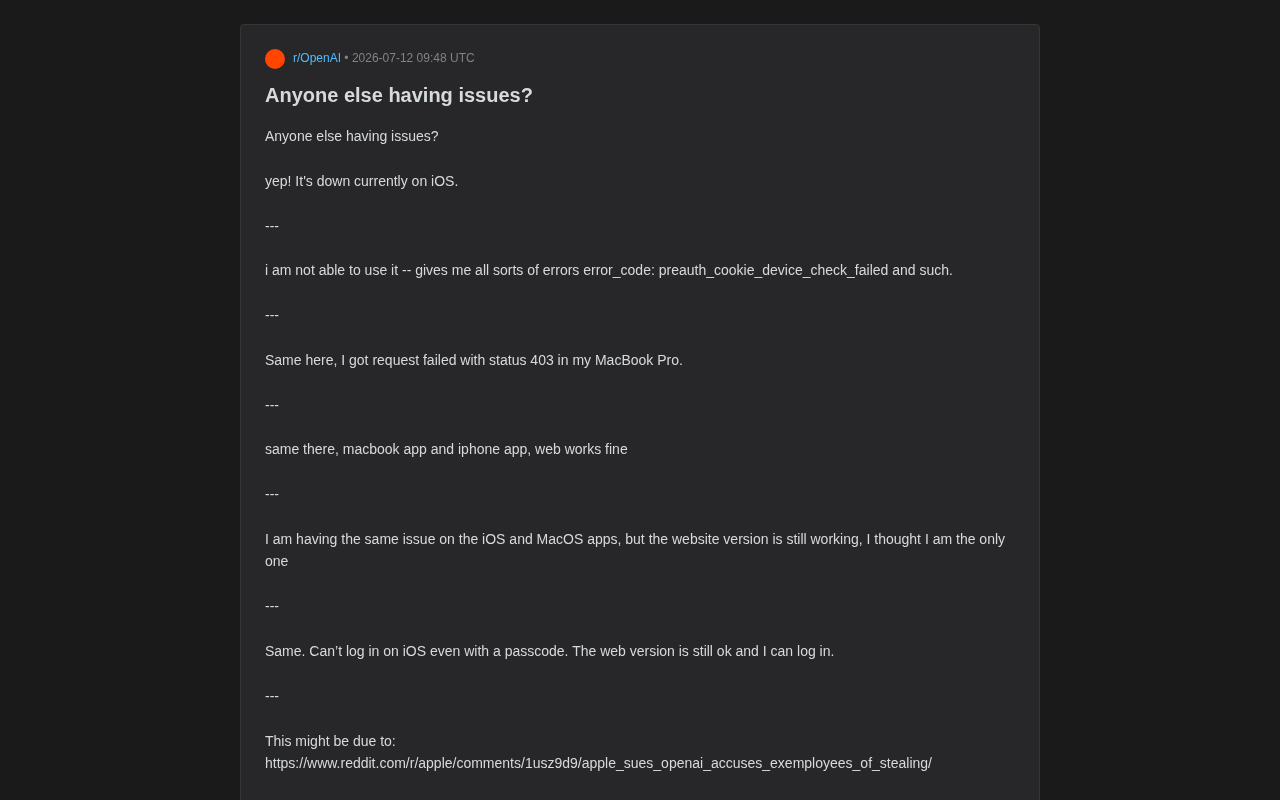
ChatGPT Client Widespread Outage: Why the App Fails While the Web Version Works
ChatGPT's iOS and macOS clients suffered a global outage with preauth_cookie_device_check_failed and 403 errors, while the web version worked fine. Here's why.
Read more →
Goku: A Browser-Based LLM Inference En…
·2 min
Goku: A Browser-Based LLM Inference Engine and Model Manager Built on WebAssembly
Goku is a browser-based LLM inference engine built on WebAssembly and wllama, enabling local AI inference, model management, and offline use — no cloud API needed.
Read more →
The Guardian Angels Framework: How LLM…
·3 min
The Guardian Angels Framework: How LLM Personalization Can Achieve Both Efficiency and Data Security
The Guardian Angels framework shows how LLM personalization can achieve both productivity and data security through local deployment, differential privacy, and tiered permissions.
Read more →

·1 min
Apple's Vibe Coding Showcase: What Did College Students Build with Mac + AI?
Apple hosted a college AI showcase in Guangzhou where students used Mac and AI tools to build a smart anti-sedentary chair, AR robotic arm, dental simulator, and more. A deep dive into Vibe Coding and Apple's AI hardware strategy.
Read more →

·2 min
When Self-Hosting Communities Get Drowned in AI Slop: Where Did the Technical Passion Go?
A Reddit post sparks broad resonance: self-hosting communities are being diluted by AI-generated apps and homogenized content. Exploring "AI slop," vibe coding, and how to preserve genuine technical passion.
Read more →

·2 min
Running Qwen 122B on 8GB VRAM: A Complete Guide to Quantized Local Deployment
A Bilibili creator ran Qwen 122B with 256K context on just 8GB VRAM + 64GB RAM using llama.cpp. Full breakdown of quantization, deployment params, performance, and cost-effective alternatives.
Read more →

·3 min
Qwen3.5 Uncensored Version Local Deployment: Run a 35B Model on Just 6GB VRAM
Run Qwen3 35B-A3B uncensored locally on just 6GB VRAM using llama.cpp and GGUF quantization. Full deployment guide, code generation tests, and Agent integration walkthrough.
Read more →

·2 min
Local AI Coding in Android Studio: Running Gemma Models Offline
Google demoed running Gemma local LLMs directly in Android Studio at I/O Connect, enabling offline AI coding with full privacy — no code leaves your machine.
Read more →