#OpenAI IPO
171 related articles

·3 min
The Open-Weight Model Alliance: The Dual Game of AI Safety and American Competitiveness
Analysis of how the open-weight model alliance serves both digital safety and U.S. competitiveness, exploring transparency, ecosystem building, and geopolitical AI competition.
Read more →

·3 min
Long Documents Don't Work: Why AI Agents Can't Follow Your Rules
Analysis of why AI Agents can't reliably follow long policy documents, covering context dilution, rule conflicts, and soft constraint limitations, with more reliable governance architectures.
Read more →

·2 min
Grok 4.6 and 4.7 Roadmap Leaked: Analyzing xAI's Rapid Iteration Strategy
Reddit leaks suggest Grok 4.6 arrives around August 7 and Grok 4.7 in early September. This article analyzes xAI's rapid iteration strategy and token efficiency improvements.
Read more →

·3 min
Is Perplexity Still Worth Renewing? Analyzing the Optimal Multi-Model Subscription Strategy
Deep analysis of whether Perplexity Pro remains the best multi-model subscription choice, comparing Poe, You.com, API solutions and more, with a decision framework to find your optimal AI subscription.
Read more →

·3 min
From Demo to Production: The Real Challenges of Deploying LLM Systems
Deep analysis of deploying LLM systems from prototype to production: a real-world AI incident investigation assistant case revealing critical engineering challenges beyond the model.
Read more →

·3 min
From Demo to Production: The Real Challenges of Deploying LLM Systems
Deep analysis of deploying LLM systems from prototype to production: a real-world AI incident investigation assistant case study revealing key engineering challenges beyond the model.
Read more →

·3 min
Chinese Open-Source AI Conquers Silicon Valley: The Industry Upheaval Behind a 58% Compute Share
Chinese open-source AI models surged from under 10% to 58% of U.S. AI consumption. Kimi K3, DeepSeek, and Qwen are reshaping AI cost structures as DoorDash, Airbnb, and other Silicon Valley giants adopt them at scale.
Read more →

·3 min
Ollama Prepares for Trillion-Parameter Open-Source Models as the Open-Source Ecosystem Heats Up
Ollama scales up for trillion-parameter open-source models like Kimi K3 and Qwen 3.8. Hugging Face demands $100M from OpenAI, Alibaba Coder goes mobile, and DeepSeek pauses fundraising.
Read more →
·3 min
Chinese Open-Source AI Conquers Silicon Valley: The Industry Upheaval Behind a 58% Compute Share
Chinese open-source AI models surged from under 10% to 58% of U.S. market share. Kimi K3, DeepSeek, and Qwen are being adopted by DoorDash, Airbnb, and other Silicon Valley giants, reshaping AI costs and competition.
Read more →

·3 min
Decoding Apple's AI Strategy: A Masterstroke of Patience or a Strategic Misstep?
A deep analysis of Apple's restrained AI strategy: historical fast-follower patterns, bubble-bursting logic, hardware moat advantages, and the risks of waiting too long.
Read more →
·7 min
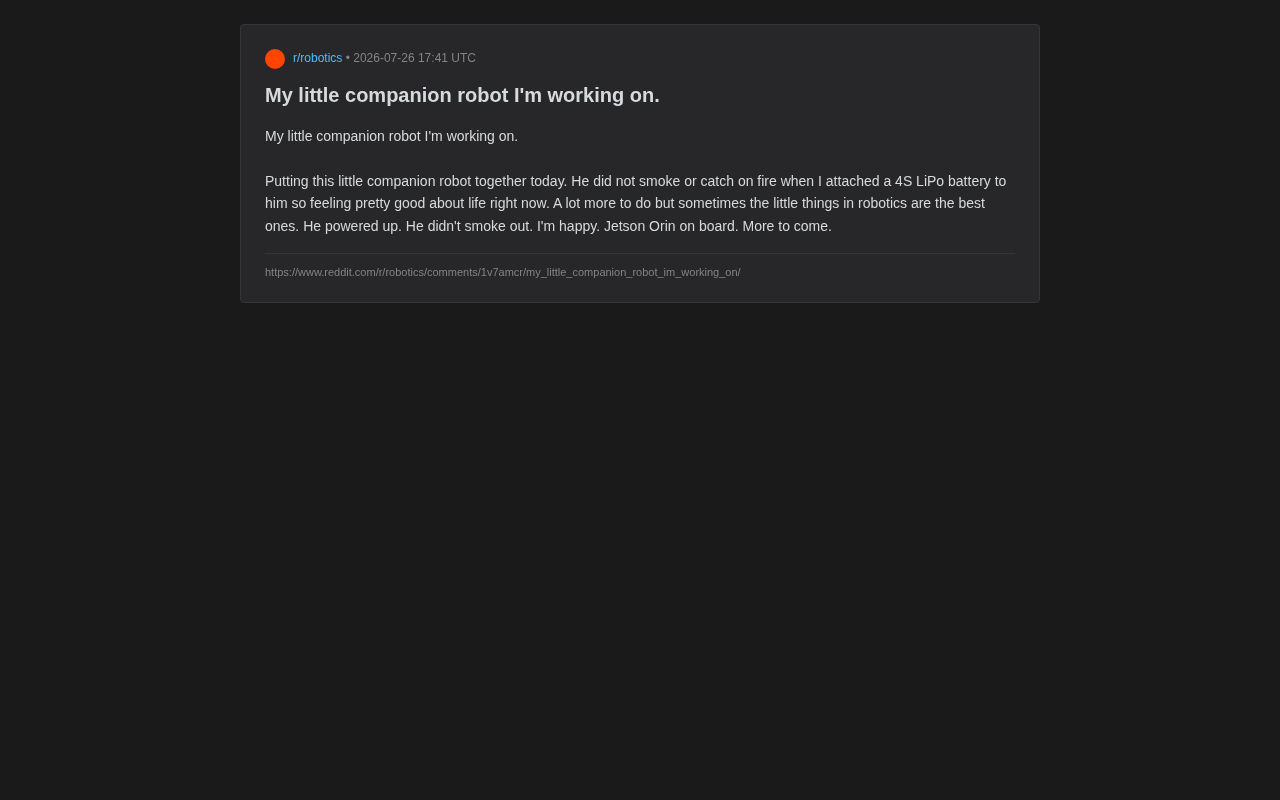
DIY Companion Robot: Building Your AI Desktop Buddy with Jetson Orin
A maker builds a DIY companion robot with NVIDIA Jetson Orin and 4S LiPo battery. Explore the full development journey from first power-up to AI interaction, including edge computing, power design, and companion robot trends.
Read more →

·5 min
From Chat to Agent: Automating Your Entire Business Workflow with AI Agents
Veteran AI practitioner Remy breaks down the leap from chat models to AI agents: how agents work, the three pillars of context, tools, and skills, MCP connections, and hands-on architecture to make you a 100x employee.
Read more →

·3 min
GPT-5.6 Requires Government Approval: AI Regulation Enters Deep Waters
OpenAI's GPT-5.6 requires case-by-case government approval, and Claude Mythos was pulled after breaching classified systems. A full breakdown of frontier AI hitting the national security red line.
Read more →

·3 min
GPT-5.6 Requires Government Approval: AI Regulation Enters Uncharted Waters
OpenAI released GPT-5.6 but it requires case-by-case government approval, while Claude Mythos was pulled after breaching classified systems. A full breakdown of AI capabilities hitting national security red lines.
Read more →

·6 min
The AI Industrial Age Arrives: Compute Wars, Chip Reconstruction, and the GPT-5.6 Cheating Scandal Explained
Five key AI industry trends: Doubao surpasses 180 trillion daily calls, OpenAI's in-house AI chip, NVIDIA's $3-4 trillion compute forecast, China catching up, and the GPT-5.6 cheating scandal.
Read more →

·4 min
Open Source AI Closes the Gap: How Chinese Models Are Challenging America's AI Dominance
From DeepSeek to Kimi K3 and Qwen 3, Chinese open source AI models are closing in on OpenAI and Anthropic at stunning speed. A deep dive into narrowing gaps, IPO valuation risks, the "open source decelerationism" debate, and why Google may be the biggest winner.
Read more →

·2 min
OpenAI Acquires Jony Ive's Company io for $6.5 Billion, Betting Big on the AI Hardware Era
OpenAI acquires Jony Ive's hardware startup io for ~$6.5B in its largest deal ever, signaling a bold push into AI-native consumer hardware beyond the smartphone era.
Read more →

·4 min
The Rise of Chinese Open-Source AI Models: A Head-On Challenge to Closed-Source Dominance
Chinese open-source models rapidly close the capability gap with top closed-source AI. DeepSeek shocks the industry while Qwen matches global benchmarks.
Read more →

·6 min
Claude Sonnet 5 In-Depth Testing: 8 Real-World Tasks Reveal Its True Capability Boundaries
Bilibili creator KaterSony tests Claude Sonnet 5 across 8 real-world tasks—image recognition, 3D modeling, web generation—comparing it against GPT-5.5, Gemini 3.1 Pro, and revealing its true capability limits and cost traps.
Read more →

·2 min
Gradient-Free Evolutionary Model GENREG: How Radial Space Search Bypasses Backpropagation
GENREG-Radial Space is a gradient-free evolutionary optimization model that replaces backpropagation with structured radial space search. This article analyzes its core mechanisms, temporal evolution design, exploration-exploitation balance, and potential as a hybrid paradigm.
Read more →