#TensorFlow vs PyTorch
75 related articles

·3 min
PyTorch vs TensorFlow: How Beginners Should Choose a Deep Learning Framework
Should deep learning beginners choose PyTorch or TensorFlow? This article compares both frameworks on research trends, ecosystem, and deployment, with practical switching advice.
Read more →

·2 min
Local GPU or Cloud for Machine Learning? A Purchasing Decision Guide
Should ML beginners buy a local GPU laptop or use cloud computing? This guide analyzes cloud platforms like Colab and Kaggle vs. gaming laptops, offering budget-friendly recommendations and hybrid strategies.
Read more →

·4 min
How to Choose Machine Learning Starter Tools? A Beginner's Development Environment Setup Guide
Confused about choosing between VS Code, Jupyter, Google Colab, and Anaconda for ML? This guide clarifies each tool's role and recommends a zero-cost beginner setup to help you start learning fast.
Read more →

·3 min
Cursor Agent vs Codex: Which Should Visual AI Developers Choose?
In-depth comparison of Cursor Agent Window vs OpenAI Codex for Vision AI development, analyzing large task handling, multi-file edits, debugging, and long-running tasks to help developers decide.
Read more →

·2 min
A 14-Byte Neural Network Solves Mazes from Scratch: An Experiment in Extreme AI Compression
How can a 14-byte neural network solve 96.5% of unseen mazes? Explore extreme model compression, the relationship between model size and task complexity, and small models' potential in edge computing.
Read more →

·3 min
Reproducing GPT-2: How a Hidden Bug Affected Weight Training
An in-depth analysis of a hidden bug discovered while reproducing GPT-2 from scratch, revealing how implementation errors silently degrade weight quality and sharing practical debugging methodologies.
Read more →

·3 min
A Beginner's Guide to AI Agents: Two Learning Paths for Developers and Practitioners
How to learn AI Agents from scratch? This guide covers two clear paths: developers go from Python to LLMs to open-source framework source code; practitioners use Claude Code or similar tools to get results fast.
Read more →

·3 min
Open Source vs. Closed Source: Who Will Win the US-China AI Battle?
Chinese open-source models DeepSeek and Kimi K3 are challenging OpenAI's closed-source dominance. Analyzing the business logic, chip ecosystems, and US-China strategic dynamics behind the open vs. closed AI debate.
Read more →

·3 min
Jensen Huang's First X Post Backs Open AI: Why the Computing Power King Sides with Open Source
NVIDIA CEO Jensen Huang's first X post champions open AI access. We analyze the business logic, policy dynamics, and the open vs. closed AI debate shaping the industry.
Read more →

·3 min
Open Source vs. Closed Source: Who Will Win the US-China AI Battle?
Chinese open-source models DeepSeek and Kimi K3 challenge OpenAI's closed-source dominance. Analysis of open vs. closed AI strategies, CUDA moat erosion, and the US-China strategic battle for AI supremacy.
Read more →

·2 min
RX 9060 XT vs RTX 5060 Ti: Which GPU to Pick for Local AI?
RX 9060 XT vs RTX 5060 Ti — both 16GB VRAM, but which is better for local AI? We compare CUDA ecosystem, ROCm compatibility, LLM inference, and real-world usability.
Read more →

·2 min
RX 9060 XT vs RTX 5060 Ti: How to Choose a GPU for Local AI
RX 9060 XT vs RTX 5060 Ti both offer 16GB VRAM — which is better for local AI inference? A full comparison of CUDA ecosystem, ROCm compatibility, LLM performance, and real-world usability.
Read more →

·2 min
Behind NVIDIA's Investment in SSI: The GPU Demand Self-Reinforcing Loop and the Superintelligence Gamble
NVIDIA's investment in Ilya Sutskever's SSI reveals a GPU demand self-reinforcing loop, a secretive superintelligence strategy, and the deep entanglement of AI capital and technology.
Read more →

·3 min
Rust and Mojo Are Quietly Replacing Python's Low-Level Engine
Python tops the language rankings again, but AI teams are quietly swapping its internals for Rust and Mojo. A look at Python's speed and GIL pains, the two-language problem, and the rise of Rust tooling and Mojo on GPUs.
Read more →

·6 min
Hands-On with Panel AI On-Premises Deployment: One-Click Enterprise Adoption and Unified Compute Cluster Scheduling
In-depth review of Panel AI v1.1.1: second-level installation, no-public-IP networking, batch compute cluster management. Learn how enterprise AI on-premises deployment barriers are dramatically lowered.
Read more →

·4 min
AMD Ryzen AI Halo Real-World Test: Can a Non-Programmer Use Local AI to Write Code?
A non-programmer tests AMD Ryzen AI Halo by deploying local AI models to tackle a real dev task. After testing Ollama and Qwen3, the verdict: AI amplifies developers, it doesn't replace them.
Read more →
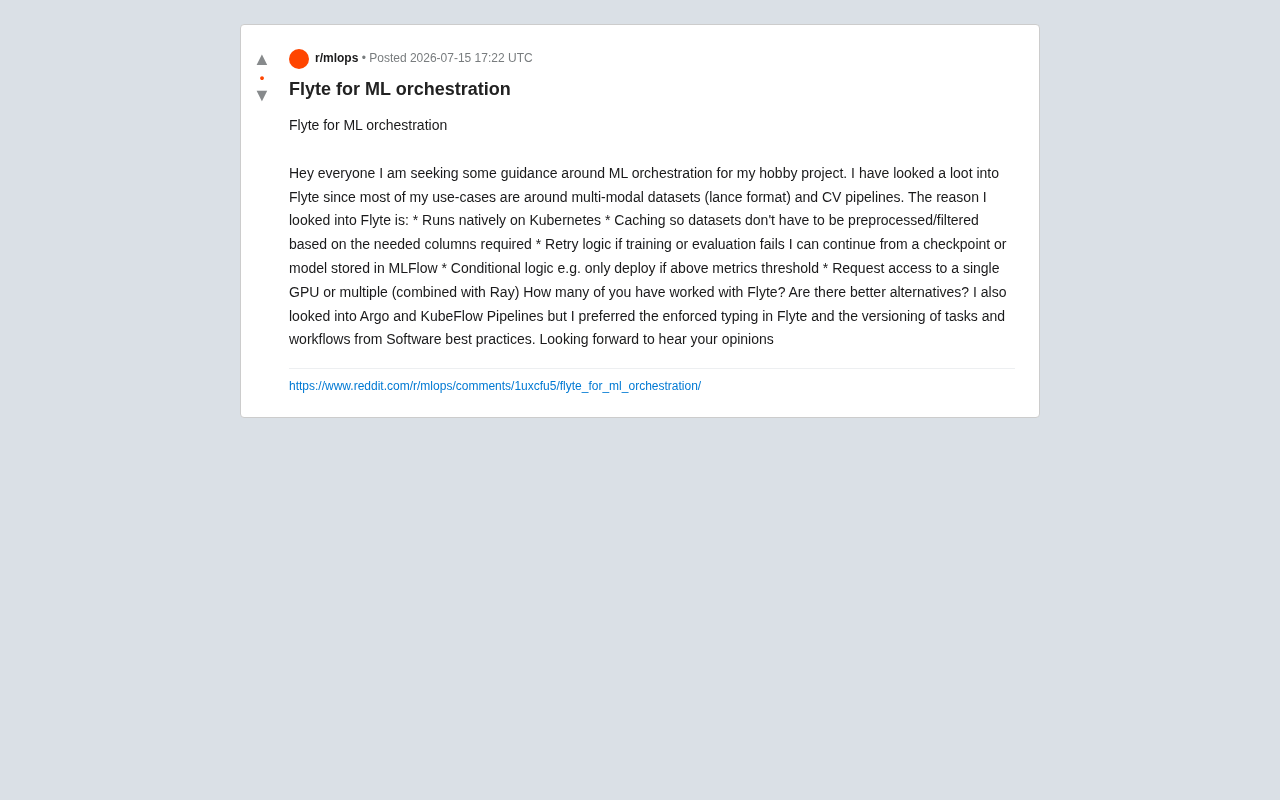
·3 min
Flyte Deep Dive: A Practical Guide to Choosing Your ML Workflow Orchestration Tool
Deep dive into Flyte's core capabilities: cloud-native GPU scheduling, intelligent caching, checkpoint recovery, and conditional deployment — plus a full comparison with Argo and KubeFlow Pipelines.
Read more →

·2 min
Symbolic AI and Neural Networks: A Systematic Learning Path and Core Mathematical Tools
A deep dive into symbolic vs. neural AI paradigms — exploring type theory, category theory, and algebraic geometry as mathematical bridges toward neuro-symbolic integration.
Read more →
Dense: An Open-Source ML Workbench Bui…
·2 min
Dense: An Open-Source ML Workbench Built for Neural Network Architecture Research
Dense is an open-source ML IDE for neural network architecture research. It integrates the DeltaImportance layer and architecture visualization to help researchers iterate faster and analyze network importance during the design phase.
Read more →
Best Laptops for AI/ML Students: A Dee…
·2 min
Best Laptops for AI/ML Students: A Deep Dive Comparing Three Popular Models
Lenovo LOQ, HP Omen, or MacBook Air M5? A deep dive comparing GPU performance, RAM, and CUDA compatibility to help AI/ML students find the right laptop.
Read more →