#Vercel Agent
186 related articles
 Product Reviews
·3 min
Trae 2.0 SOLO Mode In-Depth Review: Full Workflow from Natural Language to Website Deployment
In-depth review of ByteDance's Trae 2.0 SOLO mode: from natural language requirements to one-click website deployment. Covers memory, self-repair upgrades, and impact on Manus and Genspark.
Read more →
 Expert Opinions
·4 min
Rejecting Vibe Coding: Matt Pocock's Engineering-Driven Approach to AI Programming
TypeScript expert Matt Pocock's open-source Skills repo earned 80K+ GitHub Stars, using TDD and Domain-Driven Design to solve AI programming's three biggest pain points.
Read more →
 Tutorials
·4 min
Replit Agent Tutorial: Build and Launch an AI Website in 30 Minutes with Zero Code
Step-by-step tutorial on building an AI photography website with Replit Agent—no coding needed. Covers requirements, API setup, iteration, and one-click deployment for rapid MVP validation.
Read more →
 Product Reviews
·3 min
BuildingAI Open Source Project Deep Dive: Building AI Apps Like Stacking Blocks
Deep dive into BuildingAI, an open source block-based AI app builder with 1600+ Stars. Explore its architecture, use cases, and how it compares to Dify and Coze.
Read more →
 Product Reviews
·3 min
ChuanhuChatGPT: A Comprehensive Analysis of the 15K-Star Open-Source Multi-Model Chat Interface
Deep dive into ChuanhuChatGPT, a 15K-star open-source project with multi-model access, Agent support, RAG file Q&A, GPT fine-tuning, and web search.
Read more →
 Product Reviews
·2 min
A Comprehensive Analysis of the Sentra-Agent Framework: Building Production-Grade Conversational AI Agents with TypeScript
Deep analysis of Sentra-Agent, a modular TypeScript framework for building production-grade conversational AI Agents, covering architecture, design philosophy, and comparison with LangChain.js.
Read more →
 Product Reviews
·3 min
GSD-2 Open Source Project Deep Dive: How Meta-Prompting + Context Engineering Keep AI Agents Working Autonomously Without Drifting
Deep dive into GSD-2's three core technologies: meta-prompting, context engineering, and spec-driven development — solving the problem of AI agents drifting off-target during long tasks.
Read more →
 Product Reviews
·3 min
Agnix: The First Linter for AI Coding Assistant Configuration Files, with LSP Real-Time Validation
Agnix is the first Linter and LSP tool for AI coding assistant config files like CLAUDE.md and AGENTS.md. Built in Rust, it offers real-time validation, auto-fix, and IDE integration.
Read more →
 Tutorials
·3 min
Agentic Flow: A Guide to Low-Cost Model Switching in Claude Code and Production Agent Deployment
Deep dive into Agentic Flow, an open-source project enabling flexible low-cost model switching in Claude Code and one-click Agent deployment to cloud production environments.
Read more →
 Deep Dives
·3 min
Open Computer Use: An Open-Source Framework for AI Agents to Autonomously Control Computers
Open Computer Use is an open-source TypeScript AI agent framework enabling automated computer control via browser, terminal, and desktop. Learn about its features, architecture, and comparison with Claude Computer Use.
Read more →
 Tech Frontiers
·3 min
Swarm IDE: Open-Source Multi-Agent Collaborative Development Environment with 1500 Stars for Agent Orchestration
Swarm IDE is an open-source IDE for Agent Swarm multi-agent collaboration, supporting Kimi-2.5, GLM-4.7 and more models with visual orchestration, debugging and management capabilities.
Read more →
 Product Reviews
·2 min
LobeHub Open Source Project Deep Dive: How a Multi-Agent Collaboration Platform is Reshaping AI Workflows
Deep dive into LobeHub's open-source multi-agent collaboration platform, covering core features, technical architecture, and industry trends. Learn how this 75K+ Star GitHub project redefines human-AI collaboration through Agent team design and multi-agent coordination.
Read more →
 Product Reviews
·2 min
Deep Dive into LobeHub: The 76K-Star Open Source Multi-Agent Collaboration Workspace
Deep dive into LobeHub's open-source agent collaboration platform covering multi-Agent collaboration, agent marketplace, TypeScript architecture, and the multi-agent system trends behind its 76K stars.
Read more →
 Product Reviews
·2 min
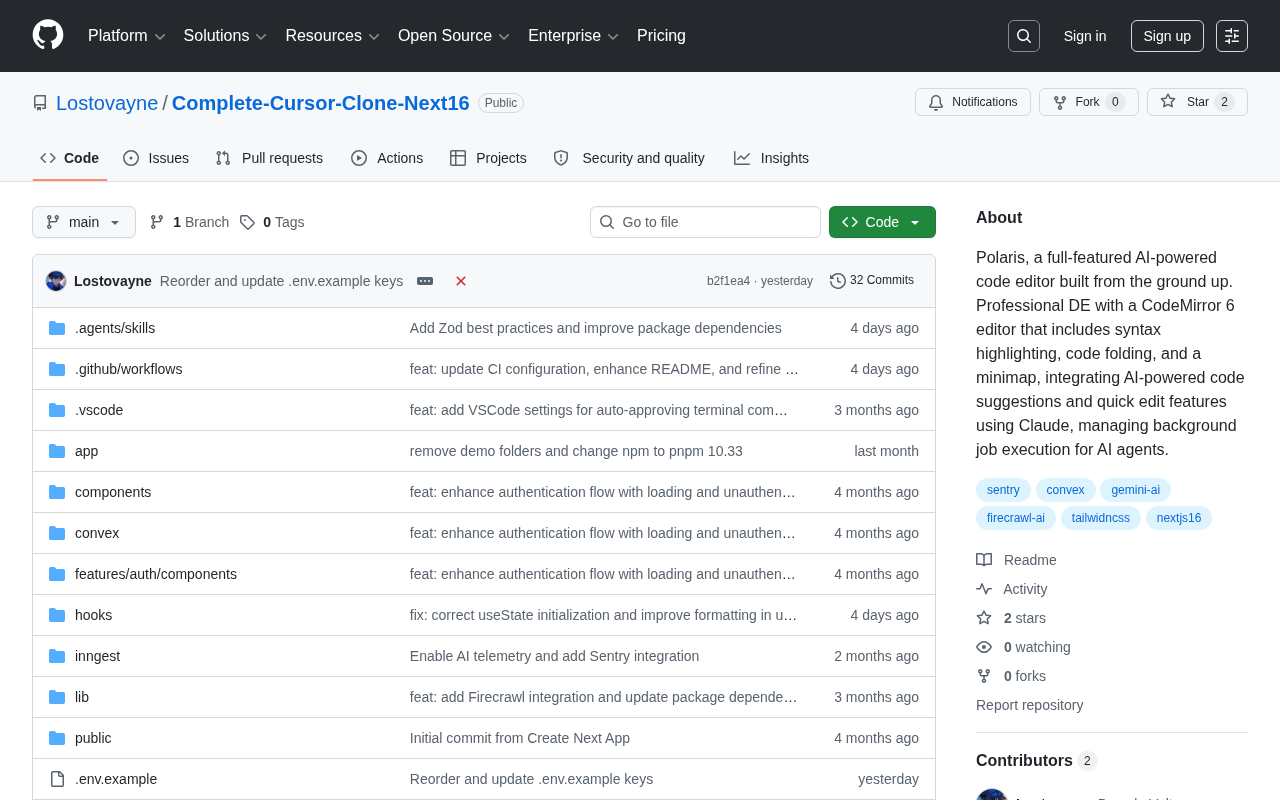
Polaris Open Source Project: Building a Cursor Clone AI Code Editor from Scratch
Deep dive into Polaris, an open-source AI code editor built from scratch with Next.js 16 and CodeMirror 6 to clone Cursor's core features, integrating Claude AI for intelligent completions and background agents.
Read more →
 Product Reviews
·3 min
Refly Open-Source Agent Skills Builder: A New Paradigm for Cross-Platform AI Skill Development
Deep dive into Refly, an open-source Agent Skills Builder featuring Vibe Workflow visual skill definition, cross-platform execution on Claude Code/Cursor, and a new "skills as infrastructure" paradigm for AI Agent development.
Read more →
 Product Reviews
·2 min
LobeHub Deep Dive: The Multi-Agent Collaboration Platform with 75K GitHub Stars
A deep dive into LobeHub, the open-source multi-agent collaboration platform with 75K+ GitHub stars. Explore its Find, Build, and Collaborate capabilities built on TypeScript.
Read more →
 Tech Frontiers
·2 min
LLM 0.32a0 Released: Message Sequences and Typed Streaming Refactor Explained
Simon Willison releases LLM 0.32a0 alpha with message sequence modeling and typed streaming parts, supporting multimodal output and conversation history injection while maintaining backward compatibility.
Read more →
 Product Reviews
·3 min
TalkToFigma MCP: An Open-Source Tool That Lets AI Directly Manipulate Figma Designs
TalkToFigma is an open-source MCP tool that lets AI agents like Cursor and Claude Code directly read and modify Figma designs. Supports design-to-code, batch styling, and design system maintenance.
Read more →
 Product Reviews
·3 min
Codexia Open-Source Tool Explained: A Multi-AI Coding Agent Collaboration Workstation
Deep dive into Codexia, an open-source AI coding agent workstation supporting Codex CLI and Claude Code multi-agent collaboration with task scheduling, Git Worktree parallel development, remote control, and skill management.
Read more →
 Deep Dives
·3 min
LLM 0.32 Refactoring Deep Dive: Message Sequence Input and Typed Streaming Response Design
Deep dive into Simon Willison's LLM 0.32a0 refactoring: message sequence inputs, typed streaming events, SQLite-decoupled serialization, and backward-compatible API evolution strategies.
Read more →