#algebraic number theory
21 related articles

·3 min
Ten Breakthroughs in Mathematics and Theoretical Computer Science and Their Far-Reaching Impact
An in-depth look at ten major advances in mathematics and theoretical computer science, covering complexity theory, combinatorics, and derandomization, and how they impact cryptography, AI training, and quantum computing.
Read more →

·4 min
OpenAI Allegedly Constructs First Nonsofic Group: A Core Problem in Group Theory May Be Resolved
OpenAI has allegedly completed the first construction of a nonsofic group in mathematical history. If proven valid, this would resolve a core open problem in group theory that has stood for over twenty years.
Read more →

·3 min
Maxwell Conjecture Disproven: GPT Produces Counterexample That Shakes the Math World
GPT 5.6 allegedly constructed a counterexample disproving the long-standing Maxwell Conjecture. We analyze the conjecture, what the AI counterexample means, and the math community's cautious response.
Read more →

·4 min
Deep Dive into the EYG Programming Language: A New Portable Programming Paradigm Designed for Humans
Deep analysis of the EYG programming language's core design, including algebraic effects, program state persistence, and cross-platform portability, exploring how it addresses modern software fragmentation.
Read more →
·3 min
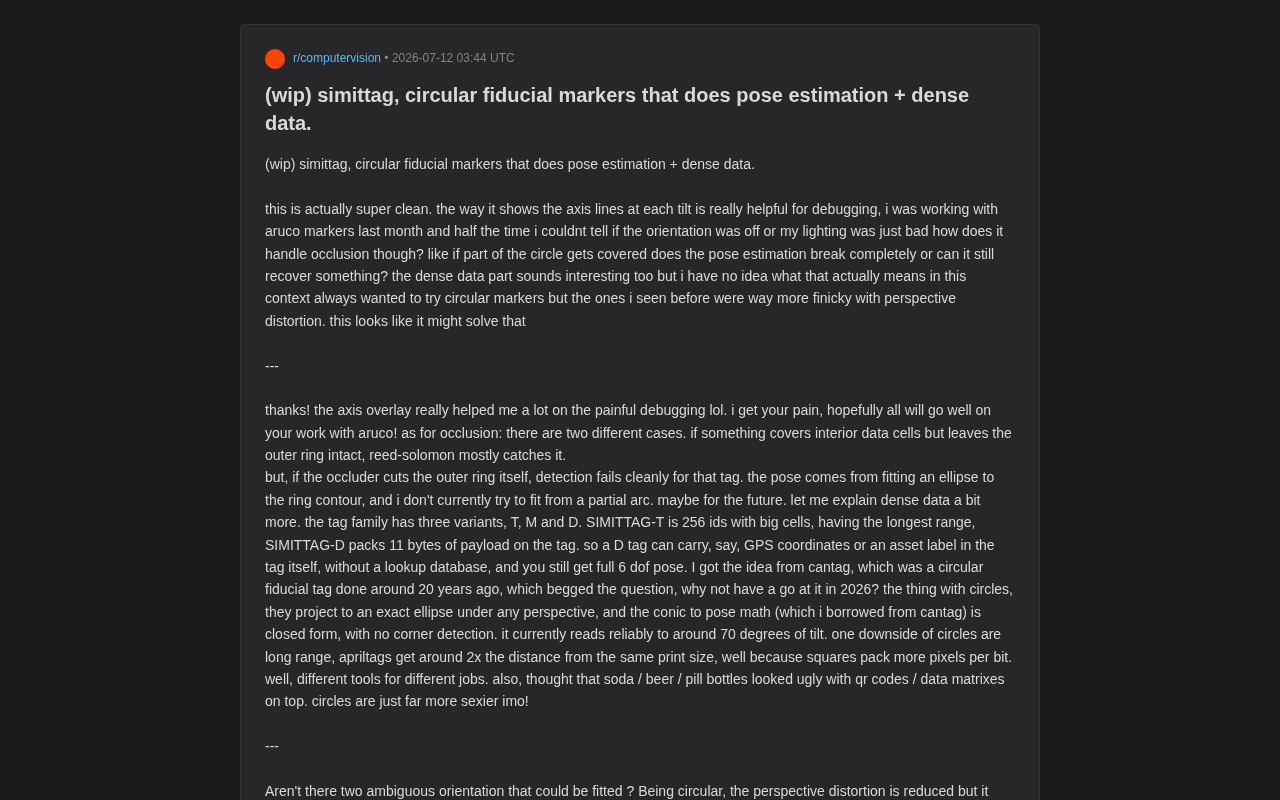
SIMITTAG Circular Fiducial Markers: Reimagining Pose Estimation with Ellipse Mathematics
SIMITTAG is a circular fiducial marker project for pose estimation that uses closed-form ellipse math instead of corner detection, supports 11-byte payloads with Reed-Solomon error correction, and compares favorably to ArUco and AprilTag in specific use cases.
Read more →
·7 min
Auditing Cryptographic Libraries with AI: What We Found in Cloudflare's CIRCL
An in-depth look at using AI LLMs to audit Cloudflare's open-source cryptographic library CIRCL, covering constant-time detection, side-channel vulnerabilities, and human-AI collaboration.
Read more →

·3 min
AI Is Conquering World-Class Math Conjectures — Will Mathematicians Become "Curators"?
AI is cracking world-class math conjectures at scale — from IMO gold medals to the Langlands Program. Terence Tao says math has entered a "proof abundance" era, but AI can't judge research significance. The mathematician's edge is shifting from proving to curating.
Read more →

·3 min
SQLite STRICT Tables Explained: The Type Enforcement Debate and Best Practices
Deep dive into SQLite STRICT tables: is flexible typing a feature or flaw? Covers the author's stance, type vs. validation debate, Turso alternatives, and best practices for type-safe database design.
Read more →

·4 min
RAM: First-Principles Approach to 50x Faster RL Post-Training for Diffusion Models
RAM (Reinforce Adjoint Matching) achieves 50x faster RL post-training for diffusion models by discarding path costs, combining ODE sampling with decorrelated training objectives. A deep dive into RAM's core principles and experiments vs. Flow-GRPO.
Read more →

·3 min
AI Cracks a 50-Year Math Problem in Under an Hour: A Deep Dive into GPT-5.6 and the Cycle Double Cover Conjecture
OpenAI's latest AI model solved the 50-year-old Cycle Double Cover Conjecture in under an hour. We break down the three-tier architecture, 64-agent workflow, and what this means for math.
Read more →
Paper Reproduction as an Entry Point i…
·4 min
Paper Reproduction as an Entry Point into Scientific Machine Learning: Path Selection and Pitfall Guide
How can applied math students efficiently enter Scientific Machine Learning (SciML)? This guide covers the value and pitfalls of paper reproduction, with a layered path from numerical PDEs to research.
Read more →

·7 min
AI Agent Runs a Fully Automated Chess Channel: A Real-World Practice of Combining LLMs with Engines
A German engineer built a fully automated chess YouTube channel with an AI Agent, combining LLMs and chess engines to auto-generate explainer videos nightly, reaching 500K views. Here's the tech architecture, tool design, and real costs.
Read more →
Can AI Prove Mathematical Conjectures?…
·5 min
Can AI Prove Mathematical Conjectures? The Truth Behind the GPT-5.6 Incident and the Limits of Large Language Models
A PDF claiming GPT-5.6 Sol Ultra proved the Cycle Double Cover Conjecture sparked debate on Hacker News. We unpack the truth and the limits of LLMs in math proofs.
Read more →

·8 min
GPT-5.6 Hands-On: Farm Automation, Mathematical Breakthroughs, and End-to-End AI Execution
GPT-5.6 (Sol, Terra, Luna) hands-on testing: a Hokkaido farmer controls a greenhouse with AI, a NYC small business builds custom software, and a Polish mathematician breaks a 3-year problem. A deep dive into end-to-end autonomous execution.
Read more →

·3 min
Triple Dragon Fractal: Recursive Generation and the Beauty of Symmetry in Dragon Curves
Explore the math behind the Triple Dragon Fractal: from paperfolding dragon curves to L-systems, threefold symmetry, Hausdorff dimension, and fractal programming.
Read more →
Leanstral 1.5: AI-Assisted Formal Proo…
·3 min
Leanstral 1.5: AI-Assisted Formal Proofs, Making Lean Theorem Verification Accessible to All
Leanstral 1.5 combines LLMs with Lean theorem proving to lower the barrier to formal proofs. Explore its core value, technical approach, and how AI can make formal mathematics accessible to all.
Read more →

·3 min
OpenAI Cracks Erdős Unit Distance Conjecture: AI Independently Disproves 80-Year-Old Math Problem for the First Time
OpenAI's general reasoning model independently disproved Erdős's 1946 unit distance conjecture without human guidance—the first time AI has autonomously solved a core open math problem, verified by nine top mathematicians.
Read more →
 Industry Insights
·2 min
Sam Altman's Three AGI Visions: From Scientific Breakthroughs to Personal AI Assistants
Sam Altman shares OpenAI's three strategic directions: AGI accelerating research, partnering with YC to empower startups, and building personal AGI assistants. A deep analysis of OpenAI's complete AGI deployment path.
Read more →
 Research
·2 min
OpenAI Overturns 80-Year Discrete Geometry Conjecture: How AI Solved the Unit Distance Problem
OpenAI's model overturns an 80-year-old conjecture in discrete geometry's Unit Distance Problem, marking a new era of AI-driven mathematical research.
Read more →
 Research
·2 min
AI Cracks Erdős's Planar Unit Distance Problem for the First Time: A Landmark Breakthrough in Mathematical History
AI solves Erdős's famous Planar Unit Distance Problem for the first time—a landmark breakthrough in combinatorial geometry. Deep analysis of how AI surpassed human mathematicians.
Read more →