#automated trading
131 related articles

·3 min
Open-Source vs Closed-Source Models, Reward Hacking & Benchmark Gaming: A Deep Dive into Core AI Model Technical Issues
Deep analysis of six core AI model issues: open-source vs closed-source models, inference throughput vs accuracy tradeoffs, benchmark gaming, distillation vs RL, reward hacking defenses, and dynamic quantization technology.
Read more →

·3 min
Open Secure AI Alliance Launched: Building AI Safety on an Open-Source Foundation
The Open Secure AI Alliance launches with NVIDIA and other tech giants, building AI agent security through open-source model weights, safety evaluations, and frontier research for industry-wide standards.
Read more →

·2 min
Dynamic Workflows: A New Paradigm for AI-Driven Quantitative Strategies
Explore how dynamic workflows are transforming quantitative strategy development. From agent orchestration to adaptive strategy iteration, discover the potential and challenges of AI-driven workflows.
Read more →

·3 min
AI Replacing Programmers? This Prediction Has Been Made for 60 Years and Never Come True
From the 1960s to today, the prediction that AI will replace programmers has repeatedly appeared yet never come true. This article reviews 60 years of programming history and explains why developers remain valuable.
Read more →

·3 min
Perplexity Comet's Declining Agent Capabilities: Why This AI Browser Is Becoming Timid
Perplexity Comet users report declining AI agent capabilities, with form-filling and automation tasks frequently refused. We analyze the causes from anti-automation detection, compliance risks, and model policy tightening perspectives.
Read more →

·2 min
GLEE Competition: A Detailed Guide to the NeurIPS 2026 Official Negotiation AI Challenge
NeurIPS 2026 GLEE Competition challenges AI agents to negotiate in real-time via natural language, covering bargaining, persuasion, and game strategies. Full guide on rules, approaches, and prizes.
Read more →

·2 min
Screen Awesome: A Privacy-First Screen Recorder That's Architecturally Incapable of Uploading Your Videos
Screen Awesome is a Chrome screen recording extension with zero host permissions, making video uploads architecturally impossible. Free, no watermarks, with auto-zoom, vector annotations, and scrolling screenshots.
Read more →

·2 min
Finyuus: A Deep Dive into the Code-First AI Workflow Governance Language
Deep dive into Finyuus, an open-source code-first AI workflow governance language built on Temporal with agent orchestration, Guards, human approvals, and Langfuse observability.
Read more →

·3 min
Driven: A Deep Dive into the AI Investment Agent That Connects the Entire Research-to-Execution Pipeline
Deep dive into Driven, the AI investment agent that connects the entire research-to-execution pipeline through 260+ API integrations, custom Skills, and Playbooks.
Read more →

·3 min
Reflections After 10 Years as a Data Engineer at Airbnb: A Deep Retrospective on Semantic Layer Development and Data Culture
A data engineer reflects on nearly 10 years at Airbnb, sharing insights on hyper-growth challenges, semantic layer development, data-driven culture, and career lessons spanning a complete company lifecycle.
Read more →

·4 min
Walsh Multi-Agent Trading System: How Risk Management Veto Power Ensures AI Autonomous Decision-Making Safety
Deep dive into the Walsh multi-agent trading system architecture, exploring how its risk management agent with veto power establishes safety boundaries for AI autonomous decision-making.
Read more →

·3 min
Complete Guide to Self-Hosted Search Engines: SearXNG and Alternative Deployment Options
A detailed guide to self-hosted search engine solutions including SearXNG metasearch engine deployment, plus alternatives like Whoogle, LibreY, and 4get for privacy-preserving search.
Read more →

·4 min
Cross-Cloud GPU Preemption Migration: How to Slash 40% of Compute Costs
Deep analysis of how cross-cloud GPU preemption migration technology helps MLOps teams cut 40% of compute costs through predictive telemetry, cross-cloud state migration, and compute arbitrage.
Read more →

·2 min
Tally: A Browser-Based Spreadsheet Data Provenance and Verification Tool
Tally is a browser-based spreadsheet verification tool that automatically checks numbers against original sources like PDFs. This article analyzes its core features, technical architecture, and value for financial auditing and data validation.
Read more →

·2 min
Vela Review: The AI Assistant That Takes Over Recruiting Coordination with Just a CC
Vela is an AI recruiting coordinator that takes over interview scheduling, candidate follow-ups, and rescheduling by simply CC'ing it on emails. Supports email, SMS, WhatsApp across all time zones 24/7.
Read more →

·3 min
Gemini Managed Agents API Update: Environment Hooks and Free Tier Fully Explained
Google Gemini Managed Agents API introduces environment hooks, model selection, free tier support, and default model upgrades—empowering AI Agent developers with stronger execution control and lower barriers to entry.
Read more →

·3 min
Kimi K3 Open-Source Release: 2.8 Trillion Parameters Tops Global Programming Leaderboard
Moonshot AI's Kimi K3 launches with 2.8 trillion parameters, tops LMArena frontend coding leaderboard as world #1, completing tasks at one-third competitors' cost. Fully open-source for commercial use.
Read more →
·4 min
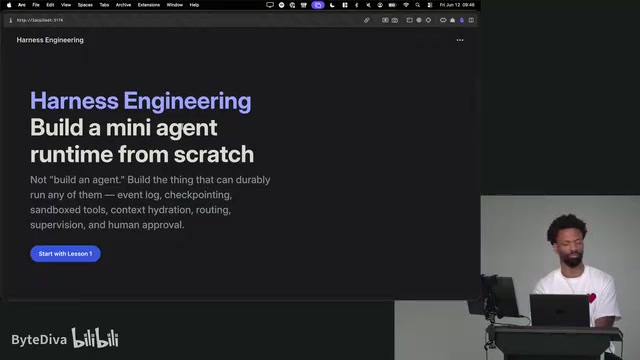
Harness Engineering: The Core Infrastructure for Taking AI Agents from Demo to Production
Deep dive into Harness Engineering: why AI Agents need memory management, durable execution, guardrails & approvals to go from demo to production.
Read more →

·4 min
Harness Engineering: The Core Infrastructure for Taking AI Agents from Demo to Production
Deep dive into Harness Engineering: why AI Agents need memory management, durable execution, guardrails & approvals to reach production. Based on Scott Moss's workshop.
Read more →

·3 min
AI Research Automation: More Like Data Cleaning Than Inventing the Transformer
Why AI research automation looks more like data cleaning than inventing the Transformer. Exploring the value of automating 60%-80% of repetitive research work and how human-AI collaboration reshapes the research paradigm.
Read more →