#content syndication
27 related articles

·2 min
Vao2 Open-Source Information Aggregator: Local AI Summaries + Multi-Source RSS Integration with a Privacy-First Approach
Vao2 is an open-source personal information aggregator combining news, YouTube, GitHub, and RSS into one feed with Ollama-powered local AI summaries for privacy-first, zero-cost usage.
Read more →

·4 min
BB1 Robot News Reporter: Using AI to Combat Algorithmic Filter Bubbles
A developer spent years building BB1, a DIY robot news reporter using AI to surface humanitarian crises ignored by algorithms. Exploring filter bubbles, attention economics, and AI as counter-tool.
Read more →

·2 min
Fedica 2.0 Deep Dive: Cross-Platform Social Media Audience Intelligence & Growth Tool
Deep dive into how Fedica 2.0 leverages 15 years of audience intelligence to deliver customized publishing across 12+ platforms, audience segmentation, and unified engagement management for creators.
Read more →

·3 min
The Attention Economy: How Algorithms Steal Your Focus in the Digital Age
Deep analysis of how the attention economy works, revealing how social media and recommendation algorithms hijack your brain through addiction mechanisms, with practical strategies to reclaim your focus.
Read more →

·3 min
Peek: An Open-Source Android Tool for Viewing Instagram and Other Social Media Links Without Logging In
Peek is an open-source Android app that lets users view Instagram Reels, posts, and other social media links without logging in, bypassing login walls and pop-up interruptions.
Read more →
·3 min
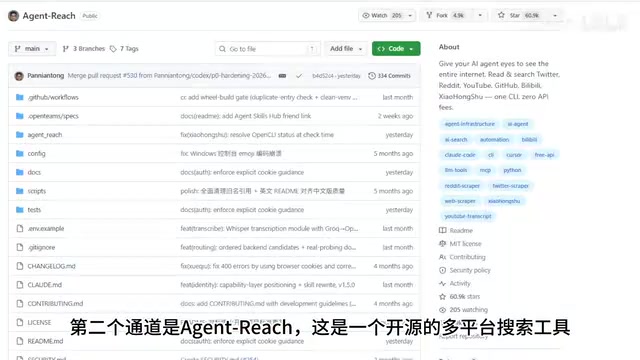
Open-Source Automated News Briefing Generator: A Zero-Technical-Barrier AI Deployment Analysis
An open-source automated news briefing system. No coding needed—just let an AI read the project docs to complete the entire deployment. Six-stage pipeline, four-channel search covering 16+ platforms, smart classification and dedup, daily auto-push to Feishu, completely free.
Read more →

·3 min
Open-Source Newsletter Auto-Generation System: A No-Code AI Deployment Breakdown
An open-source newsletter auto-generation system requiring no coding—just have AI read the project docs to complete deployment. Six-stage pipeline, four-channel search covering 16+ platforms, smart classification & deduplication. Completely free.
Read more →

·2 min
Local AI Agent Reads arXiv So You Don't Have To: Only the Papers That Actually Matter
Research Radar is an open-source local AI agent that fetches arXiv papers daily, scores and filters them in batches, deep-reads summaries, and pushes truly relevant content via Telegram. Supports local models, keeps data on your machine, free and self-hostable.
Read more →

·4 min
Chrome DevTools MCP Hands-On: Using AI to Automatically Control a Browser, Write Articles, and Publish Them
Hands-on test of Chrome DevTools MCP with Claude Code: AI automatically opens a browser, writes an article, fills in tags, and publishes — full workflow breakdown with pros and cons analysis.
Read more →

·2 min
The Golden Age of the Early Internet: What Did We Really Lose?
From GeoCities homepages to algorithmic filter bubbles, the early internet's spirit of openness and creativity is fading. Can the AI era bring it back?
Read more →

·4 min
OpenAI Codex Desktop Experience: A Zero-to-Hero Guide for AI Programming
A detailed hands-on experience with OpenAI Codex Desktop, covering interface features and real-world examples. Free users can try it now with parallel tasks and natural language programming.
Read more →
 Expert Opinions
·4 min
In the Vibe Coding Era, Why Do We Need RSS for Distributing Personal Apps?
Vibe Coding makes building apps as easy as writing blog posts, but personal tools lack good distribution channels. This article explores using RSS as a lightweight app distribution protocol.
Read more →
 Expert Opinions
·2 min
In the Vibe Coding Era, Using RSS to Share and Discover Personal Apps
AI-assisted programming makes building tools as easy as blogging, but how are these personal apps discovered? Matt Webb proposes RSS for vibe-coded apps, and Simon Willison quickly validates the idea.
Read more →
 Expert Opinions
·3 min
In the Vibe Coding Era, Why We Need RSS to Share Personal Apps
AI programming makes building micro-apps as easy as blogging, but distribution is the new bottleneck. Matt Webb proposes RSS for sharing vibe-coded apps, and Simon Willison is already doing it.
Read more →
 Expert Opinions
·2 min
The Vibe Coding Era: Why We Need RSS to Share Personal Micro-Apps
Vibe coding makes AI programming as simple as blogging, driving an explosion of personal micro-apps. Matt Webb proposes RSS for sharing micro-apps, and Simon Willison has already implemented it.
Read more →
 Expert Opinions
·2 min
The Vibe Coding Era: Why We Need RSS to Distribute Personal Apps
As vibe coding makes app development as easy as blogging, personalized micro-tools are proliferating. This article explores why RSS/Atom is the ideal solution for app discovery and distribution in the AI-assisted programming era.
Read more →
 Product Reviews
·2 min
Simon Willison Used Claude Code on His Phone to Add Wildlife Sightings to His Blog
Simon Willison used Claude Code's web version on his phone to integrate a decade of iNaturalist wildlife observations into his blog, showcasing AI-assisted mobile development.
Read more →
 Expert Opinions
·2 min
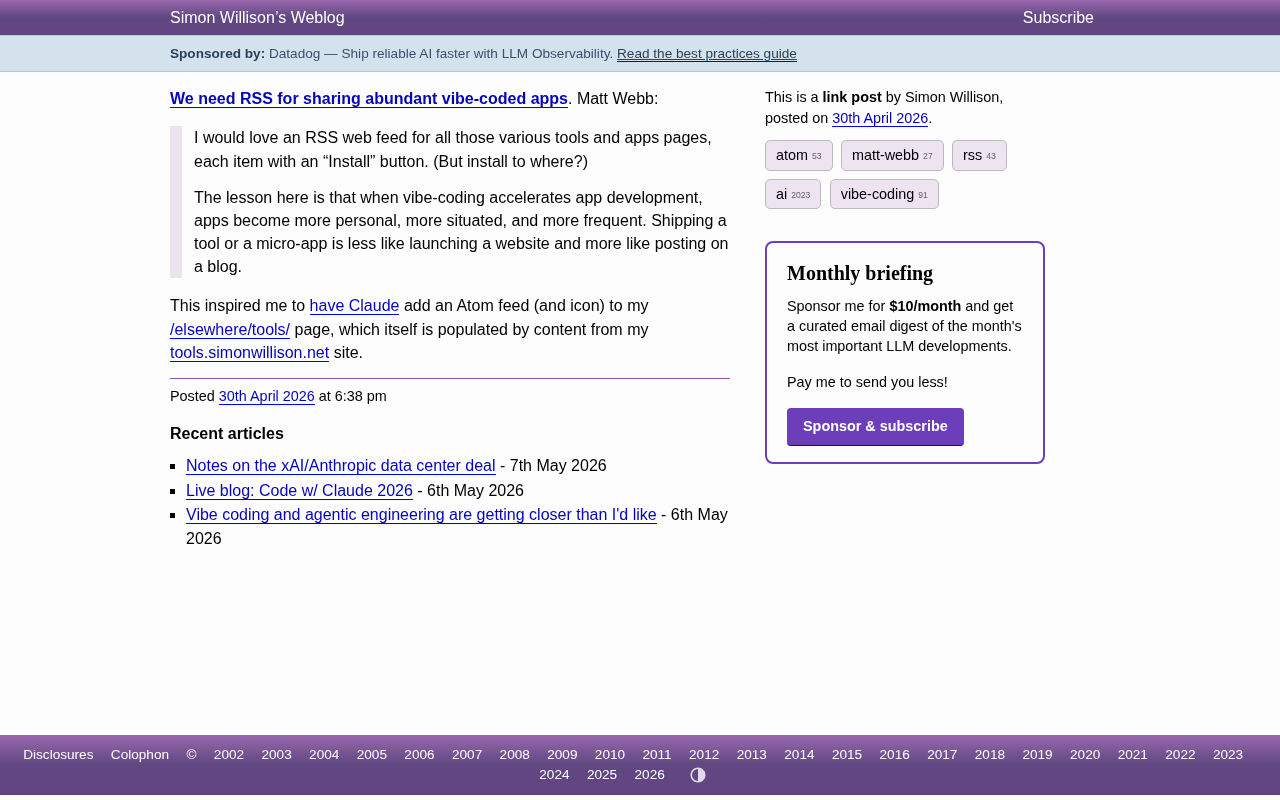
The Vibe Coding Era: Why We Need RSS to Distribute Personal AI Apps
As vibe coding makes app development as frequent as blogging, we need lightweight mechanisms like RSS to discover and share personal AI tools. Exploring the future infrastructure of AI app distribution.
Read more →
 Product Reviews
·2 min
Full Record: Simon Willison Develops Blog Wildlife Sighting Feature Using Claude Code on His Phone
Simon Willison used Claude Code on his phone to build an iNaturalist wildlife sighting sync feature for his blog, backfilling a decade of data. A deep dive into the technical details and AI-assisted mobile development.
Read more →
 Expert Opinions
·2 min
The Vibe Coding Era: Why We Need RSS to Share Personal Micro-Apps
AI coding makes building micro-apps as easy as blogging, but how do we share them? Matt Webb proposes RSS for distributing vibe coding output, and Simon Willison has already put it into practice.
Read more →