#dynamic app icons
57 related articles

·2 min
MascotAI: AI-Powered Animated SVG Mascot Generator That Brings Brand Personality to Your App
MascotAI is an AI-powered animated SVG mascot studio for indie developers, offering editable, interactive vector mascot packs with gestures, themes, and modular parts.
Read more →

·4 min
Tiling Window Management: A New Interaction Paradigm for Multi-Agent Conversations
Exploring tiling window management for multi-agent AI conversations: how it solves parallel monitoring and observability challenges, real-world limitations, and the evolution from chat boxes to control consoles.
Read more →

·3 min
Canvas + SVG Path Animation: A Complete Guide to Smooth Element Motion Along Curves
Learn how to combine Canvas and SVG for smooth path animations using getPointAtLength, easing functions, and coordinate caching for data visualization and interactive effects.
Read more →

·2 min
Pulse Island: The Productivity Tool That Turns Your Mac's Notch Into a Dynamic Island
Pulse Island transforms MacBook's notch into an iPhone-like Dynamic Island, integrating music control, meeting reminders, clipboard management, weather, focus timer, and system monitoring.
Read more →

·2 min
CodexBar Lite: An Open-Source macOS Menu Bar Tool for Monitoring Codex Usage
CodexBar Lite is a privacy-first macOS menu bar app that reuses Codex CLI sessions for real-time usage monitoring — no API Key or browser cookies needed. Open-source and built for security-conscious developers.
Read more →

·2 min
AI Emotional Dependency: A Reddit Help Post Reveals a Deeper Crisis
A Reddit user's emotional breakdown over sudden AI output changes reveals deep issues around AI emotional dependency, silent model updates, and product responsibility boundaries.
Read more →

·5 min
Running GPT-5.6 Inside Claude Code: Best Practices for Subagent Orchestration and System Prompts
Deep dive into running OpenAI GPT-5.6 inside Claude Code: comparing Codex vs Claude Code on subagent orchestration, workflow design, and system prompt quality, revealing how harness engineering determines model output.
Read more →

·3 min
In-Depth Analysis of Three AI Test Automation Approaches: Code Scripting, DOM Parsing, and Visual Models
A systematic breakdown of the three mainstream test automation approaches in the AI era: AI-generated code scripts, DOM parsing driven, and LVM visual model driven. In-depth comparison of principles, pros/cons, and use cases.
Read more →

·3 min
Zhipu's Mobile AI Agent Tested: A Full Breakdown of the Cloud Phone Approach — Capabilities and Limitations
Hands-on test of Zhipu's mobile AI Agent: using a cloud phone to bypass permission limits, it supports natural language-driven automation. We cover its core mechanics, real performance, app restrictions, and future potential.
Read more →
·3 min
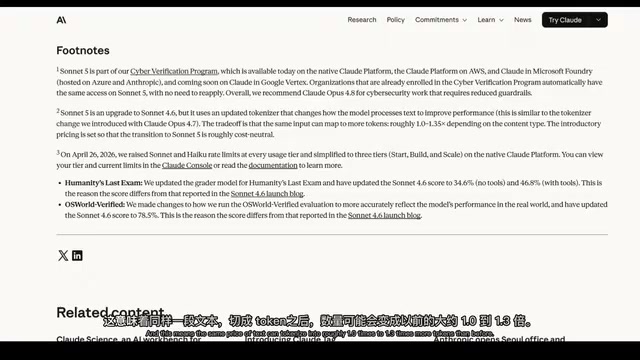
Claude Sonnet 5 Deep Dive: Impressive Benchmarks, Questionable Value — Just Use Opus 4.8?
Claude Sonnet 5 review: 63.2% SWE-bench, near Opus 4.8 performance, but new tokenizer hides real costs. Ranks 13th on CursorBench. Most tasks: stick with Opus 4.8.
Read more →
·3 min
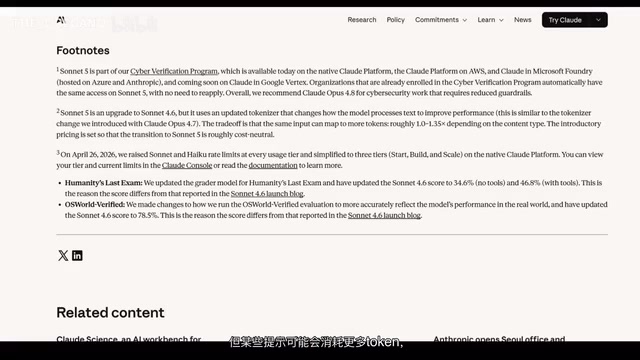
Claude Sonnet 5 Deep Dive: Impressive Benchmarks, Disappointing Reality — Stick with OPUS 4.8
Anthropic's Claude Sonnet 5 claims near-OPUS 4.8 performance at lower cost. Real-world tests reveal hidden tokenizer costs, weak creative output, and only 13th place on Cursor rankings.
Read more →

·2 min
How to Remove Floating AI Assistants in Your Browser: 3 Steps to Eliminate Annoying Web Popups
Floating AI assistant icon appearing on every website? Follow these 3 steps to find and remove it — from browser extensions and Edge Copilot to adware — and reclaim your browsing experience.
Read more →

·3 min
iOS 27 In-Depth Review: Five Major New Features Tested and Analyzed
iOS 27 deep dive: AI photo Extend & Spatial Reframe, a rebuilt Siri with personal data access, 30%+ system-wide speed gains, and long-overdue quality-of-life fixes — all tested and explained.
Read more →
Voice-Driven Geometric Interaction: LL…
·2 min
Voice-Driven Geometric Interaction: LLM Semantic Parsing and Function Calling Architecture in Practice
How can LLMs translate natural language into geometric operations? This article breaks down a voice-driven geometry system: LLM for semantic parsing, Function Calling to bridge the geometry SDK.
Read more →

·7 min
Building a Published App with Zero Code in Four Days: A Complete HarmonyOS Development Journey
A tech blogger with zero programming knowledge built a retro DV app in four days using AI tools like Cursor and Codex, and got it published on Huawei App Gallery. A full vibe coding walkthrough.
Read more →
·3 min
Tencent Hunyuan HY3 In-Depth Review: How a Small Open-Source Model Punches Above Its Weight
In-depth analysis of Tencent's open-source reasoning model Hunyuan HY3: MoE architecture, 295B total params, Apache 2.0 license, coding & front-end rivaling DeepSeek V4 Pro at 1/35 the cost.
Read more →

·3 min
GPT 5.6 + Codex In-Depth Review: Three-Tier Models and Ultra Mode Fully Explained
GPT 5.6 updates Codex with Sol/Terra/Luna model tiers, Ultra thinking mode, 350K context, and stronger autonomous loops. Full hands-on review of all core upgrades.
Read more →

·4 min
Claude Sonnet 5 In-Depth Review: Impressive Performance, but Hidden Traps in the Pricing Strategy
A full review of Claude Sonnet 5: major agentic gains, benchmarks near Opus 4.8, but a Tokenizer switch inflates real costs, nearly erasing the price gap with Opus. We break down the pricing traps.
Read more →

·5 min
Getting Started with AI Agents: Concepts, Architecture, and Core Components Explained
What is an AI Agent? Starting from Bill Gates' claim about the computing revolution, this article explores AI Agents' intuitive concepts, four core components (LLM+Planning+Memory+Tools), and what Agent development means for programmers.
Read more →

·3 min
Getting Started with AI Agent Development: A Complete Learning Path to Building Intelligent Applications from Scratch
AI Agents are reshaping software development with 42.8% market CAGR. Learn the difference between Agents and traditional AI, plus a complete LangChain-based curriculum to launch your career in intelligent agent development.
Read more →