#local LLM deployment
1242 related articles
 Tutorials
·5 min
Ollama Tutorial: One-Click Local Deployment of DeepSeek and Other LLMs
Ollama is an open-source tool with 170K+ GitHub Stars for running DeepSeek, Qwen, Gemma and other LLMs locally. Learn installation, supported models, use cases and core advantages.
Read more →
 Product Reviews
·3 min
The Complete Guide to AnythingLLM: A Privacy-First AI Knowledge Base Tool for Local Deployment
Deep dive into AnythingLLM, an open-source AI tool with 59K+ GitHub Stars. Supports local LLM inference, RAG private knowledge base Q&A, and zero-config setup. Explore core features, use cases, and architecture.
Read more →
 Tutorials
·2 min
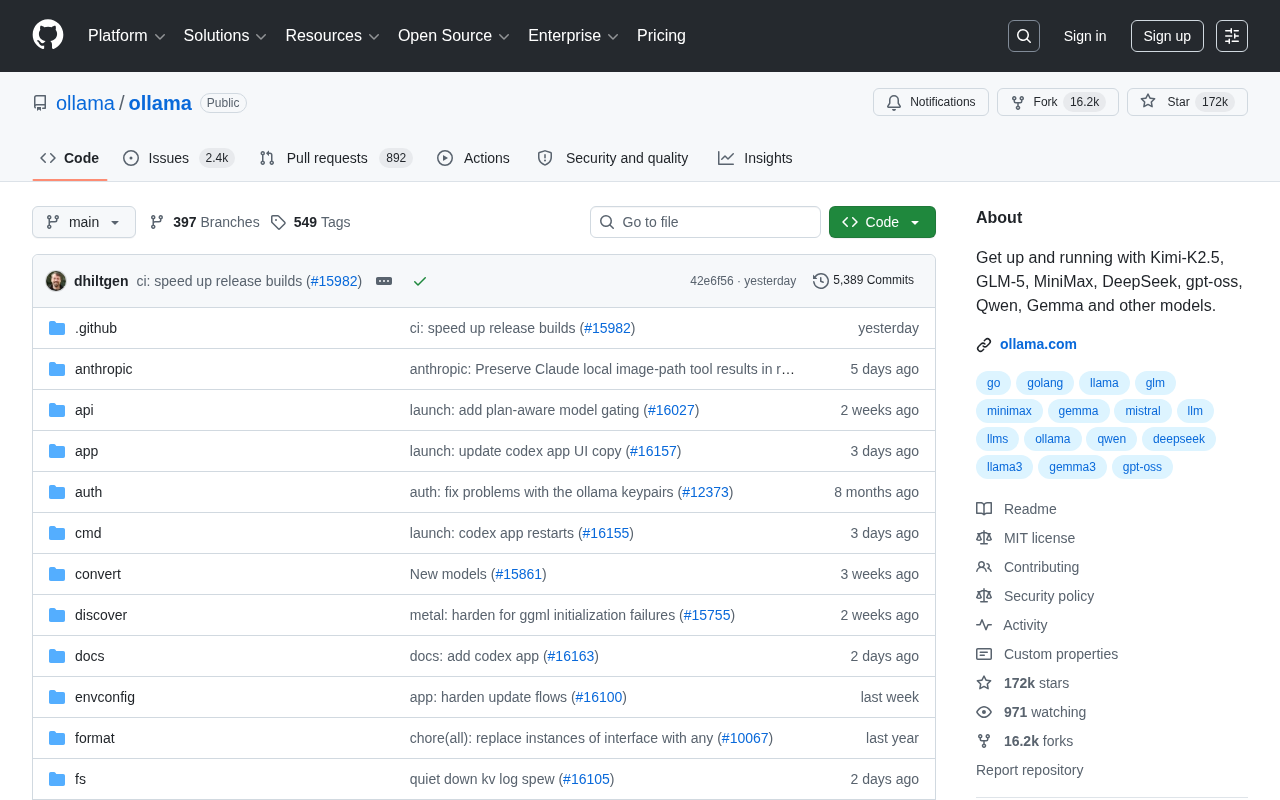
Ollama Local LLM Deployment Guide: The 170K-Star Open Source Tool That Runs DeepSeek, Qwen, Kimi, and More
Ollama is a 170K-star open source tool for local LLM deployment. Run DeepSeek, Qwen, Kimi-K2.5, GLM-5 and more with one command. Learn its advantages and setup.
Read more →

·3 min
Domo: An AI Agent That Manages Your Family Calendar via Text Message — A Zero-Barrier Blueprint for Building Your Own Agent
Domo is a family calendar AI assistant running on Claude subscriptions. Add events via text message with an always-on wall dashboard. An open-source, replicable blueprint for building personal AI agents.
Read more →

·2 min
Finyuus: A Deep Dive into the Code-First AI Workflow Governance Language
Deep dive into Finyuus, an open-source code-first AI workflow governance language built on Temporal with agent orchestration, Guards, human approvals, and Langfuse observability.
Read more →

·3 min
Quantprobe: An Open-Source Tool for Running 30B LLMs on 6GB GPUs
Quantprobe is an open-source memory optimization framework that enables 30B LLMs to run at 22 tokens/s on 6GB GPUs through per-layer quantization and intelligent CPU/GPU splitting.
Read more →

·2 min
LangGraph Studio Hidden Features: Practical Tips for Visually Debugging Agent Workflows
Explore LangGraph Studio's hidden features including time travel debugging, interactive state editing, and human-in-the-loop testing to efficiently debug AI Agent workflows.
Read more →

·2 min
Qwen3.8-Max Preview Continues Iterating with Major Improvements in Frontend Development Capabilities
Alibaba's Qwen3.8-Max-Preview iterates daily with significant frontend development improvements. The team uses an open preview strategy to collect community feedback, promising open-weight release.
Read more →

·2 min
Ollama Shifting from Local Deployment to Cloud Services? Community Controversy and the Open-Source Commercialization Dilemma
Ollama's recent brand shift from local LLM deployment to cloud API services sparks heated Reddit debate. Analyzing the capital logic, community concerns, and what open-source AI tool users should know.
Read more →

·3 min
Comparing China's Four Major AI Labs: Strategic Analysis of Qwen, DeepSeek, Moonshot, and Ling
An insider's analysis of China's four AI labs — Qwen, DeepSeek, Moonshot, and Ling — revealing their distinct strategic bets on distribution, architecture, long-termism, and serving cost.
Read more →

·4 min
Running an 80B Large Model on Mac with Only 4.3GB of Memory: Extreme Compression Techniques Explained
Deep dive into how an 80B-parameter LLM runs on Mac with only 4.3GB memory, covering ultra-low-bit quantization, sparsity, memory mapping, and implications for privacy and edge AI.
Read more →

·3 min
Open Source Wins: How China Is Using Open Source Strategy to Dominate the Second Half of AI
Chinese open-source AI models are rapidly rising with near-top performance at fraction of cost, dominating local deployment. As the gap shrinks to single digits and OpenAI cuts prices, open source is reshaping AI competition.
Read more →

·2 min
New Model Arrives on OpenRouter Aggregation Platform: What 'Open Weights Dropping Soon' Really Means
A tweet reveals new AI model distribution trends: a team launches on OpenRouter and teases open weights. We analyze aggregation platforms, open weights vs open source, and what it means for developers.
Read more →

·3 min
Xberg v1 Open-Source Document Extraction Engine: CPU-Only Local Processing Supporting 101 Formats
Xberg v1 is an MIT-licensed open-source local document extraction engine. CPU-only, supporting 101 formats with built-in SPLADE and ColBERT retrieval, Rust-powered for RAG and ML pipelines.
Read more →

·2 min
How AI Product Launches Ignite Developer Community Sentiment: From Euphoria to Rational Evaluation
Deep analysis of how AI product launches ignite developer community sentiment, exploring the industry trends behind collective excitement on Reddit, Discord, and X, and how developers shift from emotional reactions to rational technical evaluation.
Read more →

·3 min
Qwen3-Max Arrives on Venice: A New Privacy-First Option for Anonymous AI Interactions
Qwen3-Max joins the Venice privacy AI platform, enabling anonymous access to Alibaba's flagship LLM without registration. Learn about Venice's features, Qwen3-Max capabilities, and anonymous AI usage.
Read more →

·3 min
Nightcrawler: Deep Dive into an AI Penetration Testing Agent Running Locally on Smartphones
Deep analysis of Nightcrawler, an AI penetration testing agent running entirely on smartphones. Exploring how on-device AI empowers cybersecurity testing, its architecture, use cases, and risks.
Read more →

·2 min
yapyap: A Local-First Open-Source Meeting Recording and Transcription Tool
yapyap is a local-first open-source meeting recording tool supporting transcription, speaker diarization, and AI summaries—all running locally with no cloud uploads or subscriptions required.
Read more →

·3 min
How Large a Software Project Can AI Complete Independently? Capability Boundaries and Human-AI Collaboration Models
Analysis of AI programming tools' limits for independent software projects, covering context windows, architectural consistency, long-range planning constraints, and optimal human-AI collaboration patterns.
Read more →

·2 min
MicroCodex: A C++ Programming Agent Under 1MB — A Fresh Take on Minimalist AI Tools
MicroCodex re-implements OpenAI's Codex programming agent in C++ with a binary under 1MB. This article analyzes its engineering design, minimalist philosophy, and use cases in CI/CD and embedded systems.
Read more →