#million token context
1679 related articles

·3 min
The State of Reinforcement Learning in Montezuma's Revenge: From Exploration Challenges to General Intelligence
In-depth analysis of Montezuma's Revenge in RL research: reviewing Go-Explore and RND breakthroughs, and the shift toward sample efficiency and generalist agents.
Read more →

·4 min
LangChain 1.3 Practical Guide: Framework Thinking and Core Essentials of Agent Development
Deep dive into LangChain 1.3's core value, covering framework learning approaches, AI programming misconceptions, LangGraph and Deep Agent relationships, and building medical multi-agent projects.
Read more →

·2 min
Qwen 3.8 Weights Open-Sourced: Technical Analysis and Ecosystem Impact of Alibaba's Open-Source Model
Alibaba's Qwen 3.8 model weights are now open-source. This article analyzes Qwen's open-source strategy, the value of weight release for private deployment and fine-tuning, and its competitive position in the global open-source LLM landscape.
Read more →

·2 min
Is Gemini Flash's Document Processing Capability Underrated? Benchmark Tests Validate Real User Experience
Reddit users highlight Gemini 3.5 Flash as severely underrated for document and spreadsheet processing. New benchmarks validate real-world experience over generic leaderboards.
Read more →

·4 min
RAG in Practice: Building a Million-Scale Medical Consultation AI System with Retrieval-Augmented Generation
Learn how to build a medical AI assistant using RAG covering 790 diseases and 1.7M consultation records, with complete implementation of knowledge base construction, vector retrieval, BERT fine-tuning, and recall-ranking optimization.
Read more →

·4 min
Microsoft Agent Framework in Practice: Building Enterprise-Grade AI Agents with .NET
A deep dive into Microsoft Agent Framework for building enterprise AI agents with .NET, covering tool calling, multi-agent orchestration, Qdrant RAG, and A2A, MCP, AGUI protocols.
Read more →

·3 min
DLLM: A Deep Dive into the Minimalist Local Coding Agent Built on llama.cpp
Deep dive into DLLM, a minimalist coding agent built directly on llama.cpp. Explore its zero-overhead architecture, local privacy advantages, use cases, and trade-offs vs. cloud AI coding tools.
Read more →

·4 min
OpenAI Chief Research Officer Mark Chen: Within Three Years, AI Will Independently Conduct End-to-End Scientific Research
OpenAI CRO Mark Chen shares frontier AI research insights: RL boundaries, why Scaling Laws aren't dead, the o1 reasoning model's origin story, and the bold three-year goal of AI conducting end-to-end scientific research independently.
Read more →

·4 min
6 Must-Do Tasks Before Deploying Enterprise AI Agents: A Complete Guide to Observability + Evaluation
A detailed guide to 6 critical engineering challenges for enterprise AI Agents before production, covering Langfuse-based tracing, observability, evaluation stages, prompt governance, and high-concurrency architecture.
Read more →

·5 min
Building Data Agents with BigQuery and ADK: AgentOps in One Line of Code
Deep dive into Google Cloud's complete stack for building data Agents with BigQuery and ADK, covering MCP Toolbox parameterized SQL, managed MCP servers, and Agent Analytics one-line observability.
Read more →

·2 min
Struggling to Choose a Gemini Model? Analyzing UX Pain Points in the Multi-Model AI Era
Facing Gemini Pro, Flash, Ultra and many variants, users often suffer choice paralysis. This article analyzes AI model naming confusion, information asymmetry, and proposes UX solutions like smart defaults and intent-first design.
Read more →

·3 min
EgoLite Browser Deep Dive: Why It's Better Than Playwright MCP for Personal AI Automation
Deep dive into EgoLite Agent browser, comparing it with Playwright MCP and Browser Use. Analyzing Space isolation, script-based operations, and Skill features.
Read more →

·3 min
The Truth Behind Cheap Cursor Pro Services: Risks and Alternatives
In-depth analysis of cheap Cursor Pro subscription services, revealing three major risks—account bans, code leakage, and service disappearance—plus compliant alternatives.
Read more →

·2 min
Claude Adds Invisible AI Watermarks: Text Marking Technology Explained and Its Implications
Anthropic adds invisible watermarks to Claude-generated text for AI content identification. This article explains text watermarking technology, its limitations, and implications for creators.
Read more →

·5 min
Matt Pocock's AI Coding Workflow Fully Deconstructed: From Grill Me to Modular Development
Deep dive into TypeScript expert Matt Pocock's open-source AI coding workflow, analyzing the design philosophy behind Grill Me, 2Spec, 2Tickets, TDD, and other modular skills.
Read more →

·3 min
DeepSeek Plans Significant Price Hikes: Is the Era of Cheap AI Coming to an End?
DeepSeek plans significant API price hikes, signaling the end of ultra-cheap AI. We analyze the drivers, developer impact, and industry shift from price wars to rational pricing.
Read more →
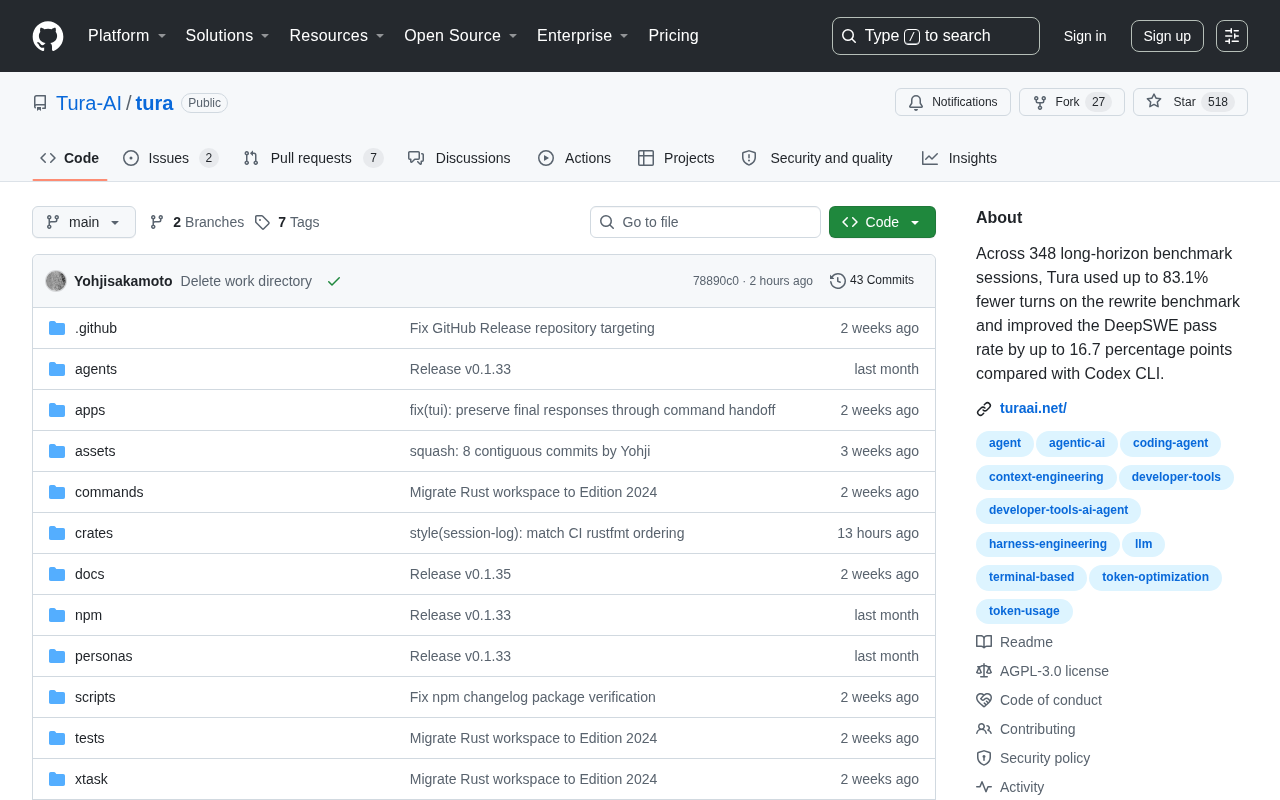
·2 min
Tura: A New Approach to Saving 80% of Tokens for AI Agents
An in-depth analysis of how the Tura framework helps AI Agents reduce 80% of token consumption while improving task quality through intelligent context management and structured tool calling.
Read more →

·2 min
Substack's Bot Epidemic: A Trust Crisis for Subscription-Based Platforms
Substack faces a serious AI bot crisis. Bulk-generated content, fake subscriber data, and spam comments are eroding the platform's trust foundation.
Read more →

·3 min
Prompt Caching Explained: The Key Technology for Saving Money with AI Agents
Deep dive into Prompt Caching: how it works, why AI Agents repeatedly send tokens causing costs to skyrocket, and best practices to slash LLM costs by up to 90%.
Read more →

·2 min
Which Programming Language Is Best for AI Coding Assistants? The Battle Between Type Systems and Training Data
Exploring language choice in the AI coding assistant era: statically typed languages like TypeScript and Rust enable AI self-correction via compiler feedback, while Python leads with massive training data.
Read more →