#mouse automation
202 related articles

·3 min
Jetson Edge AI Development: Setting Up a VS Code + Claude Code Workstation
Set up an AI coding workstation on NVIDIA Jetson using VS Code + Claude Code. Covers JetPack NVIDIA Skills, token budget management, headless SSH dev, and coding agent best practices.
Read more →

·2 min
Python Learning Path for Beginners: A Complete Breakdown of Three Core Modules
A complete Python learning path for beginners covering three modules: Fundamentals, Intermediate, and Hands-On Practice — including web scraping, office automation, and data analysis.
Read more →

·2 min
On-Device LLMs, Custom Silicon, and 100K-GPU Clusters: AI Industry Enters Full-Spectrum Competition
Apple's 1-bit compression fits 27B models on iPhone, Meta builds custom chip Iris, China's 100K-GPU cluster goes live, Samsung enters AI PC — a deep dive into AI's new full-spectrum competition.
Read more →

·7 min
Claude Code Practical Tutorial: A Complete Beginner's Guide to Automating Your Entire Workflow
No coding required! This guide breaks down the complete Claude workflow: custom Projects, batch SEO content, one-sentence tool building with Artifacts, and Claude Code terminal ops—with real traffic-growth cases.
Read more →

·3 min
GPT-5.6 Real-World Test: The True Capability Limits of AI-Assisted Game Development
A creator tests GPT-5.6 Codex on two real projects: an Android MAUI app and a tower defense game prototype. Zero code written for the app; the game demo surfaces multiple bugs. Honest look at AI coding's real limits.
Read more →
·3 min
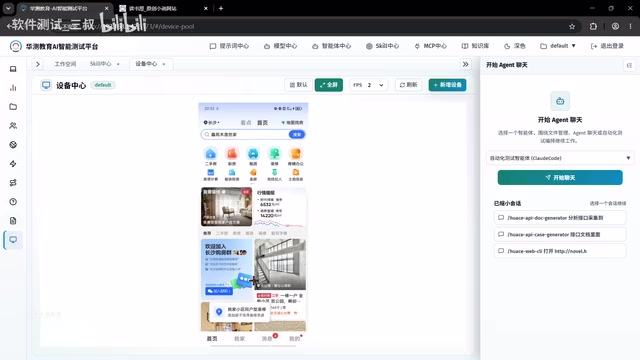
AI Testing in a Closed Loop: Full Pipeline from API Collection and Test Case Generation to Agent-Driven Execution
Full breakdown of a real AI testing pipeline: API collection, doc enrichment, AI test case generation, Agent-driven execution, and test reports — with Skills, RAG, and Harness engineering.
Read more →

·4 min
AI Agents Automating JS Reverse Engineering: A Deep Dive into the New Paradigm for Web Scraping
AI agents are revolutionizing JS reverse engineering. This deep dive covers built-in tool chains, automation modes, prompt engineering for e-commerce, and full pipeline automation from parameter extraction to database storage.
Read more →

·3 min
AI Testing End-to-End in Practice: A Complete Guide from Test Case Generation to Agent Automation
A deep dive into AI testing workflows: API capture, test case generation, Agent orchestration, and automated execution. Learn the two core challenges — incomplete information and mandatory human review.
Read more →
Coasty: API Infrastructure Built for C…
·2 min
Coasty: API Infrastructure Built for Computer-Use Agents
Coasty (YC S26) is an API platform for computer-use agents, wrapping screenshot capture, mouse/keyboard control, and session management into a unified interface so developers can focus on agent logic.
Read more →

·6 min
OpenAI Merges ChatGPT and Codex: The Super App for the AI Agent Era Is Here
OpenAI merges ChatGPT and Codex into a super app and releases three new GPT-5.6 models: Sol, Terra, and Luna. A deep dive into four hands-on workflows—Computer Use, Loops, and multi-threading—for the AI agent era.
Read more →
Meta Muse Spark 1.1 Released: A Deep D…
·4 min
Meta Muse Spark 1.1 Released: A Deep Dive into the First Spark Model with an Open API
Meta officially releases Muse Spark 1.1, the first model in the Spark series to offer an API, with a focus on strengthening agentic tool calling and computer use capabilities.
Read more →

·3 min
Does Vim Still Matter in the AI Era? Three Strategies to Find Your Answer
As Cursor and GitHub Copilot redefine programming, where do Vim users go? This article analyzes the tension between AI tools and Vim, and three key strategies.
Read more →

·4 min
RoughCut: A Fully Automated AI Video Editing Tool Built with Codex
RoughCut is a fully automated AI editing tool generated by Codex, supporting talking-head, unboxing, and commentary modes with a semi-automated publishing system.
Read more →
Reverse-Engineering Web Apps: A New Ap…
·3 min
Reverse-Engineering Web Apps: A New Approach to Breaking Through the API Barrier for AI Agents
Explore a new approach to AI Agent tool integration: reverse-engineering web apps to turn API-less pages into callable Agent tools, with analysis of MCP synergy and challenges.
Read more →

·5 min
Hands-On with PageAgent: Add AI Agent Capabilities to Web Pages with a Single Line of Code
In-depth hands-on review of Alibaba's open-source web automation tool PageAgent: three integration methods, script execution analysis, and a full breakdown of current limitations. Add AI Agent capabilities to web pages with one line of JS.
Read more →

·4 min
BrowserWing: A Browser Action Recorder That Offers a Pragmatic Approach to AI Web Automation
BrowserWing is an open-source browser action recorder (1300+ GitHub stars) with 78 built-in scripts for GitHub, Bilibili, Zhihu, and more. Record once, run repeatedly, and let AI Agents reliably execute fixed web workflows.
Read more →

·3 min
APA: A New Enterprise-Grade Automation Approach Merging Agents with RPA
APA (Agentic Process Automation) merges LLM agents into RPA, supporting natural language, operation manuals, and video recording to generate scripts—paired with financial-grade security and three-layer protection for enterprise automation.
Read more →

·3 min
GPT-5.6 Launches with Three Models: Sol/Terra/Luna and ChatGPT Work Reshape How We Work
OpenAI launches the GPT-5.6 family—Sol, Terra, and Luna—alongside ChatGPT Work, a new desktop app, and Sites. AI evolves from a chat tool into a true productivity partner, completing financial analysis, presentations, and cross-platform collaboration in one operation.
Read more →

·3 min
Benchmarking LLMs on Smartphones: A Deep Dive into the MELTing Point Benchmark
The MELTing Point paper is the first to evaluate mobile LLM performance in real user scenarios, covering iPhone, Samsung, Pixel and more, testing TinyLlama, Mistral-7B and others—revealing GPU inference gains, 47°C heat warnings, and prefill-decode disaggregation.
Read more →

·5 min
GPT-5.6 In-Depth Field Test: A Real-World Log After Burning Through $200K
A developer stress-tested GPT-5.6 for six weeks across 67 projects, burning $180K-$240K in inference. Real cases of task persistence, Rust rewrites, autonomous browser control — plus honest frontend and 3D shortfalls.
Read more →