#numerical simulation
47 related articles

·2 min
awesome-systematic-trading: A Complete Guide to the 9,000-Star Quantitative Trading Open Source Resource List
Deep dive into the 9,100-star awesome-systematic-trading GitHub project covering backtesting frameworks, strategy implementations, data tools, and classic books for quantitative traders.
Read more →

·3 min
Low Initial Review Scores for NeurIPS 2026 Theory Papers? Community Discussion and In-Depth Analysis
NeurIPS 2026 theory papers are receiving low initial review scores. This article analyzes structural causes, scoring trends, and rebuttal strategies for theory researchers.
Read more →

·4 min
FPGA Softmax Approximation in Practice: A Detailed Guide to Taylor Expansion and Padé Approximation Methods
A detailed guide on efficiently implementing Softmax on FPGAs, comparing Taylor series and Padé approximation methods for accuracy and resource trade-offs, with Python simulation and range reduction techniques.
Read more →

·6 min
Claude Sonnet 5 In-Depth Testing: 8 Real-World Tasks Reveal Its True Capability Boundaries
Bilibili creator KaterSony tests Claude Sonnet 5 across 8 real-world tasks—image recognition, 3D modeling, web generation—comparing it against GPT-5.5, Gemini 3.1 Pro, and revealing its true capability limits and cost traps.
Read more →
Block Low-Rank Compression: A Guide to…
·2 min
Block Low-Rank Compression: A Guide to Accelerating Large Model Inference on Memory-Constrained GPUs
Learn how Block Low-Rank (BLR) decomposition compresses large model memory usage and accelerates GPU inference, including CUDA kernel optimization and combination with quantization and pruning.
Read more →

·2 min
Testing AI Scientific Engineering with the Three-Body Problem: From Numerical Integration to Chaos Visualization
A developer tasked GPT-5.6 Sol with building a three-body problem simulation site covering four integrators, chaos detection, and independent review. An in-depth look at AI's real scientific computing capabilities.
Read more →
LFortran + Enzyme: A New Path to Autom…
·2 min
LFortran + Enzyme: A New Path to Automatic Differentiation for Fortran Code
LFortran + Enzyme enables automatic differentiation for decades of Fortran scientific code without rewrites. Learn the technical principles, implementation path, and impact on scientific ML.
Read more →

·4 min
RAM: First-Principles Approach to 50x Faster RL Post-Training for Diffusion Models
RAM (Reinforce Adjoint Matching) achieves 50x faster RL post-training for diffusion models by discarding path costs, combining ODE sampling with decorrelated training objectives. A deep dive into RAM's core principles and experiments vs. Flow-GRPO.
Read more →
Paper Reproduction as an Entry Point i…
·4 min
Paper Reproduction as an Entry Point into Scientific Machine Learning: Path Selection and Pitfall Guide
How can applied math students efficiently enter Scientific Machine Learning (SciML)? This guide covers the value and pitfalls of paper reproduction, with a layered path from numerical PDEs to research.
Read more →
Frieve Vinyl: How Microscopic Physical…
·3 min
Frieve Vinyl: How Microscopic Physical Simulation Recreates the Mechanics of a Vinyl Stylus
Frieve Vinyl digitally recreates vinyl playback through microscopic stylus/groove physics simulation. Explore stylus geometry, contact mechanics, and tracking distortion.
Read more →
Using Claude for Constrained Optimizat…
·2 min
Using Claude for Constrained Optimization Research: The Promise and Limits of AI-Automated Science
How Claude and LLMs assist constrained optimization research — from problem modeling to solver integration. An honest look at AI's real capabilities and limits in automated science.
Read more →

·4 min
Hands-On with GPT-5.6: A Single Prompt Builds a Real-Time Voice Anime App
Hands-on with GPT-5.6 Sol: auto-generate real-time voice anime characters from one prompt, write physics engines from scratch, and build unfamiliar toolchains autonomously. In-depth review of coding, agentic tasks, benchmarks, and its hallucination weakness.
Read more →

·3 min
Neuro-Symbolic AI Architecture: A New Approach Inspired by Neurotransmitters and Sleep Cycles
Explore how neuro-symbolic AI architecture fuses neural networks with symbolic reasoning, simulating neurotransmitter regulation and sleep cycles to tackle hallucination and catastrophic forgetting.
Read more →

·3 min
The Field Equation: Bringing Math Equations to Life with Real-Time Shaders
Explore how The Field Equation project uses real-time shaders and field equation techniques, via SDF ray marching and noise functions, to generate breathing dynamic geometric art.
Read more →
·7 min
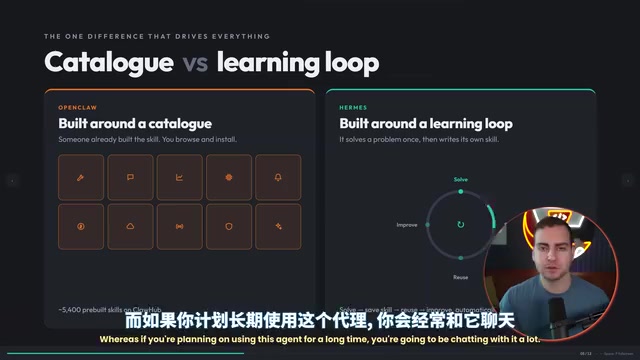
OpenClaw vs Hermes: An In-Depth Comparison and Selection Guide for AI Agent Tools
An in-depth comparison of OpenClaw and Hermes Agent, covering skill management, memory mechanisms, security, and gateway configuration to help you find the right AI agent solution.
Read more →

·7 min
Practical RL Compute Optimization: Core Strategies to Boost CPU and GPU Utilization
An in-depth look at why CPU and GPU utilization is low in RL training, covering vectorized environment parallelism, distributed Actor-Learner architectures, GPU-side simulation (Isaac Gym/Brax), and Ray RLlib practice.
Read more →

·2 min
VR Teleoperation Robotics: A Practical Guide to Swapping Left/Right Controller Data and Aligning Coordinate Systems
How to programmatically swap left/right controller mappings in MuJoCo when using Pico 4 Ultra and XRoboToolkit for VR robot teleoperation, including coordinate frame alignment and quaternion mirroring.
Read more →

·3 min
How to Choose a Practical LLM/RAG/AI Agent Course: Four Key Criteria
Learn how to pick the best LLM, RAG, and AI Agent courses. Discover 4 key criteria for hands-on AI learning and top resources for developers.
Read more →

·4 min
AI Joins Forces with SpaceX to Train Aerospace Foundation Model: A New Milestone in Vertical Domain AI
An AI company announces a joint model training initiative with SpaceX, integrating rocket telemetry, orbital data, and engineering assets. A deep dive into the strategic and technical implications of vertical domain AI for aerospace.
Read more →

·4 min
DeepSeek Coder Deep Dive: How This Open-Source Code LLM Outperforms GPT-4
A deep dive into DeepSeek Coder V1 to V2: MoE architecture, 128K context, 90.2% HumanEval pass rate, and how it became the first open-source model to beat GPT-4 Turbo.
Read more →