#open source models
8096 related articles

·3 min
Run Multiple Open-Source OCR Models via a Unified API: 100K Pages for Just $60
VLM.run wraps open-source OCR models like DeepSeek-OCR-2, GLM-OCR, and dots.mocr into a unified OpenAI-compatible API. Parse 100K pages for just $60 with JSON output and MCP server support.
Read more →

·3 min
Codex Harness Goes Open Source: AI Moats Shift from Models to Runtimes
OpenAI open-sources Codex Harness with Rust core, app server, and full AST processing. Same model scores nearly 3x higher on ARC-AGI-3, saves 6x tokens. Deep analysis of Codex vs DeepSeek Harness.
Read more →

·2 min
DeepSeek Open-Sources Harness Framework: AI Competition Shifts from Models to Agents and Infrastructure
DeepSeek open-sources Harness framework, gaining 50K GitHub stars in 12 hours; Claude tackles Riemann Hypothesis; OpenAI's wafer-scale chip boosts inference 14x. AI competition shifts to agents and infrastructure.
Read more →

·2 min
The Real Motivations Behind Meta's Open-Source AI Models: A Rational Breakdown from the Developer Community
Reddit developers dissect Meta's open-source AI strategy across technical performance, competitive dynamics, and business motivations, revealing why competition drives healthy open-source ecosystems.
Read more →

·3 min
Open-Source vs Closed-Source Models, Reward Hacking & Benchmark Gaming: A Deep Dive into Core AI Model Technical Issues
Deep analysis of six core AI model issues: open-source vs closed-source models, inference throughput vs accuracy tradeoffs, benchmark gaming, distillation vs RL, reward hacking defenses, and dynamic quantization technology.
Read more →

·3 min
How Open-Source Models Achieve Superior Retrieval Performance at 1% of GPT's Cost
Deep analysis of how open-source models match GPT-level retrieval performance at 1/100th the cost. Covers RAG cost optimization, embedding model fine-tuning, and deployment strategies.
Read more →

·2 min
Anthropic's Call to Restrict Open-Source Models Sparks Outrage: Safety or Monopoly?
Anthropic CEO's call to restrict "dangerous capabilities" in open-source AI models sparks fierce backlash. Developers question double standards and fear monopoly disguised as safety.
Read more →

·4 min
Heretic Uncensoring Technology Explained: Practical Applications on Jamba2 and Qwen3.5 Open-Source Models
Deep dive into Heretic uncensoring technology applied to Jamba2-Mini, Qwen3.5-9B, and 27B open-source models, exploring how refusal rates dropped from 97% to 4% and the safety debates involved.
Read more →

·1 min
AI Model Iteration Accelerates: Has GPT-5 Already Been Surpassed by Smaller Models? The Rise of Open Source
Exploring the accelerating AI model iteration trend: open-source models like Qwen3.6 27B rival GPT-5 in benchmarks. Analysis of the technical reasons, open-source rise, and future competition.
Read more →

·1 min
AI Model Iteration Accelerates: Has GPT-5 Already Been Surpassed by Smaller Models? The Rise of Open Source
Exploring the accelerating AI model iteration trend: open-source models like Qwen3.6 27B rival GPT-5 in benchmarks. Analysis of the technical reasons, open-source rise, and future implications.
Read more →

·3 min
Kimi K3 Real-World Testing in 3D Modeling & Game Development: Can Open-Source Models Overtake Closed-Source Giants?
In-depth testing of Kimi K3 in 3D modeling, physics simulation, animation rigging, and game development vs Fable 5 and GPT Solve 5.6. Open-source model delivers top-tier results at one-quarter the price.
Read more →

·4 min
Jensen Huang Joins 50 Silicon Valley Giants to Champion Open-Source Models: How Capital Logic Overrides Political Correctness
Jensen Huang's first-ever tweet backs open-weight AI. 50 Silicon Valley giants oppose banning Chinese open-source models. Deep analysis of the interests behind closed vs. open AI ecosystems.
Read more →
·3 min
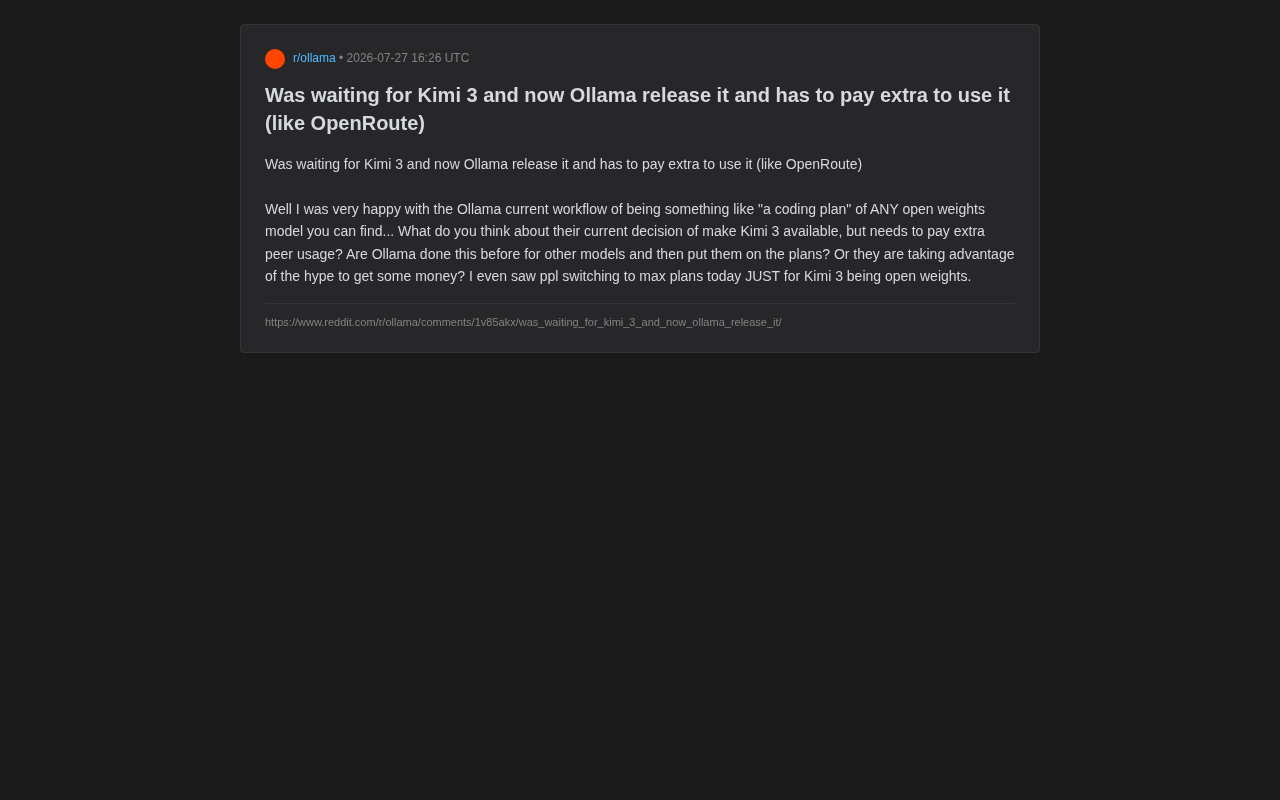
Ollama's Extra Charges for Kimi 3 Spark Community Controversy: Should Open-Source Models Be Free to Use?
Ollama lists Kimi 3 with extra pay-per-use fees, breaking subscription expectations and sparking debate over open-weight models and AI service pricing tiers.
Read more →

·3 min
Ollama Prepares for Trillion-Parameter Open-Source Models as the Open-Source Ecosystem Heats Up
Ollama scales up for trillion-parameter open-source models like Kimi K3 and Qwen 3.8. Hugging Face demands $100M from OpenAI, Alibaba Coder goes mobile, and DeepSeek pauses fundraising.
Read more →

·5 min
Will Chinese Open-Source Models Burst the US AI Bubble? A Deep Dive into the Transmission Chain
Chinese open-source models like Kimi K3 and DeepSeek approach US closed-source performance at a fraction of the cost. This deep dive analyzes the transmission chain from price competition to valuation reassessment.
Read more →

·2 min
Jensen Huang Praises DeepSeek and Kimi: Markets Have Twice Misjudged the Impact of Chinese Open-Source Models
NVIDIA CEO Jensen Huang says markets have twice misjudged the impact of DeepSeek and Kimi, arguing Chinese open-source models boost rather than reduce overall AI compute demand.
Read more →
aisuite: Andrew Ng's Open-Source Unifi…
·1 min
aisuite: Andrew Ng's Open-Source Unified Interface for Multiple AI Models
aisuite, open-sourced by Andrew Ng's team, provides a unified interface for calling OpenAI, Anthropic, Google, and other major LLMs. Switch providers seamlessly by just changing the model parameter. 15,000+ GitHub stars.
Read more →

·5 min
Why Are China's Open-Source AI Models Getting Stronger? A Deep Dive Into Three Comeback Strategies
Facing US chip bans and closed-source monopoly, how do China's open-source AI models keep fighting back? A deep dive into three core paths: open-source pricing games, optical interconnect positioning, and on-device scenarios.
Read more →

·5 min
Why Are China's Open-Source AI Models Getting Stronger? A Deep Dive into Three Comeback Paths
Facing US chip bans and closed-source monopolies, how do China's open-source AI models keep striking back? A deep dive into three core paths: open-source pricing-power games, optical interconnect positioning, and edge-side use cases.
Read more →

·3 min
Jensen Huang Backs Chinese Open-Source AI: Great Models Deserve to Be Widely Used
NVIDIA CEO Jensen Huang says US companies should absolutely be allowed to use Chinese open-source AI models like DeepSeek and Kimi, calling backdoor fears a misunderstanding and arguing great models drive more compute demand.
Read more →