#parallel tasks
1754 related articles
 Tech Frontiers
·2 min
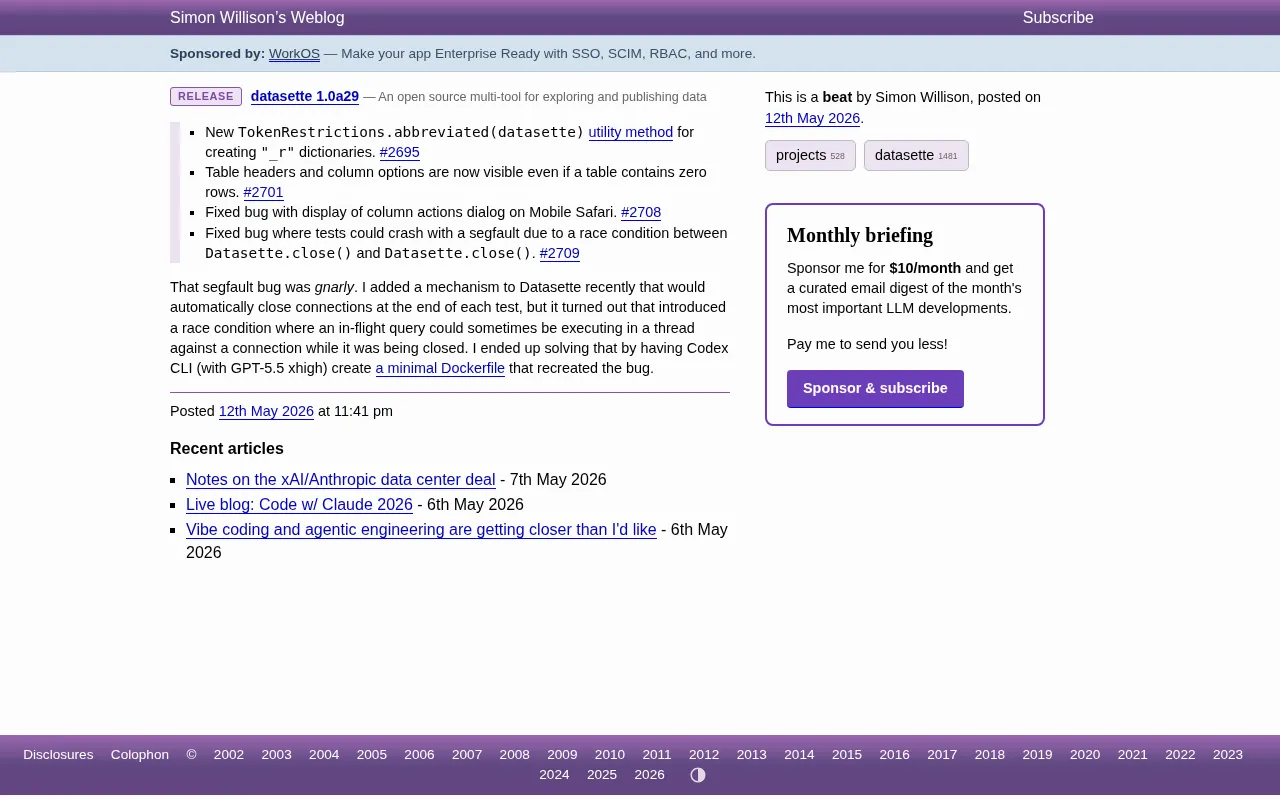
Datasette 1.0a29 Released: Fixing a Gnarly Segfault Race Condition with GPT-5.5
Datasette 1.0a29 preview released, fixing a segfault race condition introduced by test optimization. Developer Simon Willison used GPT-5.5 xhigh to help reproduce the issue, showcasing AI debugging in practice.
Read more →
 Tech Frontiers
·3 min
OpenAI Codex Adds Computer Use: AI Agents Autonomously Control Mac in the Background
OpenAI adds Computer Use to Codex, enabling AI agents to autonomously click, type, and operate across Mac apps in the background without taking user control.
Read more →
 Tech Frontiers
·2 min
OpenAI Symphony: One Codex Agent Per Task — A New Paradigm for Multi-Agent Parallel Programming
Deep dive into OpenAI's Symphony: assigning an independent Codex agent to each task for multi-agent parallel programming. Explore its architecture, developer impact, and industry trends.
Read more →
 Deep Dives
·3 min
Claude's Advisor Strategy: Small Models Execute, Large Models Supervise — A New Cost-Saving Paradigm for AI Agents
Anthropic's Advisor Strategy lets Sonnet execute tasks while Opus serves as advisor, cutting costs 12% while boosting SWE-Bench by 2.7 points. A new multi-model AI Agent paradigm explained.
Read more →
 Tutorials
·3 min
Claude Code Domestic Alternative: Low-Cost Deployment and Six Core Architecture Components Explained
Detailed guide on deploying Claude Code domestic alternatives via compatible API interfaces. Deep dive into six core systems: built-in tools, hierarchical memory, multi-Agent collaboration, and more.
Read more →
 Tech Frontiers
·3 min
OpenAI Codex 2.0 Deep Dive: From Coding Assistant to All-Purpose AI Agent
OpenAI Codex major update: new Computer Use, built-in browser, long-term memory features. 3M weekly developers. How Codex evolved from coding assistant to full SDLC AI Agent.
Read more →
 Tutorials
·3 min
AI Project Evaluation Framework: A Practical Guide to 5 Levels and 30 Key Metrics
A battle-tested AI project evaluation framework covering 5 levels and 30 core metrics—model quality, UX, system efficiency, business value, and data loops—to scientifically assess LLM Agent performance.
Read more →
 Deep Dives
·3 min
Augment Code Architecture Revealed: Dedicated Subagents Replace KV Cache, Cutting Costs by 90%
Deep dive into how Augment Code uses Mercury 2 dedicated subagents to replace traditional KV cache, achieving 82% faster context compaction, 90% lower summarization costs, and 30% reduced LLM spending.
Read more →
 Industry Insights
·3 min
AI Tool Adoption ≠ Transformation: 219 Engineering Leaders Reveal the Real Gap
A survey of 219 engineering leaders reveals most teams adopted AI dev tools without truly changing how they build software. Discover the gap and three key traits of successful transformation.
Read more →
 Research
·2 min
Prompt Tuning Delivers 3-10% Efficiency Gains: The Hidden Dividend of Scaling Coding Agents
Prompt engineering optimizations for coding Agents reduce tool calls, lower output tokens, and improve completion speed by 3-10%—delivering significant cost savings and latency reduction at scale.
Read more →
 Tech Frontiers
·2 min
DeepAgents: LangChain's Deep Agent Development Framework Built on LangGraph
DeepAgents is LangChain's open-source Agent framework built on LangGraph, supporting multi-step reasoning, state management, and multi-Agent collaboration for production-grade AI development.
Read more →
 Deep Dives
·3 min
LangGraph Deep Dive: An Open-Source Framework for Building Resilient AI Agents
Deep dive into LangGraph's core architecture, StateGraph design, multi-Agent collaboration, and deployment. Learn how this 31K+ Star project helps build reliable AI Agents.
Read more →
 Tutorials
·3 min
Hands-On Intelligent Agent Development with LangGraph: From Getting Started to Full Project Architecture
A deep dive into intelligent Agent development with LangGraph, covering core concepts, project architecture, state management, and practical tips for building AI agents in Python.
Read more →
 Product Reviews
·3 min
Agentica Open-Source Framework Review: A Lightweight Async AI Agent Development Alternative
In-depth review of Agentica, an open-source AI Agent framework featuring async-first architecture, tool calling, RAG, multi-agent collaboration, and MCP protocol support, with comparisons to LangChain and other mainstream frameworks.
Read more →
 Product Reviews
·3 min
NekroAgent Open-Source Framework: AI Agent Solution Supporting QQ, Discord, and Multiple Platforms
Deep analysis of NekroAgent open-source AI Agent framework supporting QQ, Discord, Telegram and more, with sandbox execution, long-term memory, MCP management, and visual console for multi-user scenarios.
Read more →
 Tutorials
·3 min
Agentic Flow: A Guide to Low-Cost Model Switching in Claude Code and Production Agent Deployment
Deep dive into Agentic Flow, an open-source project enabling flexible low-cost model switching in Claude Code and one-click Agent deployment to cloud production environments.
Read more →
 Tutorials
·2 min
ComfyUI-WanVideoWrapper: A Complete Guide to Installing and Using Wan Video Generation Nodes
A detailed guide to ComfyUI-WanVideoWrapper: integrate Wan video generation models into ComfyUI with text-to-video and image-to-video workflows, VRAM optimization tips, and use cases.
Read more →
 Product Reviews
·3 min
Bailing: Open-Source Voice Assistant with 800ms Low Latency, Rivaling GPT-4o Conversation Experience
Bailing is an open-source voice assistant using ASR+LLM+TTS architecture with DeepSeek R1 integration, achieving 800ms end-to-end latency with barge-in support, running smoothly on Mac and low-spec devices.
Read more →
 Deep Dives
·3 min
Open-Source Replication of OpenAI Operator: Building a Computer-Controlling AI Agent in 48 Hours
A developer open-source replicated OpenAI's $200/month Operator in 48 hours using Anthropic Computer Use, building a full-stack Dockerized computer-controlling AI Agent with deep analysis of architecture and industry trends.
Read more →
 Deep Dives
·3 min
oh-my-kimi: Deep Dive into a Multi-Agent Orchestration Framework for Kimi Code CLI
Deep analysis of the oh-my-kimi open-source project, a multi-agent orchestration framework for Kimi Code CLI featuring Worktree Runtime, DAG planning, MCP hooks, Quality Gates, and Local Graph Memory.
Read more →