#self-improvement AI
82 related articles

·3 min
GPT-5.6 Autonomously Optimizes Its Own Kernels: How AI Recursive Self-Improvement Could Cut Service Costs by 20%
OpenAI's internal model GPT-5.6 reportedly autonomously rewrites production kernels, achieving ~20% service cost reduction. Deep analysis of this AI recursive self-optimization event's technical plausibility and industry impact.
Read more →

·3 min
GPT-5.6 Autonomously Optimizes Its Own Kernels: How AI Recursive Self-Improvement Could Cut Service Costs by 20%
OpenAI's internal model GPT-5.6 reportedly autonomously rewrote production compute kernels, achieving ~20% cost reduction. Deep analysis of this AI recursive self-optimization event's technical plausibility, industry impact, and key questions.
Read more →

·4 min
Cursor's Recursive Self-Improvement: A Complete Path to Models Training the Next Generation
Cursor ML engineer reveals Recursive Self-Improvement (RSI) in practice: dual-loop flywheels, agent-driven data, anti-cheating evals, SpaceX compute, and how models are training the next generation.
Read more →
Training an RL Agent That Can Do RL: A…
·2 min
Training an RL Agent That Can Do RL: A Deep Dive into Meta-Reinforcement Learning Self-Improvement
An independent developer ran a meta-RL experiment at near-zero cost — training an agent to autonomously perform RL training. Explore the technical depth, cost model, and industry implications.
Read more →

·4 min
GPT-5.6 Launches: Flagship Model Sol Personally Trains Smaller Models, Recursive AI Self-Improvement Becomes Reality
OpenAI releases the GPT-5.6 series (Sol/Terra/Luna), with flagship Sol directly handling smaller model Luna's post-training—marking recursive AI self-improvement in practice. A deep dive into performance, cost, ChatGPT Work, and computer use design leaps.
Read more →
 Tech Frontiers
·2 min
A Rare Quiet Day in AI: Recursive Self-Improvement Stirs Beneath the Surface
A rare quiet day in AI sees multiple sources go silent simultaneously. Behind the calm, Recursive Self-Improvement (RSI) research continues. What this means for the industry.
Read more →

·1 min
Sakana AI Launches RSI Lab: The Path to Recursive Self-Improvement Where AI Builds AI
Sakana AI launches RSI Lab for recursive self-improvement, letting AI autonomously improve its own architecture. Explore their four-stage roadmap and key breakthroughs.
Read more →

·2 min
Sakana AI Establishes Recursive Self-Improvement Lab, Replacing Brute-Force Compute with Creativity to Pioneer a New AI Paradigm
Sakana AI launches its Recursive Self-Improvement Lab, focusing on using AI to redesign AI development. From LLM² to AI Scientist, this Tokyo company proposes a sample-efficient path to AI self-evolution without brute-force compute.
Read more →

·2 min
Anthropic's Latest Research: AI Recursive Self-Improvement Is Rapidly Approaching Human-Level Capability
Anthropic's new research reveals AI recursive self-improvement progress: Claude writes 80%+ of code, achieves 52x training speedup, and outperforms humans at 64% of research decision points.
Read more →
 Industry Insights
·1 min
Recursive Self-Improvement: The Flywheel Effect of AI Giants and the Acceleration of Industry Oligopoly
Recursive self-improvement is reshaping AI competition. Leading labs form talent siphoning flywheels through AI-assisted R&D, rapidly closing the entry window for competitors.
Read more →

·6 min
Using RL to Please the Reward Model: The Reward Hacking Concern Behind Soaring Elo Scores
When RL continuously optimizes models to please reward models, do soaring Elo scores truly represent capability gains? A deep dive into Reward Hacking in RLHF, Goodhart's Law in AI, and industry countermeasures.
Read more →

·5 min
Have AI Doomers Actually Used AI? A Developer Exposes the Gap Between Hype and Reality
AI Doomers warn AI will destroy humanity, but have they actually built AI apps? A developer's sharp critique reveals the vast gap between AI demos and real engineering practice.
Read more →

·4 min
Notion Digital Twin: How to Build a Personal Life Operating System
Explore building a personal life operating system with Notion. From fragmented info management to a unified digital twin, analyzing the Ultimate Bundle for Notion's value and challenges.
Read more →

·5 min
MemBoostAI: A Deep Dive into the AI-Powered Daily Memory Training Tool
MemBoostAI is a memory training app combining cognitive science with AI. Through short daily practice, active recall, and gamified challenges, it helps users boost memory retention. A deep analysis of its features, science, and differences from traditional flashcard tools.
Read more →

·3 min
Cekura: A Deep Dive into the Automated Testing, Monitoring, and Self-Healing Closed-Loop Platform for Voice AI Agents
Deep analysis of how Cekura's five-step closed loop—scenario simulation, failure capture, root cause diagnosis, automatic prompt rewriting, and regression verification—solves voice AI agent quality assurance in production.
Read more →

·4 min
A Beginner's Guide to AI Agents: Core Principles and Learning Paths Explained
Learn AI Agent core principles from scratch: understand how Agents differ from LLMs, their execution mechanisms, why rule design matters, and find the right learning path for your goals.
Read more →
·4 min
A Beginner's Guide to AI Agents: Core Principles and Learning Paths Explained
A beginner's guide to AI Agents: understand core principles, how Agents differ from LLMs, their execution mechanisms, and get tailored learning path recommendations.
Read more →

·2 min
Comparing Three Self-Hosted AI Agents: How to Choose Between OpenClaw, Odysseus, and Hermes
An in-depth comparison of three leading self-hosted AI agents: OpenClaw, Odysseus, and Hermes. From positioning to core features and security risks, find the right tool for your needs.
Read more →

·1 min
A Practical Guide to Vibe Coding: How AI Is Reshaping the Frontend Engineer's Skill Model
An in-depth look at the Vibe Coding paradigm: how AI tools shift engineers from 'writing code' to 'directing AI,' exploring frontend skill tiers, polarization trends, and building irreplaceable value.
Read more →
·3 min
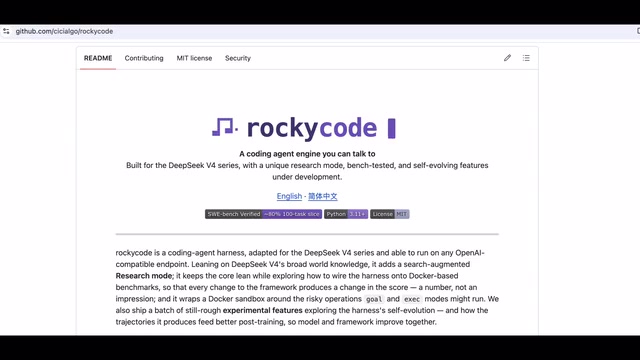
Rocky: An Open-Source Coding Agent with Minimal Architecture and Native DeepSeek Integration
Rocky is a minimal, transparent open-source coding agent with a core loop under a few hundred lines of Python, native DeepSeek search, Research mode, and built-in SWE benchmarking for reproducible agent experiments.
Read more →