#workflow agent architecture
2863 related articles

·2 min
From Workflow Graphs to Distributed Protocols: Dissecting Multi-Agent System Architecture Paradigms
How does Cosmonapse replace LangGraph's graph structure with event-driven distributed protocols? A deep dive into two multi-agent architecture paradigms, their trade-offs, and when to use each.
Read more →

·2 min
GPT-5.6 Deep Dive: Tiered Models + Multi-Agent Architecture, LLMs Evolve into Workflow Engines
GPT-5.6 isn't just a capability upgrade — it's an architectural shift: tiered models, programmatic tool calling, and multi-agent collaboration turn LLMs into workflow engines for production systems.
Read more →

·2 min
When Does Multi-Agent Architecture Slow Down Your Workflow? A Single vs. Multi-Agent Comparison
Multi-agent architecture isn't always better. This article analyzes how splitting tasks across agents introduces latency, token costs, and error propagation — with a practical framework for deciding when to use single vs. multi-agent design.
Read more →

·6 min
What Is Vibe Coding? A Complete Breakdown of the LLM + Agent + Workflow Three-Layer Architecture
Vibe Coding, coined by ex-Tesla AI Director Karpathy, redefines AI programming. This article breaks down the LLM + Agent + Workflow three-layer architecture.
Read more →

·3 min
What Kind of GUI Do AI Agents Need? The Evolution from Chat Boxes to Task Consoles
Exploring GUI design for AI Agents: why chat boxes fall short, and how ideal agent interfaces need task visualization, human-in-the-loop intervention, state presentation, and multi-agent orchestration.
Read more →

·3 min
GPT-5.6 Slashes Prices by 80%: The Industry Logic Behind the AI Price War and Opportunities for Developers
OpenAI's GPT-5.6 series sees massive price cuts—Luna drops 80% to $0.20/M input tokens. Deep analysis of the AI price war's tech drivers, competitive landscape, and impact on developer costs and model selection.
Read more →

·3 min
GPT-5.6 Price Cut of 80%: The Industry Logic Behind the AI Price War and Opportunities for Developers
OpenAI's GPT-5.6 series sees major price cuts with Luna dropping 80% to $0.20/M input tokens. Analysis of the AI price war's technical drivers, competitive landscape, and impact on developer costs.
Read more →

·2 min
GPT-5.6 Price Cut of 80%: How OpenAI Reclaims the AI Price-Performance Throne
OpenAI launches GPT-5.6 with 80% price cuts on its Luna model series, surpassing DeepSeek on the price-performance curve. Analysis of the tech logic, developer impact, and AI price war trends.
Read more →

·2 min
GPT-5.6 Price Cut of 80%: How OpenAI Reclaims the AI Price-Performance Throne
OpenAI releases GPT-5.6 with 80% price cuts on Luna models, overtaking DeepSeek on price-performance. Analysis of the tech logic, developer impact, and AI pricing trends.
Read more →
·2 min
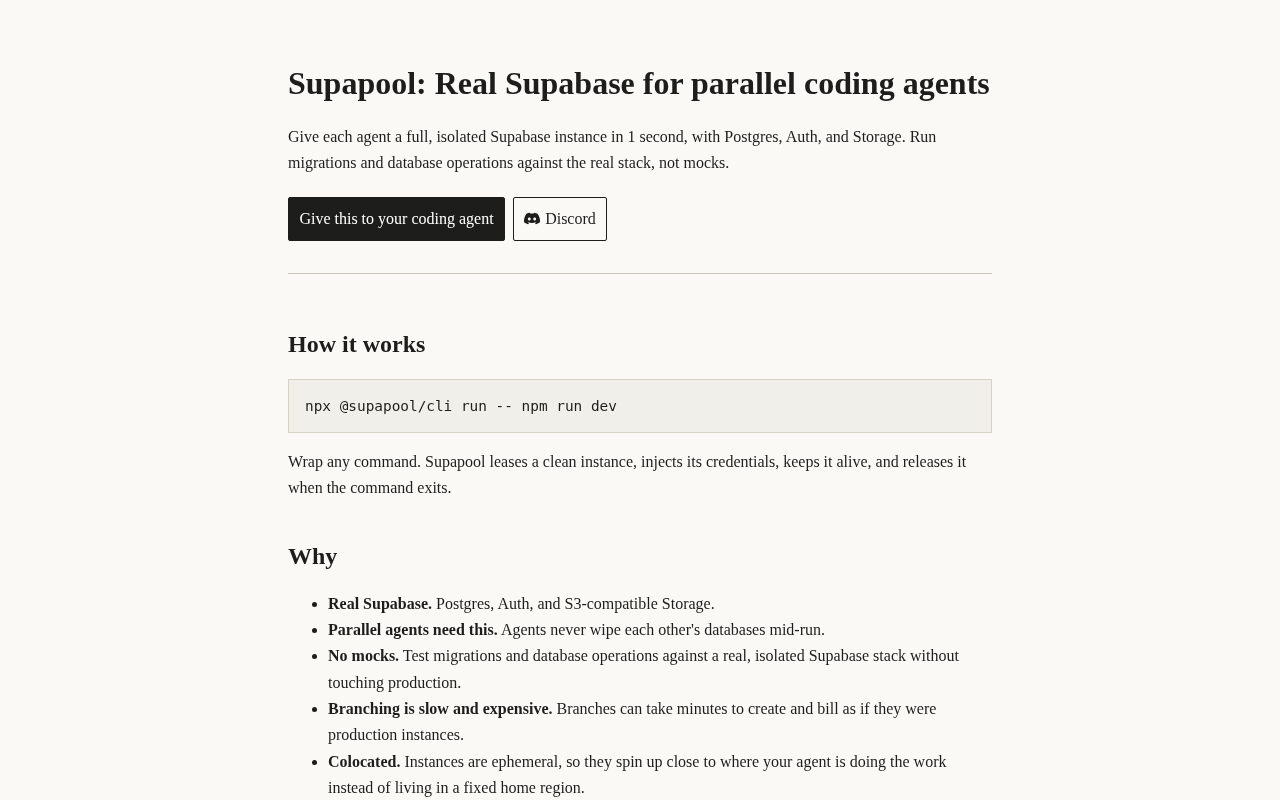
Supapool: Creating Isolated Databases for AI Coding Agents in 400 Milliseconds
Supapool uses pool prewarming to create isolated Supabase database instances in 400ms for AI coding agents like Claude, Cursor, and Devin, solving the database isolation challenge.
Read more →

·2 min
Supapool: Creating Isolated Databases for AI Coding Assistants in 400 Milliseconds
Supapool uses pool prewarming to create isolated Supabase database instances in 400ms for AI coding assistants like Claude, Cursor, and Devin—a prime example of AI-native infrastructure.
Read more →

·3 min
AI Agent Authentication and Authorization: Core Analysis of the IETF Draft and Security Best Practices
Deep analysis of the IETF Internet-Draft on AI Agent authentication and authorization, covering identity attribution, delegation chains, least privilege, OAuth 2.0 extensions, and MCP integration.
Read more →

·2 min
GPT-5.6 Released: Redefining the Price-Performance Boundary of AI Models
OpenAI releases GPT-5.6, targeting the price-performance frontier. Analysis of how architectural optimization and inference efficiency reduce costs, and how LLM competition shifts from capability to cost efficiency.
Read more →

·6 min
Securely Exposing Self-Hosted Services via VPS: Architecture & Practical Guide
Learn how to securely expose self-hosted services via VPS using WireGuard tunnels, Pangolin, and reverse proxies — enabling client-free access to Plex, Immich, and more while hiding your home IP.
Read more →

·3 min
Jina v3 Matryoshka Embeddings in Practice: Cut Vector Storage Costs by 75%
Use Jina v3 Matryoshka embeddings to truncate 1024-dim vectors to 256-dim, cutting Pinecone storage costs by 75% while maintaining retrieval quality with task-specific LoRA adapters and circuit breakers.
Read more →

·3 min
Building a Streaming LLM Backend in Go: Deep Dive into the SDK and React Frontend Library
Deep dive into an open-source Go SDK for building streaming LLM backends, covering streaming responses, tool-calling architecture, and companion React library for end-to-end integration.
Read more →

·2 min
Moving State Out of Framework Memory: A Multi-Agent Architecture Refactoring Guide
Exploring how 70% of multi-agent memory is consumed by non-reasoning state, and a refactoring approach using email threads to replace framework memory for better token efficiency, auditability, and resilience.
Read more →

·2 min
LangChain or LangGraph? Choosing the Right Framework for Production-Grade AI Applications
In-depth analysis of core differences between LangChain and LangGraph, exploring why more teams are migrating to LangGraph for production AI apps, with framework selection guidance.
Read more →

·2 min
LangChain or LangGraph? Framework Choices for Production-Grade AI Applications
In-depth analysis of LangChain vs LangGraph differences, why teams are migrating to LangGraph for production AI apps, and framework selection guidance based on project complexity.
Read more →

·3 min
Jina v3 Matryoshka Embeddings in Practice: Cut Vector Storage Costs by 75%
Use Jina v3's Matryoshka embeddings to truncate 1024-dim vectors to 256-dim, cutting Pinecone storage costs by 75%. Covers dimension truncation, task-specific LoRA adapters, and circuit breakers for reliable RAG systems.
Read more →