AI Agent Development in Practice: A Complete Breakdown of the LangChain + MCP + RAG Stack
A practical breakdown of AI Agent engineering using LangChain, MCP, and RAG with a real Vue project demo.
This article explains how AI Agents replace fixed scripts with a think-act-observe loop, giving LLMs genuine perception, decision-making, and action capabilities. Using an agent that autonomously scaffolds Vue 2/3 projects as a case study, it covers the full LangChain + LangGraph + MCP + RAG technology stack, from LLM deployment options to observability tooling. The content targets Python-familiar developers and follows a project-driven learning methodology.
AI Agents are rapidly becoming the dominant paradigm for deploying large language models in production. Unlike traditional programs that follow fixed logic, agents can perceive their environment, reason through decisions, and take action — much like a human would. This article is based on a hands-on course focused on engineering AI Agents into real-world applications. It covers the core operating principles of agents, the full technology stack, and a reproducible development case study — giving developers a clear learning path from foundational concepts to production deployment.
What Is an AI Agent? A Program That Thinks and Acts
At its core, an AI Agent is still a program — but what sets it apart from ordinary programs is its ability to perceive, decide, and act. A helpful analogy: think of an agent as a person. It needs "eyes" to observe the real world and feed that information back; a "brain" in the form of a large language model to reason and make decisions; and "hands" to take concrete actions.
This mirrors exactly how humans handle tasks — do something, check the result, then do the next thing. The agent's execution flow is therefore broken into three repeating phases: Thought → Action → Observation. An agent doesn't assume success after completing a step — it reads the execution result, evaluates the current state, and reasons through the next decision. This observe-then-think feedback loop is precisely what distinguishes agents from scripted automation.
Case Study: An Agent That Autonomously Creates a Vue Project
One of the course's signature demonstrations involves an agent creating a Vue 3 project from scratch on a local machine — entirely autonomously, triggered by a single instruction from the developer.
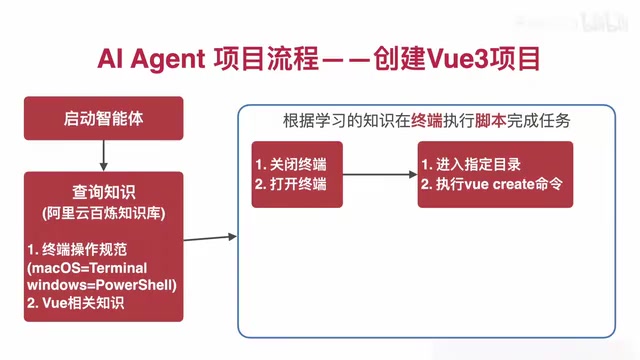
Once started, the agent's first move is to query its knowledge base. In this case, it connects to Alibaba Cloud's Bailian knowledge base to look up two things: terminal operation conventions (Terminal for macOS, PowerShell for Windows) and Vue-related knowledge. With that information in hand, the agent closes any existing terminal window, opens a fresh one, navigates to the target directory, and runs the vue create command.
The real insight lies in what happens after the command runs. Rather than assuming success, the agent uses a tool called get terminal full text to read the terminal's full output, then reasons about the next step based on what it sees — pressing Enter to confirm a directory, selecting the Vue 3 preset — each micro-step accompanied by an observation.
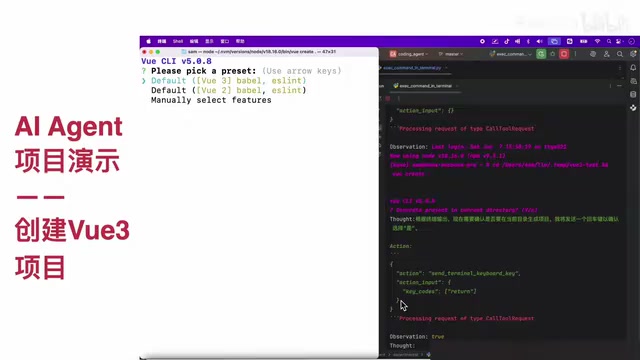
The agent's decision-making capacity becomes even clearer when creating a Vue 2 project. Unlike Vue 3, which can be confirmed with a default Enter press, selecting Vue 2 requires the agent to determine that "the cursor needs to move down before confirming." In the demo, the agent reads the terminal output, independently decides to press the down arrow key, then hits Enter — successfully scaffolding a Vue 2 project. This seemingly small difference validates that the agent is exercising genuine reasoning, not following a hard-coded script.
Agents Can Do Far More Than Scaffold Projects
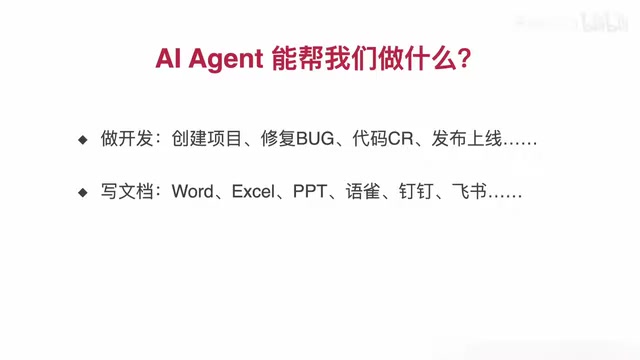
Creating a Vue project is a small task, but it threads together the agent's complete end-to-end workflow. Extend that capability further, and an agent can handle a wide range of OS-level automation: fixing bugs, conducting code reviews, and even deploying to production.
Because it can directly operate the system, writing Word documents, Excel spreadsheets, and PowerPoint decks, controlling the browser, and operating apps like DingTalk, Feishu, WeChat, and QQ all fall within its reach.
From an engineering perspective, the core value of AI Agents lies in eliminating repetitive work. Any task with a clear process that requires cross-tool collaboration is a natural fit. This is why Agents are seen as the critical leap that takes LLMs from "conversation" to genuine productivity.
The Full Technology Stack, Layer by Layer
To build agents like the one described above, the course outlines a layered technology stack worth examining closely:
Foundation Layer: Large Language Models
Three deployment options are provided to suit different budgets and compliance requirements:
- Cloud API: Alibaba Cloud Bailian
- International models: Claude and GPT series
- Local free deployment: Open-source models via Ollama
Middle Layer: AI Development Frameworks and Observability
The core framework is LangChain + LangGraph, used to orchestrate the agent's think-act loop. The tool integration layer introduces MCP (Model Context Protocol) to give agents standardized access to external tools. LangSmith and Langfuse handle tracing and observability monitoring — critical for debugging complex agents.
LangChain is currently the most widely adopted framework for building LLM-powered applications. It provides standardized abstractions for conversation chains, tool calling, and memory management, abstracting away the differences between various LLM APIs. LangGraph is a graph-based orchestration framework within the LangChain ecosystem, purpose-built for constructing multi-step, multi-node agents. It models the "think-act-observe" loop as a directed graph — where nodes represent operations and edges represent state transitions — giving developers precise control over loop conditions, branching logic, and interruption recovery. This makes it far better suited to production-grade complex tasks than simple chain-based approaches.
MCP (Model Context Protocol) is an open protocol championed by Anthropic, designed to define a unified standard for interactions between large models and external tools. Before MCP, every tool had its own integration pattern, requiring custom adapter code for each one. MCP standardizes tool description formats and call interfaces, allowing models to discover and invoke any third-party tool in a consistent way — dramatically lowering the cost of building out a tool ecosystem.
Tool Layer
Two categories of tools are included: custom-built tools (such as the terminal controller and browser controller used in the case study) and LangChain's built-in tools (covering database operations, Python code execution, file operations, and more). The knowledge base connects via Alibaba Cloud Bailian, forming the foundation of the RAG retrieval-augmented generation pipeline.
RAG (Retrieval-Augmented Generation) is the dominant technique for solving LLMs' "knowledge cutoff" and "private knowledge gap" problems. The approach works by vectorizing external documents (such as internal company guidelines or product manuals) and storing them in a knowledge base. When the model needs to answer a relevant question, it first performs a semantic search to retrieve the most relevant text fragments, then injects them as context into the prompt — enabling the model to respond based on up-to-date, accurate private knowledge. In the case study above, the agent queries via RAG to retrieve operational conventions like "use Terminal on macOS and PowerShell on Windows," enabling correct tool selection across different system environments — rather than relying on internal training knowledge that may already be outdated.
Development Environment
Recommended tools include Cursor, Tongyi Lingma, and Trae — the open-source AI IDE developed by ByteDance.
A Project-Driven Learning Approach for Developers
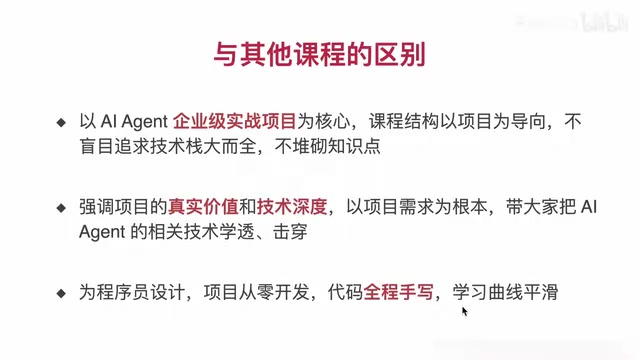
The course's methodology differs noticeably from the typical "knowledge dump" style of instruction. Its defining characteristic is a project-driven approach: rather than chasing breadth across the entire technology landscape, it treats real project requirements as the anchor and builds deep understanding from there.
The course is explicitly designed for developers who already have experience using large models and are familiar with Python and Node.js. The primary language is Python, with some Node.js in select sections. The goal is to master LangChain/LangGraph Agent development, integrate LLMs with MCP/RAG and automation tooling, and ultimately build a complex AI Agent application from scratch that can deliver real-world value.
For developers looking to make the transition into AI Agent work, the value isn't in learning to call a particular API — it's in deeply understanding the perceive-decide-act architectural pattern and developing the ability to apply it to real business problems.
Closing Thoughts
The heart of AI Agents isn't a more powerful model — it's enabling the model to form a closed loop in a real environment: observe results, refine decisions, and keep acting. Starting from something as small as scaffolding a Vue project, you can clearly see how the LangChain + MCP + RAG stack works together in practice. For developers, mastering this engineering approach is the key step toward turning LLM capabilities into genuine productivity.
Related articles
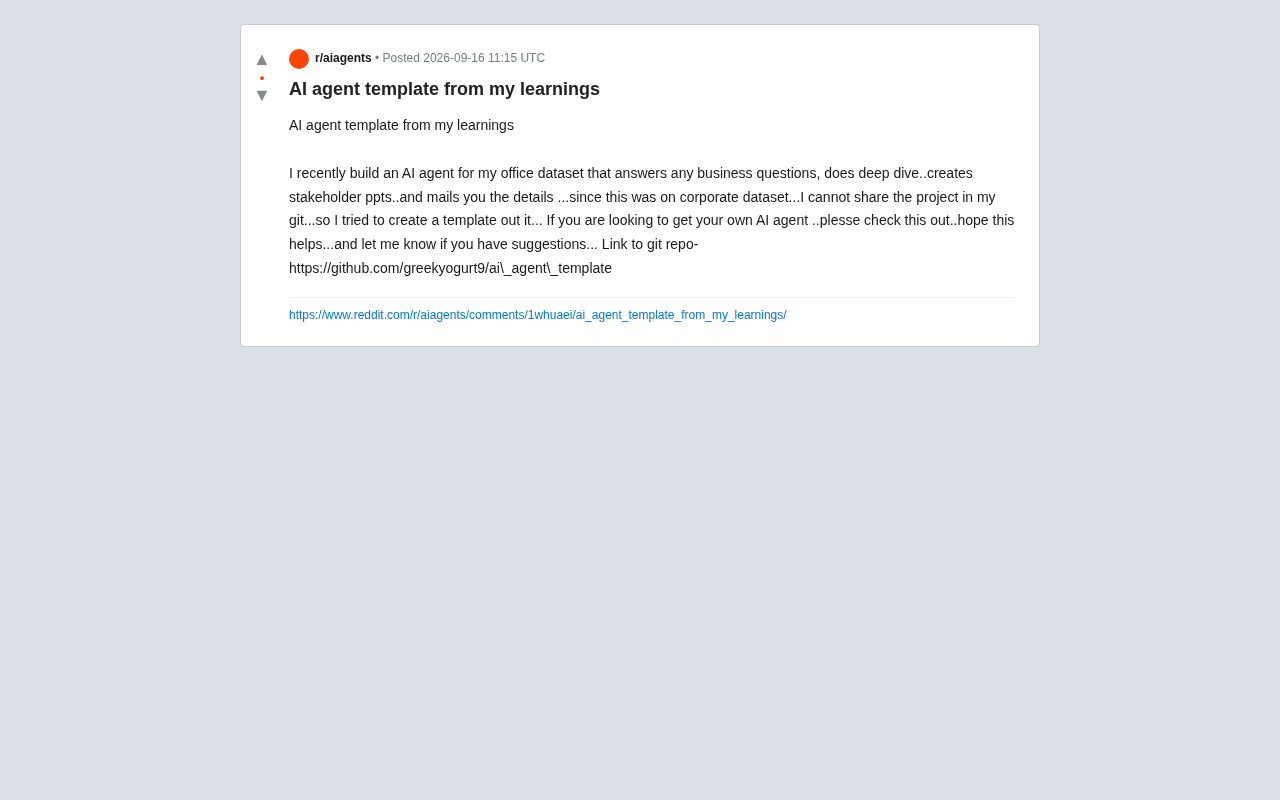
From Enterprise Practice to a Reusable Template: Lessons from Building an AI Agent
A developer shares an open-source AI Agent template built from an enterprise project, covering natural language data Q&A, analysis, auto-generated PPTs, and email distribution.
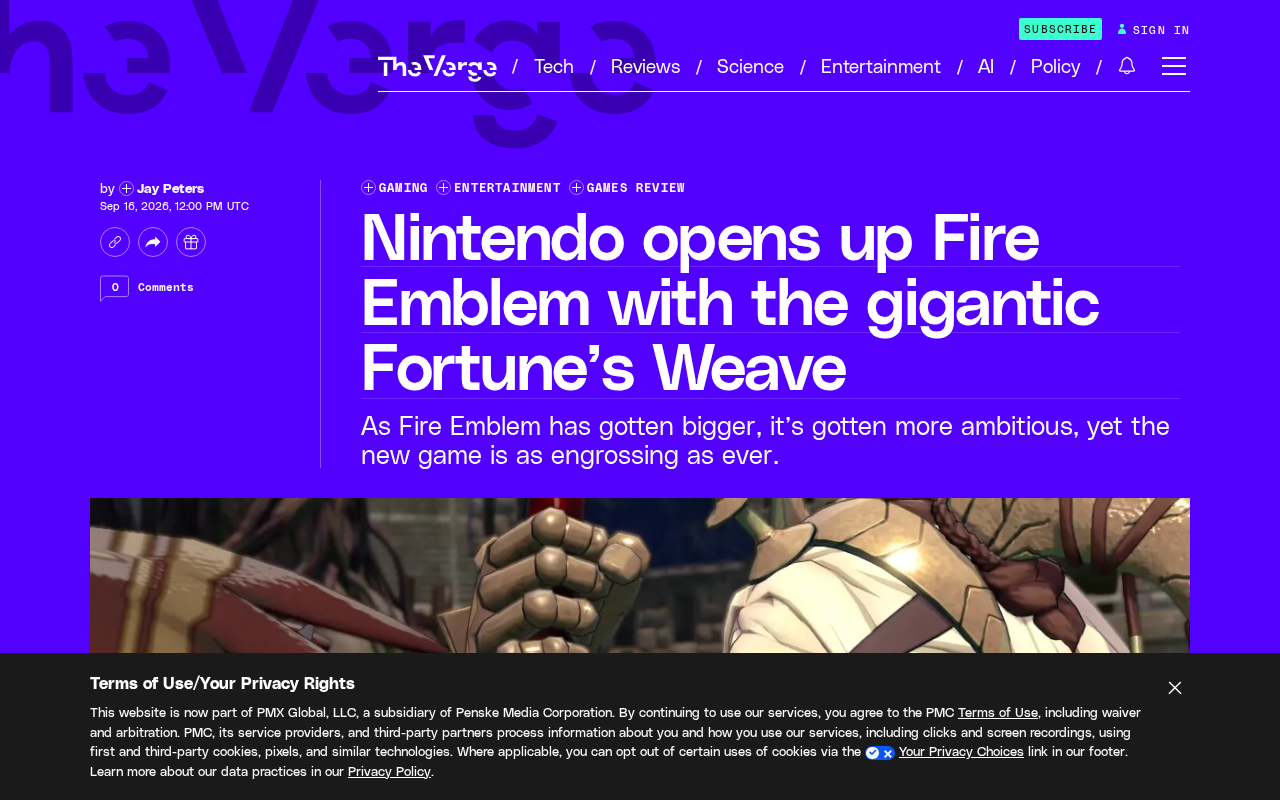
Nintendo's Open-World Design Evolution: Breaking Down Fire Emblem Fortune's Weave
Nintendo brings the open-world design philosophy of Breath of the Wild to Fire Emblem with the massive Switch 2 title Fortune's Weave. Here's what it means.
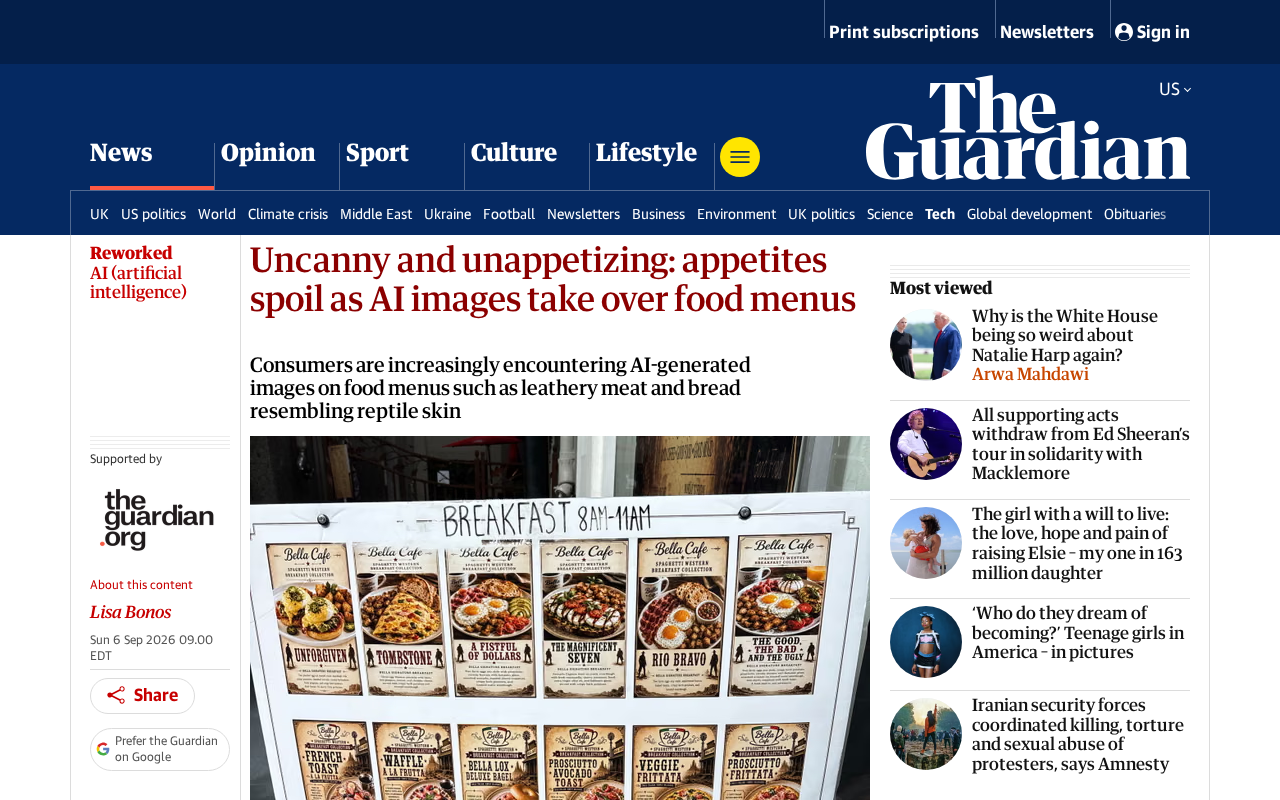
AI-Generated Food Photos Are Ruining Menus: How the Uncanny Valley Kills Appetite
AI-generated food images are flooding restaurant menus and delivery apps, but uncanny details kill appetite instead of sparking it. Here's why the uncanny valley effect hurts brands.