AI Agent Learning Roadmap: A Four-Stage Guide from Zero to Production
A four-stage roadmap to go from AI Agent beginner to production-ready developer in six months.
This article presents a systematic AI Agent learning roadmap with four progressive stages: Foundational Knowledge (core concepts, prompt engineering, tool calling, memory), Core Frameworks (ReAct, Plan-and-Execute, state management), Scenario-Based Practice (office automation, customer service, content creation projects), and Advanced Mastery (product thinking, error handling, cost optimization). At roughly 6 hours per week, learners can build production-grade business agents within six months.
Why AI Agents Are Worth Studying Systematically
AI Agents are becoming the core paradigm for deploying large model applications in the real world. The concept of an agent originates from classical AI theory, tracing back to the 1990s when Russell and Norvig defined an intelligent agent in Artificial Intelligence: A Modern Approach as an entity that perceives its environment through sensors and acts upon it through actuators. In the era of large models, however, the meaning of "agent" has undergone a qualitative leap: using an LLM (Large Language Model) as its core reasoning engine, combined with three key capabilities — Tool Use, Planning, and Memory — it forms a system capable of autonomously completing complex tasks. Compared to purely conversational AI, an Agent can independently invoke tools, execute multi-step tasks, and maintain contextual memory, truly bridging the gap from "chatting" to "getting things done." Compared to traditional RPA (Robotic Process Automation), AI Agents can understand natural language instructions, dynamically adjust execution strategies, and process unstructured data — capabilities that extend their applicability far beyond fixed-script automation solutions.
As observed by tutorial creators on Bilibili, the Agent tutorials available on the market are "a mixed bag" — some remain at the conceptual level without practical grounding, while others are scattered and lack a cohesive structure, making it difficult for beginners to build a complete knowledge framework. This is precisely where a systematic learning roadmap adds value — it not only tells you "what it is," but also "how to do it" and "how to deliver."
This article is based on a comprehensive Agent learning plan, attempting to outline a clear path from zero experience to production-ready deployment. At an estimated pace of 6 hours per week, you can develop the ability to independently build business-grade agents in about six months.
The Four Stages of the AI Agent Learning Roadmap
A complete Agent learning journey can typically be broken down into four progressive stages: Foundational Knowledge, Core Frameworks, Scenario-Based Practice, and Advanced Mastery. These four stages are not simply stacked by difficulty — they correspond to distinct capability leaps: "understanding principles → mastering the skeleton → adding flesh and blood → elevating your thinking."

Stage 1 — Foundational Knowledge: Building Your First Agent
The core objective of this stage is to establish a holistic understanding of Agents. It covers several key topics:
- Core components of an AI Agent: Understanding that an Agent consists of modules for perception, decision-making, execution, and memory.
- Choosing a framework: The Agent development landscape has evolved into several major framework ecosystems. LangChain was one of the first frameworks to gain widespread attention, offering modular components such as Chains, Agents, and Memory for rapid prototyping. LangGraph is an advanced framework from the LangChain team, built on the concept of Directed Acyclic Graphs (DAGs) to orchestrate complex multi-step Agent workflows with support for loops, conditional branching, and human-in-the-loop collaboration. CrewAI focuses on multi-Agent collaboration scenarios, allowing developers to define Agents with different roles that work together to complete tasks. AutoGen (open-sourced by Microsoft) emphasizes multi-Agent conversational collaboration. Additionally, low-code platforms like Dify and Coze have lowered the barrier to entry. When choosing a framework, consider factors such as project complexity, team tech stack, and community activity.
- Prompt Engineering: Learning how to guide model behavior through prompts. Prompt Engineering is a foundational skill for Agent development. The core idea is to craft carefully designed instructions that help the model accurately understand task requirements and produce output in the desired format. Common techniques include role definition (System Prompt), Few-shot Learning, and Chain-of-Thought prompting.
- Tool calling logic: Tool calling is the key capability that distinguishes Agents from ordinary chatbots. The technical implementation primarily relies on the model's Function Calling mechanism: developers pre-define a set of available tool descriptions (including function names, parameter formats, and capability descriptions), the model determines during inference whether to call a tool, which tool to call, and what parameters to pass, and then the system executes the actual call and returns the result to the model for continued reasoning. OpenAI pioneered native Function Calling support in GPT models in June 2023, followed by Anthropic's Claude, Google's Gemini, and other models. Notably, MCP (Model Context Protocol) is an open standard proposed by Anthropic in late 2024, designed to unify how LLMs connect with external tools and data sources — widely regarded by the industry as the "USB port" for AI applications.
- Memory mechanisms: Agent memory is typically divided into two layers: Short-term Memory and Long-term Memory. Short-term memory is essentially the current conversation's Context Window, limited by the model's maximum Token length (e.g., GPT-4 Turbo supports 128K Tokens). When conversation content exceeds the window limit, strategies such as summary compression and sliding windows are needed. Long-term memory relies on external storage solutions, most commonly Vector Databases — converting historical interactions, user preferences, and other information into vector embeddings, storing them in databases like Pinecone, Chroma, or Milvus, and retrieving relevant memories through semantic search (i.e., RAG, Retrieval-Augmented Generation) when needed. This mechanism enables Agents to "remember" users' historical needs and preferences, delivering personalized services.
After completing the foundational stage, learners should be able to independently build a simple agent capable of automated Q&A, document organization, and other basic functions. The most important thing at this stage is getting hands-on — transforming abstract concepts into runnable code through a combination of principle explanations, operational demos, hands-on exercises, and pitfall guides.
Stage 2 — Core Frameworks: Mastering the Underlying Logic of Agent Development
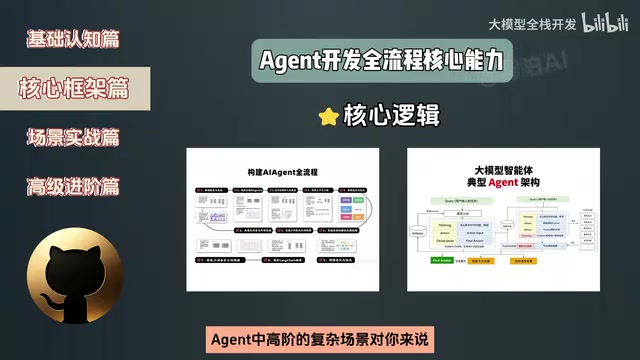
If the foundational stage is the entry point, the core frameworks stage is the heart of the entire learning roadmap. As the tutorial creator emphasizes: "All the core logic of Agents lies in this stage."
This perspective is worth reflecting on. The essence of Agent development is not about memorizing a specific framework's API, but understanding the underlying operational logic — how tasks are decomposed, how tools are orchestrated, and how state is managed. In terms of technical implementation, task decomposition and orchestration follow two core paradigms: first, the ReAct (Reasoning + Acting) pattern, where the model alternates between reasoning (Thought) and acting (Action), making decisions at each step based on the previous observation — a dynamic, step-by-step approach to task processing; second, the Plan-and-Execute pattern, where a Planner module first breaks a complex task into a list of subtasks, and then an Executor module completes them one by one. State Management is responsible for maintaining task progress, intermediate results, and error recovery information throughout the execution process, ensuring the reliability of multi-step workflows. Once you understand these underlying patterns, you can quickly get up to speed with any specific framework.
Once you've truly internalized the core frameworks, tackling mid-to-advanced complex scenarios is simply a matter of "swapping tools and swapping scenarios" — no rote memorization required.
This learning philosophy of "understanding the essence rather than memorizing the surface" is what separates people who "can use tools" from those who "truly master the technology." It also explains why many people, after following a tutorial to build a demo, are completely lost when facing a new requirement — they learned operational steps, not design thinking.
From Technical Implementation to Commercial Deployment
Stage 3 — Scenario-Based Practice: Growing Your Skills Through Projects
The tutorial creator uses a vivid metaphor: if the core frameworks stage is the "skeleton of the human body," then the scenario-based practice stage is the "muscles and blood." In technical learning, the importance of hands-on practice cannot be overstated.
This stage is designed around "one theme per lesson + complete project replication," covering a comprehensive range of commercial scenarios:
- Office automation assistants
- E-commerce customer service agents
- Content creation Agents
- Data analysis assistants
- Private domain marketing bots
- Workplace reporting tools
According to the tutorial, by this stage, learners' Agent development skills are sufficient to "handle daily needs and tackle 80% of commercial scenarios." While this figure is an experiential estimate, it reflects a reality: the vast majority of enterprise-level Agent requirements are essentially variant combinations of these typical scenarios. Mastering these project templates covers most freelance opportunities in the market.
Commercial deployment of AI Agents is on the eve of an explosion. According to a 2024 McKinsey report, the application of generative AI in enterprises is shifting from the experimental phase to scaled deployment, with Agent-form applications showing the most rapid growth. In the Chinese market, enterprise demand for AI Agents is primarily concentrated in customer service, marketing, data analysis, and office automation. Gartner predicts that by 2028, at least 15% of daily work decisions will be made autonomously by AI Agents. From a business model perspective, monetization paths for Agent developers include: building custom vertical-scenario Agents for enterprises (project-based billing), developing SaaS-based Agent products (subscription billing), and taking on Agent-building tasks on freelance platforms. Currently, a mid-complexity enterprise-level Agent project typically commands fees ranging from several thousand to tens of thousands of yuan, and developers with practical skills are in high demand.
Stage 4 — Advanced Mastery: From Technical Execution to Product Thinking
The final stage targets a higher goal — upgrading from a "technical implementer" to a "product designer."
The tutorial creator describes a vivid contrast: when an average developer delivers, the client might just "politely compliment the complete feature set"; but a truly high-level delivery makes the client "show an expression of disbelief when asking about the development timeline." The difference behind this is advanced product thinking.
The core of this stage is no longer technology, but a shift in mindset: instead of forcing requirements into pre-made templates, you design Agents directly using product logic. Understanding users' real pain points, designing sensible interaction flows, and balancing features against costs — these are the skills that create the gap, and they represent the essential path from freelance side work to professional development. Specifically, product thinking requires developers to consider: Agent error handling and degradation strategies (how to gracefully handle model hallucinations or tool call failures), cost optimization (finding the balance between model call frequency, Token consumption, and user experience), and observability design (continuously improving Agent performance through logging, monitoring, and evaluation systems).
Practical Advice for AI Agent Learners
Drawing from this learning roadmap, here are several universally applicable tips for Agent learners:
First, prioritize underlying principles over tool accumulation. Frameworks and tools will keep evolving, but the core design logic of Agents remains relatively stable. Investing time in understanding fundamentals yields higher returns. Take LangChain as an example: it underwent a major refactor from v0.1 to v0.2, with many legacy APIs deprecated, yet the core abstractions — Chain, Agent, Tool — remained consistent throughout. Master these abstract concepts, and you can quickly adapt even when frameworks change.
Second, stick to project-driven learning. Just watching tutorials without getting hands-on traps you in the illusion of "I get it." For every concept you learn, find a real scenario to implement and validate it.
Third, develop a product perspective. Technology is just a means to an end — only Agents that solve real business problems have value. In the later stages of learning, consciously think about problems from the user's and business's point of view.
Fourth, plan your time realistically. The pace of "6 hours per week, entry-level in six months" is a reasonable reference point. Consistency is key in technical learning — maintaining a steady investment rhythm beats sporadic bursts of effort.
Final Thoughts
As an important application paradigm in the age of large models, the learning barrier for AI Agents is gradually decreasing, but truly achieving "production-ready deployment" still requires systematic knowledge accumulation and extensive hands-on practice. The four-stage roadmap outlined above — Foundational Knowledge, Core Frameworks, Scenario-Based Practice, and Advanced Mastery — provides a clear framework for progression.
A word of caution: any claims of "from beginner to expert in 7 days" or "job-ready upon completion" should be viewed with healthy skepticism. There are no shortcuts to technical growth. A solid understanding of principles combined with sufficient project practice is the real way to avoid detours.
Related articles

Uber Deploys ChatGPT Work Company-Wide: AI in the Workplace Enters the Scaled Implementation Phase
Uber deploys ChatGPT Work to 30,000+ employees, extending it from engineering to all roles. We analyze its expert-engineer pairing, end-to-end automation, and questions of AI control and power concentration—insights for scaling AI in the workplace.

Shift at Midnight Hands-On: When "ID Verification" Becomes Alien Hunting
Shift at Midnight blends ID verification with horror survival in a four-player co-op game. We break down its inspection mechanics and chaotic humor.

Zelensky Recounts the Outbreak of War: I Need Ammunition, Not a Ride
Zelensky recalls the first day of war in a YouTube interview: farewell to family, rejecting Biden's evacuation offer with "I need ammunition, not a ride," and how Bucha shaped his stance on compromise and peace talks.