From Chain to Graph: Why LangGraph Has Become the Engineering Foundation for AI Applications

AI app development is evolving from Chain to Graph — and LangGraph is the best engineering vehicle for that shift.
This article traces the logic behind the shift in AI application development from Chain (linear pipeline) to Graph structure. While Chain was widely adopted for its simplicity and mature ecosystem, it hits fundamental limits in complex Agent scenarios: no backtracking, no state management, no dynamic branching, and no structured memory. Graph — built on nodes, edges, and shared State — natively supports cycles, branching, parallelism, and backtracking. LangGraph, as a framework built on this model, delivers deterministic workflow orchestration, a unified State abstraction, and production-grade capabilities like checkpoint-and-resume and Human-in-the-loop, earning its reputation as the "operating system for Agents."
The development paradigm for AI applications is quietly shifting — moving from the familiar Chain (linear) structure toward a Graph structure. This isn't a concept invented out of thin air; it's a technical evolution that was gradually forced into existence by the demands of complex real-world scenarios. Based on the first chapter of a LangGraph tutorial series, this article traces the logic behind this architectural shift and explains why LangGraph is often called the "operating system for Agents."
The Golden Age of Chains — and Their Limits
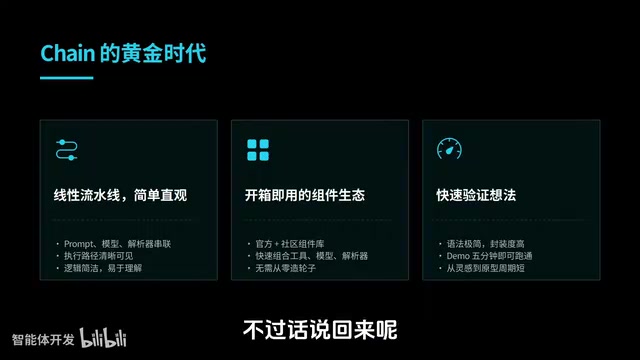
In the early days of AI application development, almost everyone used the Chain (linear pipeline) model, and it had its golden age for good reason. Its rapid adoption came down to three core advantages: First, it's a purely linear pipeline — like following a recipe step by step. Chaining together a prompt, a model, and a parser is straightforward, with a clear execution path and virtually no learning curve. Second, the component ecosystem is mature, with a wealth of ready-made components contributed by both the official team and the community — tool calling, model integration, and output parsing can all be snapped together. Third, it's ideal for rapid prototyping: simple syntax, high-level abstractions, and you can have a working demo running in five minutes.
But the problem with Chain isn't that it's "bad" — it's that its capability boundaries are very well defined. Once you step into complex Agent application territory, the underlying limitations become unavoidable. They show up in four main ways:
- No backtracking: Chain executes in one direction only. Once you move from one step to the next, you can't go back if something went wrong. Errors propagate forward, polluting subsequent reasoning with no ability to self-correct.
- No native state management: Execution only passes the output of one step as input to the next. Complex context and intermediate variables must be stored and passed manually, and it's easy to lose data if you're not careful.
- No dynamic branching: Execution is strictly linear — you can't dynamically choose a different path based on intermediate results. It's like driving on a road with no turns: if there's a blockage ahead, you're stuck.
- No structured memory: Multi-turn conversation history has to be manually stitched into the prompt, making it difficult to maintain state consistency and prone to contradictions between turns.
The Three Core Elements of a Graph Structure
These are precisely the problems that Chain was never designed to solve — and they gave rise to the Graph-based approach. To understand Graph, you first need to grasp three fundamental building blocks.
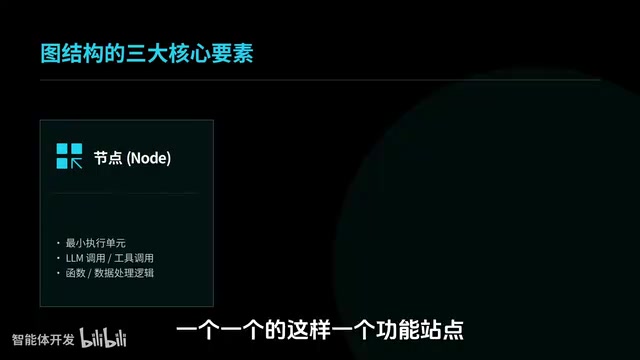
Nodes are the smallest units of execution in a graph — think of them as individual functional stations. Calling an LLM is a node. Calling a tool is a node. Writing a function to process data can also be a node. Each node is responsible for one specific task.
Edges represent the flow logic between nodes — like the routes connecting stations. An edge can be a simple direct connection (A goes straight to B), or it can carry decision logic (choose a route based on the current situation).
State is the most critical element of the entire graph structure — think of it as a shared "public notebook" available to the whole graph. Every node can read from and write to it, storing context, intermediate results, and conversation history, all synchronized and accessible throughout execution.
In a nutshell: Graph replaces the chain by using nodes to carry specific functionality, edges to define execution paths, and State to accumulate all information — creating an intelligent execution framework that is both flexible and capable of backtracking.
In LangGraph, State is typically defined using Python's TypedDict or a Pydantic model — essentially a strongly-typed dictionary structure. Unlike ordinary function-to-function parameter passing, State persists throughout the entire lifecycle of the graph. After each node executes, it can return a partial update to the State, and the framework is responsible for merging that update back into the global State. This design draws inspiration from frontend state management libraries like Redux: a single source of truth, immutable updates, and traceable history. Because State is shared across the entire graph, LangGraph can support "checkpoint-and-resume" execution — simply serialize the State at any point in time, and execution can be resumed from that exact State later. This is a capability that the Chain model fundamentally cannot support.
A Four-Dimensional Comparison: Graph vs. Chain

Comparing the two across four dimensions makes the differences immediately clear:
| Dimension | Chain | Graph |
|---|---|---|
| Execution flow | Unidirectional and linear, fixed sequence — like a one-way street | Topological network structure supporting cycles, branching, and parallelism — like a full city road network |
| Data passing | Single-value chained passing with limited information capacity | Global State shared across all nodes, with full context available at any time |
| Branching capability | No native branching; relies on Prompt-based hints to guide the model — unstable | Built-in conditional edges with deterministic, code-level decision logic |
| Fault tolerance | Essentially none — one failure collapses the whole chain, no retry support | Supports retries, fallback logic, and even checkpoint-and-resume |
This comparison makes it clear: Chain's limitations are baked into its underlying design and can't be patched away. Graph, built on the core model of nodes, edges, and state, is inherently suited to expressing complex decision logic.
The "conditional edge" mentioned in the table is one of the key mechanisms that makes Graph superior to Chain. In LangGraph, a conditional edge is simply an ordinary Python function: it takes the current State as input and returns the name of the next node to jump to. This means all routing logic is explicit code — not vague instructions buried in a prompt. By contrast, the common Chain-era approach was to write "if the result is X, do A; if it's Y, do B" in the prompt, then parse the model's output to guess which path to take — an approach that is unreliable, hard to test, and nearly impossible to debug. Conditional edges elevate "decision-making" from the model behavior layer to the engineering control layer, making them a foundational piece of infrastructure for building reliable Agents.
Three Core Values LangGraph Brings
As a framework built on top of the Graph structure, LangGraph delivers practical value on three levels.

Deterministic workflow orchestration. With Chain, complex logic often ends up buried in prompts — essentially a black box where you don't know why a particular path was chosen. LangGraph moves decision logic out of opaque prompts and into transparent code. The entire workflow becomes visualizable, testable, and traceable — predictable, debuggable, and monitorable.
State-driven design philosophy. LangGraph provides a unified State abstraction. Whether you're handling multi-turn conversations, tool calls, or memory management, everything is stored in the same standardized carrier — dramatically reducing the development cost of complex interactions.
A production-ready engineering foundation. LangGraph ships with out-of-the-box support for checkpoint-and-resume, Human-in-the-loop, streaming output, and other capabilities essential for production environments — ready to deploy without building from scratch.
This is why LangGraph is often described as the "operating system for Agents" — it distills industry best practices into a standard programming model and helps build a reusable AI development ecosystem.
"Human-in-the-loop" refers to pre-defined checkpoints in an automated workflow that allow humans to pause execution at specific nodes, review the current State, make manual adjustments, and then resume. This is critical in high-stakes scenarios such as financial approvals, content compliance, and medical decision-making — an Agent should never execute irreversible actions (like sending an email or triggering a payment API) without human confirmation. LangGraph natively supports this pattern through interrupt_before or interrupt_after mechanisms. Developers simply declare which nodes require human review when compiling the graph, and the framework automatically suspends execution at those points and waits for external input — no need to manually implement complex state-saving and restoration logic.
Three Core Conclusions
Looking at this architectural evolution, three conclusions emerge:
- Chain is well-suited for simple, linear scenarios. It's highly efficient for straightforward tasks, but struggles in complex Agent scenarios — its underlying design determines its ceiling.
- Graph is inherently suited for complex decision-making. Built on the core model of nodes, edges, and state, it supports cycles and backtracking, offers strong expressive power, and can adapt to a wide variety of complex business scenarios.
- LangGraph is the standardized engineering foundation for AI applications. It encodes industry best practices, provides a standardized programming model, and offers complete engineering support for complex AI systems.
In one sentence: the shift from Chain to Graph is the direction AI technology is heading, and LangGraph is currently the best engineering vehicle for that evolution. Subsequent chapters will break down LangGraph's core concepts one by one — State (the data carrier), Node (the execution unit), Edge (the connecting bridge), and Conditional Edge (the key to dynamically selecting paths based on state for intelligent flow control).
Related articles

Free Unlimited Claude Code Solution: Agnes AI + CC Switch Setup Guide
No paid subscription needed — pair the free AI platform Agnes AI with the open-source tool CC Switch to provide a backend for Claude Code, enabling unlimited free calls to text, image, and video models. This guide covers the full setup, test results, and usage boundaries.

A Complete Zero-Cost Guide to Getting Started with Claude Code for Beginners in China
A beginner's guide to Claude Code for users in China: two installation methods (command line and IDE plugin), full configuration steps for replacing the official API with the free domestic LongCat model, and a hands-on demo of building a small tool with natural language, plus tips.

When the NSA Gets Involved: The AI Supply Chain Crisis Behind Open-Source CVEs and API Key Hijacking
Multiple open-source projects disclosed severe CVEs in one day, PHP flaws alarmed the FBI, and Railway and OpenCode were breached with API keys stolen. This article breaks down the vulnerability window, AI-accelerated exploitation, and the AI supply chain crisis behind the API key black market, with a developer defense checklist.