LangGraph in Practice: From Building Blocks to Production-Grade AI Agents

*LangGraph in Small Pieces* systematically explains LangGraph by breaking it into small pieces, from foundational building blocks to production-grade capabilities.
*LangGraph in Small Pieces* is an open handbook written by the author of a popular Reddit post, helping developers gradually build production-grade AI Agents from the smallest usable building blocks. Part One covers LangGraph foundations (state, nodes, edges, loops, checkpoints, interrupts) without the LLM; Part Two introduces the LLM and covers tool calling, MCP, RAG, query rewriting, memory, evaluation, serving, and guardrails. All examples are real model runs using local models by default. The 31-chapter book is in beta at lgisp.ai with paragraph comments.
Why Do We Need a "Small but Complete" Handbook on LangGraph?
Many developers have built working Agents with LangGraph, but often use only a small subset of its features. The author of a popular Reddit post shared his experience: after delivering his first client-side Agent built on LangGraph at his previous company, he realized he had never touched many of LangGraph's features. So he started writing small examples to explore these features and recorded what each feature does and what surprised him. When these examples and notes gradually came together, they formed the first draft of LangGraph in Small Pieces: Building AI Agents from Blocks to Production.
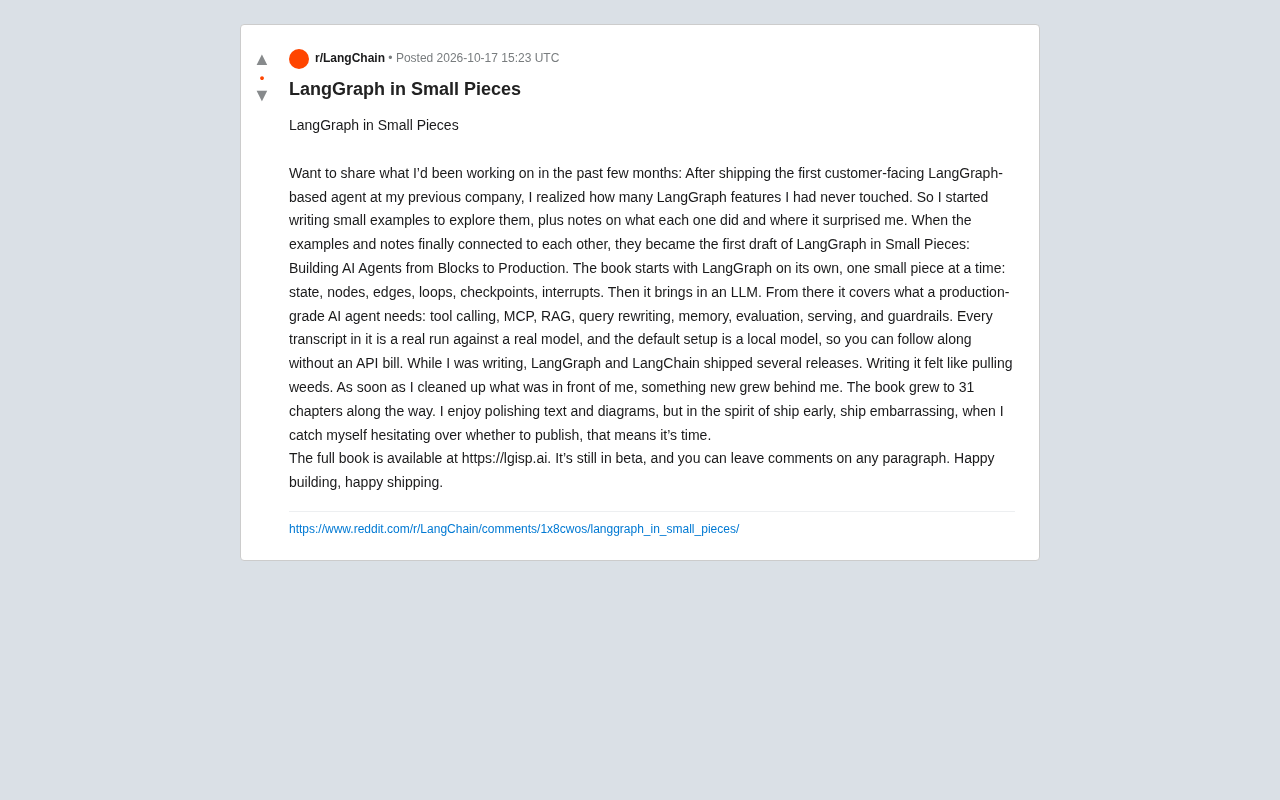
The book's starting point is clear: start from the smallest usable building blocks and gradually build up to production-grade AI Agents. The author breaks LangGraph down into foundational blocks such as state, nodes, edges, loops, checkpoints, and interrupts, then introduces the LLM, and finally covers the production-essential stages of tool calling, MCP, RAG, query rewriting, memory, evaluation, serving, and guardrails.
From Building Blocks to Production: The Book's Structure
Part One: LangGraph Foundational Building Blocks
The first half of the book focuses only on LangGraph itself, without involving the LLM. The author walks through state, nodes, edges, loops, checkpoints, and interrupts one by one. Each concept comes with an independent small example that can be run on its own to help readers understand the behavior of each building block. The author also includes notes explaining what each feature actually does and what surprised him. This "disassemble first, then assemble" approach lowers the learning curve and helps readers quickly build intuition for LangGraph's execution model.
Checkpoints are the core mechanism in LangGraph for persisting graph execution state. After the graph executes to a certain node, the framework can serialize the current complete state (including message history, variable values, etc.) and save it to external storage (such as memory, SQLite, Postgres, etc.). This allows the Agent to resume execution from the last saved point after an interruption, rather than starting over. Checkpoints are also the foundation for "time travel" debugging, human-in-the-loop approval, and long-running workflows. For production environments, the checkpoint mechanism ensures state consistency and fault tolerance.
Interrupts allow pausing during graph execution to wait for external input or human decisions. Developers can call an interrupt function within a node, and the graph will suspend there and return control to the caller. The caller can inspect the current state, modify the state, or provide additional information, and then resume execution. Interrupts are commonly used in scenarios requiring human review, conditional branch confirmation, or dynamic parameter adjustment, and are a key feature for building human-machine collaborative Agents.
Part Two: Introducing the LLM and Production-Grade Capabilities
After mastering the foundational building blocks, the book then introduces the LLM and gradually expands to the core capabilities required for production-grade Agents: tool calling, MCP (Model Context Protocol), RAG (Retrieval-Augmented Generation), query rewriting, memory, evaluation, serving, and guardrails. These topics cover the complete chain from prototype to deployment, and each topic comes with a runnable example.
The author emphasizes that every conversation transcript in the book is a real run against a real model, and the default configuration uses a local model, meaning readers can follow along without paying API fees. For developers who want hands-on practice, this is very friendly.
MCP (Model Context Protocol) is an open protocol designed to standardize the way AI models interact with external tools and data sources. It defines how models discover available tools, call tools, and obtain results, similar to a "USB-C interface for AI applications." Integrating MCP in LangGraph allows Agents to connect to a variety of tools and services in a unified way, reducing integration complexity and improving cross-platform portability. The emergence of MCP responds to the fragmentation of the tool-calling ecosystem, enabling Agents to expand their capability boundaries more flexibly.
Query Rewriting is an optimization technique in the RAG pipeline. When user queries are vague, colloquial, or contain references, direct retrieval often performs poorly. Query rewriting uses the LLM to rewrite, expand, or decompose the original query, generating query statements more suitable for retrieval (such as adding synonyms, clarifying intent, or splitting into sub-questions). This can significantly improve retrieval recall and the accuracy of the final answer. In LangGraph, query rewriting is usually implemented as a separate node placed before the retrieval node.
Challenges During Writing and the "Ship Early" Philosophy
The author admits that during writing, LangGraph and LangChain released multiple versions. The writing process was like "pulling weeds": just as you cleared what was in front of you, new growth appeared behind. Eventually, the book expanded to 31 chapters. Although the author enjoys polishing prose and diagrams, he believes in "ship early, ship embarrassing." When he hesitates about whether to publish, that is precisely the sign that it is time to publish.
This philosophy is also reflected in the book's release status: the full book is now live at https://lgisp.ai and is still in beta, and readers can leave comments on any paragraph. This open feedback approach allows the book's content to keep iterating and aligns with the collaborative spirit of the open-source community.
Who Is This Book For?
This book is suitable for developers who already have a preliminary understanding of LangGraph but want to systematically master the full picture. If you have built a simple Agent with LangGraph but feel fuzzy about mechanisms such as checkpoints, interrupts, and memory, or want to learn how to deploy Agents to production, then this book's "small pieces" breakdown approach will be very helpful. In addition, for developers who prefer local models and want to avoid API costs, the book's default use of local models lowers the barrier to practice.
LangGraph Learning Resources from Multiple Perspectives
Although this post mainly introduces the author's personal book, combined with community discussions about LangGraph, we can see a consensus: LangGraph is feature-rich, but official documentation often focuses on API references and lacks coherent examples from zero to production. This book's "small pieces" approach fills exactly this gap. However, some developers point out that LangGraph iterates quickly, and the book's content may soon become outdated. The author's response is to use beta releases and paragraph comments to enable continuous updates. Whether this model can effectively cope with a rapidly changing tech stack remains to be seen.
Conclusion
LangGraph in Small Pieces offers a progressive learning path: start from the smallest building blocks and gradually build up to production-grade Agents. For developers who want to master LangGraph in depth, this is a resource worth following. The examples and notes in the book come from the author's real practice rather than simple documentation restatement, which also makes the content more valuable as a reference. If you are interested in LangGraph, you might want to visit https://lgisp.ai and leave your feedback.
One-line Summary
LangGraph in Small Pieces systematically explains LangGraph by breaking it into small pieces, from foundational building blocks to production-grade capabilities.
Paragraph Summary
LangGraph in Small Pieces is an open handbook written by the author of a popular Reddit post, designed to help developers gradually build production-grade AI Agents from the smallest usable building blocks. The book is divided into two parts: the first focuses on LangGraph foundational building blocks (state, nodes, edges, loops, checkpoints, interrupts) without involving the LLM; the second introduces the LLM and covers production-essential topics such as tool calling, MCP, RAG, query rewriting, memory, evaluation, serving, and guardrails. All examples are based on real model runs, and local models are used by default to reduce practice costs. Upholding the philosophy of "ship early, ship embarrassing," the author has published the full 31 chapters in beta at lgisp.ai with paragraph comments, suitable for developers who already have a preliminary understanding of LangGraph and want to systematically master it and deploy to production.
Related articles

Free Unlimited Claude Code Solution: Agnes AI + CC Switch Setup Guide
No paid subscription needed — pair the free AI platform Agnes AI with the open-source tool CC Switch to provide a backend for Claude Code, enabling unlimited free calls to text, image, and video models. This guide covers the full setup, test results, and usage boundaries.

A Complete Zero-Cost Guide to Getting Started with Claude Code for Beginners in China
A beginner's guide to Claude Code for users in China: two installation methods (command line and IDE plugin), full configuration steps for replacing the official API with the free domestic LongCat model, and a hands-on demo of building a small tool with natural language, plus tips.

When the NSA Gets Involved: The AI Supply Chain Crisis Behind Open-Source CVEs and API Key Hijacking
Multiple open-source projects disclosed severe CVEs in one day, PHP flaws alarmed the FBI, and Railway and OpenCode were breached with API keys stolen. This article breaks down the vulnerability window, AI-accelerated exploitation, and the AI supply chain crisis behind the API key black market, with a developer defense checklist.