Deep Dives
In-depth AI analysis, industry observations, and technical insights — slow down and read.

Is a Touchscreen MacBook Coming? Vergecast Reveals Apple Executive's Response
Vergecast podcast reveals a conversation between a reporter and Apple executive John Ternus about a touchscreen MacBook and Apple Pencil support. Ternus says iPad is the best device for a stylus, while the reporter bets MacBook will eventually support Apple Pencil.

DeepSeek Harness: A Beginner's Installation and Testing Guide
A DeepSeek Harness tutorial for test engineers: set up Node.js, launch with one NPX command, configure official and third-party models, and explore web search, file I/O, and trace-view agent observability.
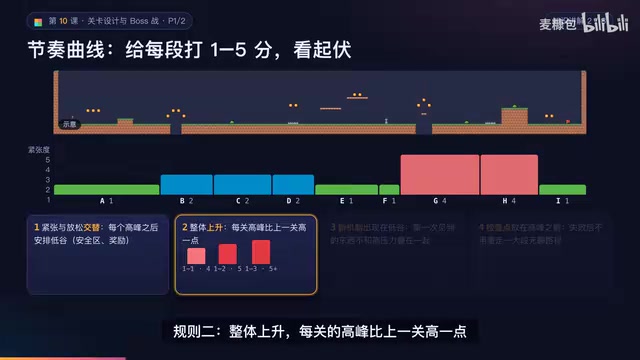
AI Game Development in Practice: Designing Levels with the Four-Step Method and Pacing Curves
AI game development lesson 10: design levels with the four-step method (teach, practice, combine, test) and a 1-5 pacing curve, plus sightline guidance and safety zones—implement Animatable Body 2D moving platforms and generate ASCII sketches for 1-2 Underground Cavern and 1-3 Guard Hall.

AI Game Development in Practice: Two-Phase Boss State Machines and Death Heatmap Tuning
AI game development lesson 10: implement a two-phase Boss with a state machine, guarantee fairness with color signals and a 0.4-second warning floor, locate difficulty cliffs with a death heatmap, and apply lightest-to-heaviest fixes one at a time, with an acceptance checklist and common pitfalls.
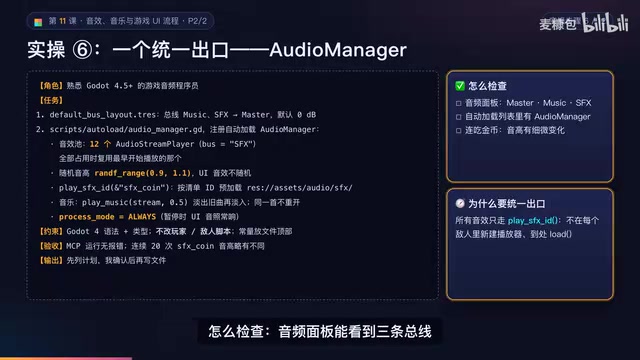
AI Game Development in Practice: Audio Buses and Building the Full UI Flow
AI game dev lesson 11 part 2: Godot's audio trio, audio buses and dB conversion, AudioManager's player pool and random pitch, autoload boundaries, the full UI flow from title to clear, fault-tolerant JSON saves, and pixel font anti-aliasing and integer-size rules.
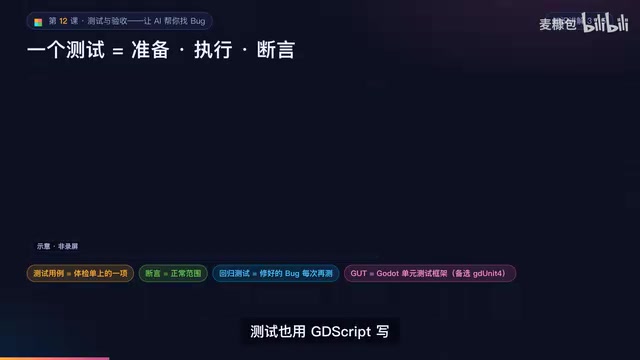
AI Game Dev Acceptance Lesson: Using GUT Tests and Agent Self-Checks to Make Bugs Impossible to Hide
Lesson 12 of AI game development: use GUT automated tests, Agent self-check loops, browser smoke acceptance, and external playtesting to turn "AI says done" into verifiable evidence.

DoorDash Reveals Only Hundreds of Orders from AI Agents, Open Collaboration Seen as Key
DoorDash reveals only hundreds of orders from AI agents and says it is open to working with third-party agent developers. This article analyzes the early state of agentic commerce, platform openness, and transaction trust bottlenecks.

Kimi K3.1 Pro Pricing and Benchmarks: Open-Weight Promises and the True Cost
Kimi K3.1 Pro costs $2 per million input tokens and $10 per million output tokens, scores 65.7% on Terminal-Bench 4.0 (vendor-reported), and promises open weights by November 4. This article breaks down its pricing structure, benchmark credibility, and real cost per task.

Waymo's New Tokyo Robotaxi to Use Toyota bZ4X, Launching in 2027
Waymo announces 2027 Tokyo robotaxi service using Japan-assembled Toyota bZ4X EVs, deepening the strategic partnership established in April 2025. This analysis examines the model choice rationale and industry impact.

North Korean Hackers Allegedly Stole $6.3 Billion in Crypto from Binance
North Korean hackers allegedly breached a Binance employee laptop to steal up to $6.3 billion in crypto. This analysis covers the attack path, attribution dispute, and security lessons for the crypto industry.

TechCrunch Summit Introduces Braindate: Skip the Small Talk, Match for Deeper Connections
TechCrunch Founder Summit 2026 will be held on November 4 in Boston and will introduce the structured networking tool Braindate, helping attendees achieve 1:1 or small-group deep conversations through topic matching. Register early to save up to $100 and receive a second pass.
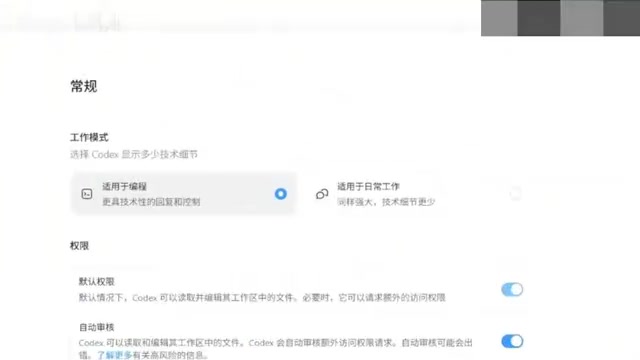
The Ultimate Codex Guide: From Installation to Real-World Use — AI That Operates Your Computer for You
A Bilibili creator demonstrates Codex: installing via app store, configuring work mode and project folders, organizing messy files into Excel, and building a visual dashboard with Plan Mode.

Getting Started with LangChain: Agent Development and RAG in Practice
A Bilibili LangChain tutorial breakdown: what LangChain is, its analogy to Spring, the three LLM limitations (knowledge cutoff, external interaction, statelessness) and how LangChain solves them, plus official docs learning path and Agent development tips.

A Three-Month Python Roadmap for Beginners: Syntax and Web Scraping in Full
Based on a Bilibili Python beginner tutorial, this article outlines a three-month path from syntax to scraping practice to framework advancement, analyzing key actions and common pitfalls at each stage and offering a sober assessment of the "job-ready in three months" claim.

Multimodal LLM Deployment and Fine-Tuning in Practice: Job Skills and Learning Path
A Bilibili public class on multimodal LLM deployment and fine-tuning: instructor Chen Bo explains the three skills AI engineers need—application development, fine-tuning, and fundamentals.

Getting Started with LangChain: A Guide to the LLM Application Development Framework
An in-depth look at the origins and core features of the LangChain framework, the three major limitations of large model applications, and how LangChain solves them through chained construction, state management, and tool calling, plus the 1.0 architecture changes and its relationship with LangGraph.

Spring AI 2.0 in Practice: A Java Developer's Guide to Agent Development
Based on Turing Classroom's Spring AI 2.0 course, this article maps the complete path for Java developers to build AI Agents with Tools, MCP, and Skill, with an airline customer service demo.

Agent Hands-On Tutorial: From Principles to Multi-Agent Deployment
Key takeaways from the first lesson of the Bilibili Agent hands-on tutorial: the essential differences between traditional large models, ordinary chatbots, and Agents; the three-layer architecture of perception, thinking, and action; and application scenarios and learning paths in education and beyond.

Hermes Agent Beginner's Guide: A Self-Evolving AI Assistant
Hermes Agent beginner's tutorial: how to install and use the 41.7K-star self-evolving AI Agent. We break down its learning loop, three-tier memory, and Skill self-improvement, compare it with Claude Code and OpenClaw, and include WSL installation steps.

RAG Interview Essentials: Breaking Down the Full Offline Indexing and Online Retrieval Pipeline
A complete breakdown of the RAG retrieval-augmented generation workflow: offline document loading, chunking, vectorization, and indexing; online query rewriting, vector retrieval, reranking, and generation, plus core interview points and system optimization directions.