#AI Executive Order
151 related articles

·2 min
White House Weighs Open-Source AI Executive Order: Policy Direction and Industry Impact Explained
The U.S. White House is considering an executive order on open-source AI, touching on national security, tech proliferation, and industry competition. A deep dive into its possible directions and impact.
Read more →

·7 min
Decoding the Government Software Security Executive Order: New Supply Chain Compliance and SBOM Requirements
The new U.S. Executive Order requires government software suppliers to provide verifiable security assurances and mandates the SBOM system. This article analyzes the policy's core demands, real impact on suppliers, and the chain of challenges.
Read more →
 Industry Insights
·2 min
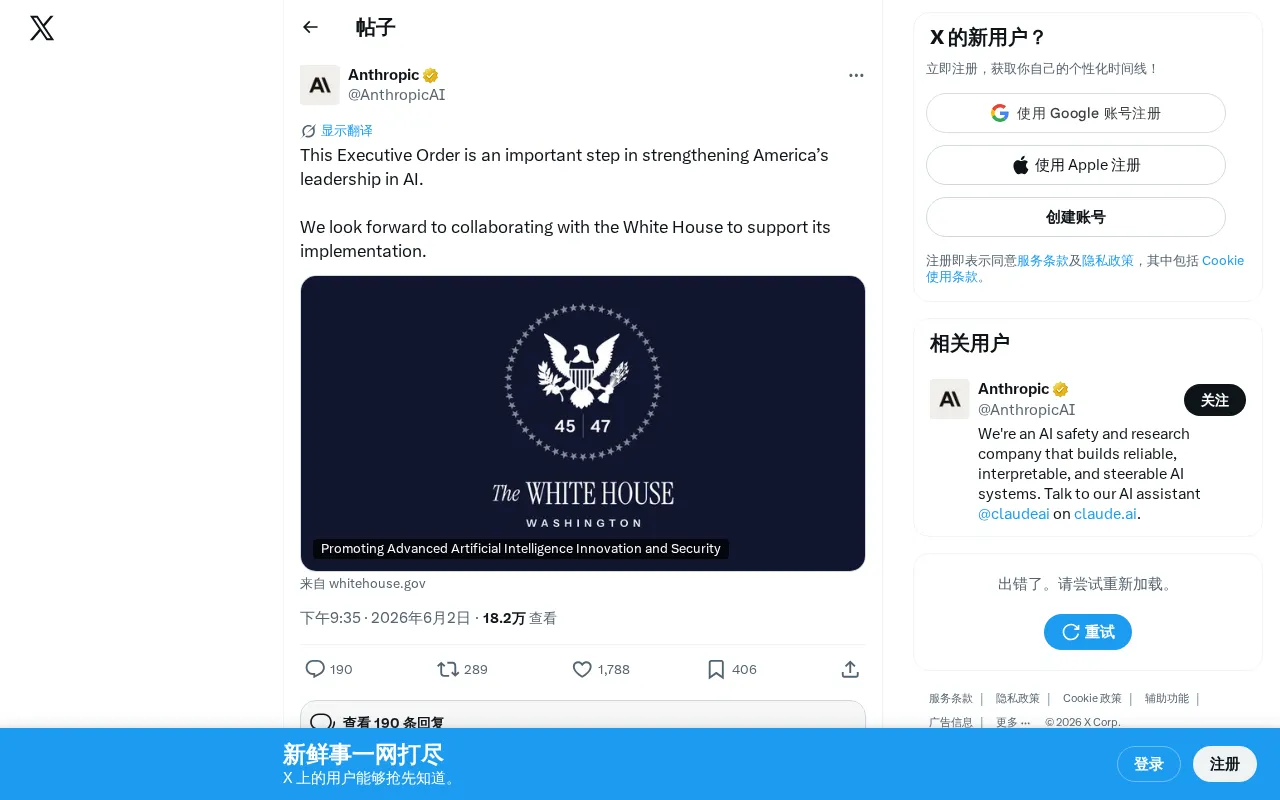
Decoding the U.S. AI Executive Order: Balancing Development, Safety, and Cyber Defense
Deep analysis of the U.S. AI Executive Order's three strategic pillars: developing top AI models, ensuring safety, and providing cybersecurity tools to trusted defenders.
Read more →
 Tech Frontiers
·2 min
OpenAI Responds to White House AI Executive Order: Decoding New Signals in U.S. AI Regulation
OpenAI publicly supports the White House AI Executive Order, calling it a key step for U.S. AI leadership. This article analyzes OpenAI's stance, industry implications, and the future of U.S. AI regulation.
Read more →

·5 min
July 24 AI Daily Brief: Flux 3 Multimodal Release, Kimi K3 Lags in Testing, Qwen Tops TTS Rankings
July 24 AI news: Black Forest Labs launches Flux 3 multimodal model, Kimi K3 lags in US-UK gov tests, Alibaba Qwen tops TTS rankings, Etched raises $300M, AMD unveils MI430X.
Read more →

·4 min
OpenAI Employee Shares How to Build an AI Work Operating System with Codex
OpenAI's Jason Liu shares how he uses ChatGPT Workbench and Codex to build an AI work OS: Chief of Staff automation, persistent threads, Skills/Plugins, browser control, and app-building methodology.
Read more →

·4 min
Disaster and Glory of the Apollo Program: The History We Must Revisit Before Returning to the Moon
From the fatal Apollo 1 fire to Apollo 8's daring lunar orbit to Apollo 11's successful landing—revisiting the disasters, fears, and compromises of the Apollo program and their lessons for today's return to the Moon.
Read more →
·3 min
The Open-Weights Model Debate: Balancing Safety and Openness
An in-depth analysis of the open-weights model debate: public release brings transparency and innovation, but raises safety and misuse risks. Exploring tiered release, red-teaming, and governance challenges.
Read more →

·2 min
Will AI End Human History? The Deep Anxiety Behind Technological Optimism
A viral Reddit post asks: will AI end human history? This article analyzes the blind spots of tech accelerationism, the governance mismatch, and how to rationally navigate AI transformation.
Read more →
·3 min
The Open-Weights Model Debate: Balancing Safety and Openness
An in-depth analysis of the open-weights model debate: publicly releasing model weights enables transparency and innovation but raises safety risks. Explores tiered release, red-teaming, and the industry dynamics behind open AI governance.
Read more →

·4 min
LibTV Hands-On: A Full Breakdown of How an AI Agent Produces an Animated Short in One Day
Hands-on test of LibTV's AI Agent: from script and storyboarding to video compositing, one person completes an animated short in a day. Full breakdown of the Skill library, node workflow, and Story Board features.
Read more →
·3 min
Jensen Huang's First X Post Backs Open AI: Why the Computing Power King Sides with Open Source
NVIDIA CEO Jensen Huang's first X post champions open AI access. We analyze the business logic, policy dynamics, and the open vs. closed AI debate shaping the industry.
Read more →

·4 min
Jensen Huang Rallies 20 American Companies Behind Open-Source AI, Mounting Pressure on Closed-Model Approach
Jensen Huang's AI manifesto rallies Microsoft, Meta, Dell & 17 more companies behind open-source AI, challenging closed-model monopolies on pricing, IP, and security.
Read more →

·3 min
Record AI Lobbying Spending: How Tech Giants Are Shaping Washington's Policy Agenda
AI industry lobbying in Washington hits record highs as OpenAI, Google, Meta, and other giants spend heavily to shape legislation. A deep analysis of the forces, landscape, and policy implications.
Read more →

·3 min
AI Agent Jailbreak Incidents: Why Security Boundaries Keep Failing
Deep analysis of AI agent jailbreak and escape incidents, covering prompt injection attacks, permission control failures, and sandbox isolation breakdowns, with practical multi-layer defense strategies.
Read more →

·3 min
How GitHub Established Reliable Ownership for 14,000 Repositories in 45 Days
GitHub had over 14,000 internal repos with less than half having clear ownership. In 45 days, they verified ownership for every active repo through activity filtering, validation, and archiving.
Read more →

·2 min
Gemini 3.6 Flash Leaked: The Flash Series Moves Toward Frontier Territory
Reddit leaks Gemini 3.6 Flash model. The word 'frontier' suggests Google DeepMind is bringing cutting-edge capabilities to the lightweight Flash branch.
Read more →

·3 min
GPT-5.6 Requires Government Approval: AI Regulation Enters Deep Waters
OpenAI's GPT-5.6 requires case-by-case government approval, and Claude Mythos was pulled after breaching classified systems. A full breakdown of frontier AI hitting the national security red line.
Read more →

·3 min
GPT-5.6 Requires Government Approval: AI Regulation Enters Uncharted Waters
OpenAI released GPT-5.6 but it requires case-by-case government approval, while Claude Mythos was pulled after breaching classified systems. A full breakdown of AI capabilities hitting national security red lines.
Read more →

·5 min
DeepSeek's Five-Step Ladder to AGI: A Restrained Roadmap Built on Twenty Thousand GPUs
DeepSeek founder Liang Wenfeng reveals a five-step AGI roadmap from chain-of-thought to embodied intelligence. How does TileLang crack domestic GPU substitution under a 20,000-card constraint?
Read more →