#AI coding reality
961 related articles
 Expert Opinions
·4 min
Rejecting Vibe Coding: Matt Pocock's Engineering-Driven Approach to AI Programming
TypeScript expert Matt Pocock's open-source Skills repo earned 80K+ GitHub Stars, using TDD and Domain-Driven Design to solve AI programming's three biggest pain points.
Read more →
 Tutorials
·4 min
Replit Agent Tutorial: Build and Launch an AI Website in 30 Minutes with Zero Code
Step-by-step tutorial on building an AI photography website with Replit Agent—no coding needed. Covers requirements, API setup, iteration, and one-click deployment for rapid MVP validation.
Read more →
 Tech Frontiers
·4 min
IBM Think 2025 Deep Dive: Rising Hallucination Rates in Reasoning Models and OpenAI's Acquisition of Windsurf
Deep dive into IBM Think 2025's Generative Computing and Granite 4, why reasoning model hallucination rates are rising, and OpenAI's $3B Windsurf acquisition strategy.
Read more →
 Deep Dives
·4 min
Claude Code Auto Mode Fully Explained: Classifier Mechanism, Fault Tolerance Design & Security Protection
Deep dive into Claude Code Auto Mode: how the independent Classifier reviews AI operations, three-level graceful degradation prevents system deadlocks, SubAgent triple review with Prompt Injection protection, plus setup and plan requirements.
Read more →
 Tutorials
·4 min
Complete Guide to Agent Observability: Tracing, Evaluation, and Red Teaming in Practice
Deep dive into Microsoft Foundry's Agent observability solution covering multi-Agent tracing, AI quality evaluation, Red Teaming security testing, and automated prompt optimization to bridge the gap between expected and actual Agent behavior.
Read more →
 Industry Insights
·4 min
The Dismantling of Windsurf: How an AI Coding Unicorn's Moat Collapsed Overnight
AI coding unicorn Windsurf, valued at $3B, was dismantled in one week — OpenAI deal collapsed, Google aquihired the team, Cognition grabbed the remains. A deep dive into AI startup moat fragility.
Read more →
 Industry Insights
·4 min
OpenAI's $3 Billion Windsurf Acquisition: The Real Reason They Didn't Choose Cursor
Deep analysis of OpenAI's $3B Windsurf acquisition: why not Cursor? How Windsurf's enterprise DNA, process data, and user mindshare fill OpenAI's gaps, while Cursor's $9B valuation reshapes the AI coding landscape.
Read more →
 Tech Frontiers
·3 min
OpenAI's $3 Billion Windsurf Acquisition: How Will It Reshape the AI Coding Tool Landscape?
OpenAI acquires AI coding tool Windsurf for ~$3B in its largest deal ever. Deep analysis of the deal's context, impact on Cursor and GitHub Copilot, and OpenAI's strategy to build an AI coding ecosystem.
Read more →
 Product Reviews
·3 min
DifyAIA: A Free Dify AI Workflow Template Library with 2500+ Stars
DifyAIA is a popular open-source Dify workflow template project on GitHub with 2500+ Stars. It offers free DSL workflow files for one-click import into Dify. Learn its features, usage, and use cases.
Read more →
 Expert Opinions
·3 min
The Tyranny of Software Is Ending: AI Lets Everyone Build Apps
Programming barriers once divided the world into those who build software and those who merely use it. AI coding tools and LLMs are breaking down that wall, enabling anyone to create apps through natural language.
Read more →
 Tutorials
·3 min
One Month Into My Internship Without Writing a Single Line of Code: A Practical Guide to AI Agent Coding
AI agent coding is now reality in 2025. Learn how to set up OpenCode with DeepSeek and let AI agents write your code through conversation, not copy-paste.
Read more →
 Industry Insights
·2 min
Uber's AI Agent Platform Now Contributes 11% of PRs — The Engineering Role Is Transforming
Uber reveals its internal Agentic Developer Platform now generates 11% of all PRs. Learn how Uber moved from AI-assisted to AI-autonomous coding and how engineering roles are transforming.
Read more →
 Product Reviews
·3 min
How to Choose an AI Agent Framework in 2026? Pros and Cons of Four Leading Solutions
Compare four leading AI Agent frameworks in 2026: Coze, AutoGen, CrewAI, LangChain, and AutoGen Studio — covering coding requirements, private deployment, and commercialization.
Read more →
 Tutorials
·3 min
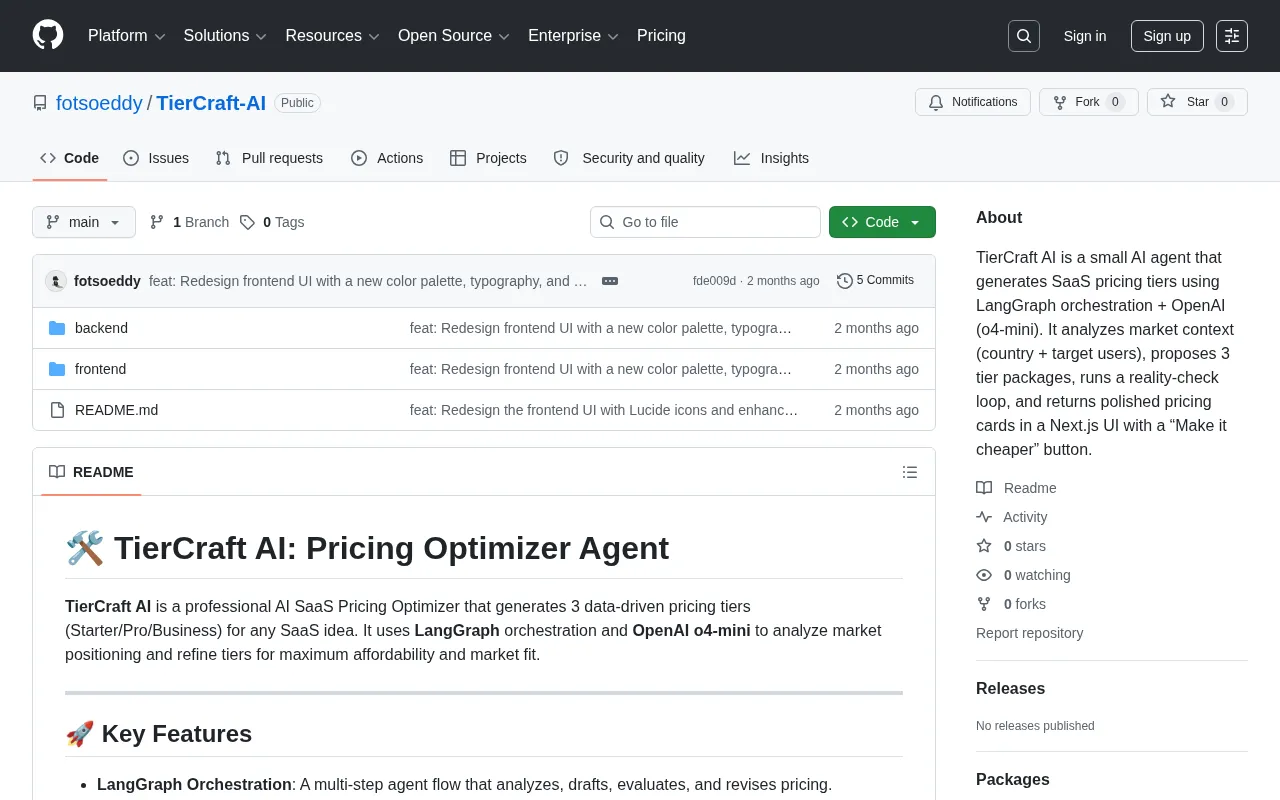
TierCraft AI: A Practical Deep Dive into Auto-Generating SaaS Pricing Plans with LangGraph + OpenAI
Deep dive into the TierCraft AI open-source project: using LangGraph to orchestrate AI Agent workflows with OpenAI o4-mini to auto-generate three-tier SaaS pricing plans, featuring Reality-Check loops and context-aware pricing.
Read more →
 Tech Frontiers
·3 min
GitLab's Major Restructuring: Layoffs, Flattening, and a Bold Bet on the AI Agent Era
GitLab announces Act 2 restructuring: cutting 30% of operating countries, removing three management layers, splitting R&D into 60 autonomous teams. A deep dive into GitLab's Jevons Paradox bet on the AI agent era.
Read more →
 Deep Dives
·4 min
AI Guardrails Index: A Comprehensive Guide to the Most Complete LLM Safety Evaluation Framework
Deep dive into the AI Guardrails Index: the most comprehensive LLM safety evaluation framework covering PII protection, jailbreak defense, harmful content filtering, and its open-source design.
Read more →
 Tech Frontiers
·2 min
Cursor Launches Claude Opus 4 Fast Mode: 2.5x Faster, 6x More Expensive — Is It Worth It?
Cursor launches Claude Opus 4 Fast Mode with 2.5x speed but 6x cost. We analyze use cases, cost tradeoffs, and practical tips to help you decide if it's worth it.
Read more →
 Tutorials
·3 min
Phone + Claude Code: Building an iNaturalist Observation Display Tool While Camping
Simon Willison built a complete iNaturalist observation display tool using only his phone and Claude Code while camping. A breakdown of the three-layer architecture: Python CLI, Git Scraping automation, and pure frontend display.
Read more →
 Expert Opinions
·2 min
In the Vibe Coding Era, Using RSS to Share and Discover Personal Apps
AI-assisted programming makes building tools as easy as blogging, but how are these personal apps discovered? Matt Webb proposes RSS for vibe-coded apps, and Simon Willison quickly validates the idea.
Read more →
 Expert Opinions
·2 min
The Vibe Coding Era: Why We Need RSS to Share Personal Micro-Apps
Vibe coding makes AI programming as simple as blogging, driving an explosion of personal micro-apps. Matt Webb proposes RSS for sharing micro-apps, and Simon Willison has already implemented it.
Read more →