#AI scraping defense
47 related articles

·3 min
Beware the Prompt Injection Trap Behind LLM Testing Posts: A Social Engineering Attack Analysis
Deep analysis of a Reddit post disguised as LLM robustness research that's actually an indirect prompt injection attack, revealing its social engineering tactics and providing security defense strategies.
Read more →

·3 min
ScrapeOps Proxy Tester: Choose the Right Proxy for Your Scraper with Real-World Data
ScrapeOps Proxy Tester benchmarks 20+ proxy configurations against your specific target URL, measuring success rate, latency, and cost to help scrapers and AI Agents choose the optimal proxy.
Read more →

·3 min
AI Crawlers Crash Gentoo Bugzilla: Open-Source Infrastructure Faces a Data Plundering Crisis
Gentoo's official Bugzilla was forced offline by AI crawler overload, exposing the data plundering crisis facing open-source infrastructure in the AI era.
Read more →

·3 min
Eliminating Fake Torrents in Sonarr: Building a Truly Hands-Off Media Library
In-depth analysis of why Sonarr grabs .exe/.scr fake torrents, with practical solutions including size minimums, Release Profile filtering, Prowlarr pre-filtering, and the case for private Trackers vs public indexers.
Read more →

·3 min
Perplexity Comet's Declining Agent Capabilities: Why This AI Browser Is Becoming Timid
Perplexity Comet users report declining AI agent capabilities, with form-filling and automation tasks frequently refused. We analyze the causes from anti-automation detection, compliance risks, and model policy tightening perspectives.
Read more →

·2 min
The Privacy Boundaries of AI Data Collection: Your Bedroom Is Becoming a Model Training Ground
A humorous tweet about clothes entering AI training data reveals the privacy dilemma of AI data collection. We explore machine unlearning challenges, consent issues, and how users can balance convenience with privacy.
Read more →

·2 min
EU AI Rules for General-Purpose Models Now in Effect: Compliance Requirements and Industry Impact
The EU AI Act's general-purpose AI model provisions are now enforceable, covering transparency obligations and additional oversight for systemic risk models. This article analyzes the impact on companies like OpenAI and Google, plus global compliance challenges.
Read more →

·3 min
Scanning 7.6PB of HuggingFace Data: A Hidden Key Crisis in AI Training Sets
A security audit of 7.6PB of HuggingFace training data uncovered massive API key and credential leaks. Analysis of risks, scanning challenges, and data supply chain security governance.
Read more →

·6 min
Separate Domains vs. Subdomains for Self-Hosted Services? A Deep Dive into Security Isolation Strategies
Deep dive into domain security architecture for self-hosted services: Should services with different exposure levels use separate domains or subdomains? Analysis of subdomain enumeration risks, defense in depth, and practical isolation strategies.
Read more →

·2 min
Anthropic's Call to Restrict Open-Source Models Sparks Outrage: Safety or Monopoly?
Anthropic CEO's call to restrict "dangerous capabilities" in open-source AI models sparks fierce backlash. Developers question double standards and fear monopoly disguised as safety.
Read more →

·2 min
Criblist: Find San Francisco Apartments Like Swiping on Tinder
Criblist is a San Francisco rental aggregation tool that brings Tinder-style swiping to apartment hunting, integrating real-time listings from Craigslist and local property managers with budget, neighborhood, and must-have filters.
Read more →

·4 min
AI Companies Buy Books, Scan Them, Then Destroy Them: Pulping of Rare Books Sparks Cultural Preservation Debate
Some AI companies are mass-purchasing physical books for destructive scanning and pulping to obtain training data, even targeting rare antiquarian volumes. This article analyzes the technical motivations, legal gray areas, and cultural preservation controversies.
Read more →

·2 min
The Truth Behind Codex 'Build a Website in 5 Minutes': AI Isn't Creating Sites—It's Helping You Copy Them
Exposing the truth behind viral Codex 5-minute website videos: creators aren't building original sites with AI—they're copying shared prompts or scraping others' work. Learn AI coding tools' real limits.
Read more →
·3 min
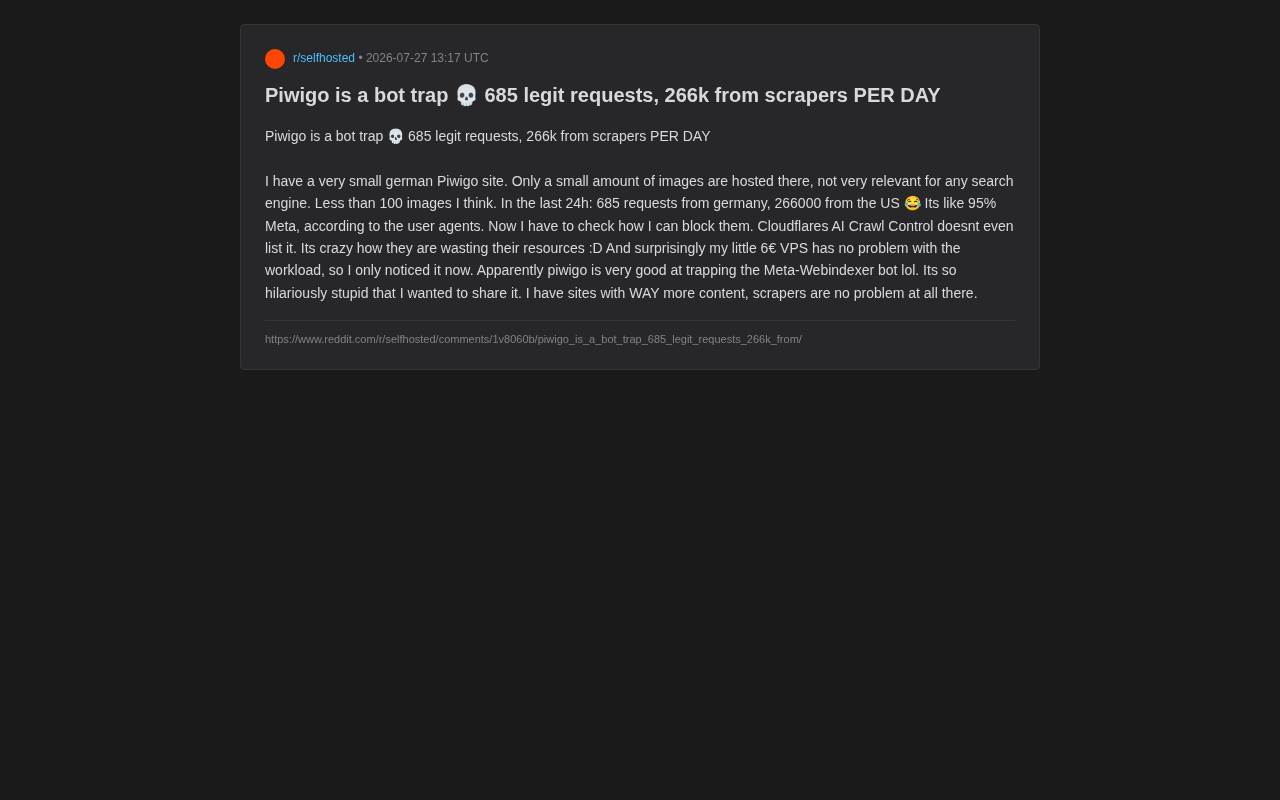
Small Site Besieged by AI Crawlers: Under 100 Images, 266K Crawl Requests
A Piwigo gallery with under 100 images received 266K AI crawler requests in 24 hours. Analysis of why gallery CMS becomes a bot trap and how to defend against it.
Read more →

·3 min
Deepfake Detection Datasets: A Complete Guide to AI-Generated Faces, Face Swaps, and Real Face Public Resources
A systematic guide to public face datasets for deepfake detection research, covering FaceForensics++, Celeb-DF, FFHQ, and more, organized by AI-generated, deepfake, and real face categories.
Read more →

·3 min
Cloudflare Blocks Anti-Scraping Proxies: IP Reputation Is the Real Culprit
Analysis of why FlareSolverr and Byparr fail against Cloudflare. The real issue isn't CAPTCHA solving — it's IP reputation. Learn about VPN pitfalls, static IP risks, and practical solutions.
Read more →
Ego-lite: An Open-Source Browser Desig…
·3 min
Ego-lite: An Open-Source Browser Designed for Humans and AI Agents to Work in Parallel
ego-lite is an open-source AI-native browser by citrolabs that lets humans and AI Agents work in parallel in the same environment. Explore its design and value.
Read more →

·7 min
Getting Started with Claude Code: Five Dimensions to Understand Why It Outperforms Regular AI
Claude Code isn't just a chat AI—it can directly read projects, modify code, and run commands. This article compares Claude Code with regular AI across five dimensions to help you decide if it's worth trying.
Read more →

·3 min
AI-Accelerated Reverse Engineering: Cracking SM2/SM4 Encrypted Freelance Jobs in 30 Minutes
Real freelance case study: how to use DeepSeek and LLMs to reverse-engineer SM2/SM4 encrypted API parameters in 30 minutes, covering anti-debug bypass, call stack backtrace, and AI-assisted deobfuscation.
Read more →

·2 min
BrowserSkill: A Controlled Channel for AI Agents to Safely Borrow Your Logged-In Browser
Tencent's open-source BrowserSkill (BSK) lets AI agents reuse your real browser login state via a separate window, single-tab borrowing, and human takeover — safely and within clear boundaries.
Read more →