#Adaptive Recall
41 related articles

·5 min
How an MD Is Reshaping Biological Research with AI Codex: A Practical Path to Accelerating the Fight Against Cancer
Immunologist Derya Unutmaz shares how he used OpenAI Codex to build research-grade apps for flow cytometry analysis and CRISPR design, exploring AI-driven digital twins and personalized cancer treatment.
Read more →

·7 min
Spring AI 2.0 in Practice: A Beginner's Guide for Java Developers Building AI Agents
A complete Spring AI 2.0 guide for Java developers covering unified API abstraction, RAG, tool calling, MCP protocol, and enterprise projects to build AI Agents.
Read more →

·7 min
The Complete Guide to AI-Powered Customer Service: How AI Is Reshaping Enterprise Service Systems
AI customer service is a core tool for digital transformation. This guide covers its value, use cases, and implementation logic, including efficiency gains, cost reduction, and data-driven optimization.
Read more →

·3 min
LLM Development Learning Path: From Zero to Enterprise-Level Projects
A complete LLM development learning roadmap covering prompt engineering, RAG, AI Agents, and fine-tuning — helping beginners master LangChain, LlamaIndex, and more.
Read more →

·2 min
AI Large Model Development Learning Path: A Complete Guide from Zero to Enterprise Projects
A complete learning roadmap for AI large model development — covering Transformer, Prompt Engineering, RAG, LangChain, Agent development, fine-tuning, and deployment.
Read more →

·3 min
Why Claude Code Ditched RAG for Grep: The Engineering Logic Behind the Decision
Why did Claude Code abandon RAG for Grep? Breaking down the three root causes — undiagnosability, the multiplication effect, and index staleness — behind the shift to Agentic Search.
Read more →
·8 min
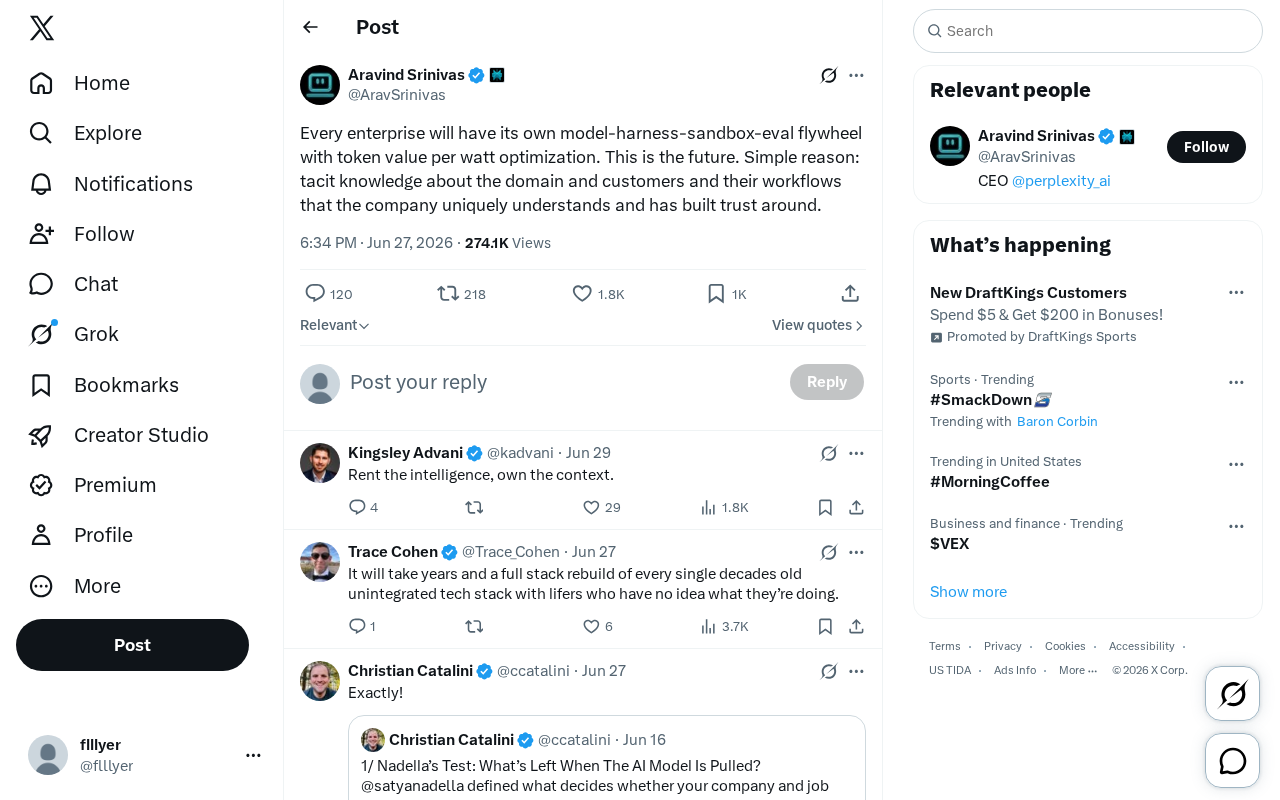
The Enterprise AI Flywheel: Building a Model-Eval Loop as a Competitive Moat
The core of enterprise AI isn't calling general models—it's building a self-reinforcing "model-harness-sandbox-eval" flywheel. This article analyzes the four components, tacit knowledge moats, and the "token value per watt" efficiency metric.
Read more →

·3 min
Complete RAG System Development Guide: Data Preprocessing, Vector Retrieval, and Output Optimization in Practice
A complete guide to building RAG systems: covering data preprocessing, vector databases, embedding models, hybrid search, re-ranking, and advanced topics like Graph RAG and multimodal RAG.
Read more →

·4 min
Harness Engineering in Practice: Taming AI Agents with Hermes Agent
Deep dive into Harness Engineering: using the open-source Hermes Agent framework's four-layer memory system and Skill evolution to build controllable, evolvable AI agents.
Read more →

·2 min
Gamified Learning with NotebookLM: Activate Your Notes Using the Sherlock Holmes Deduction Method
Google NotebookLM launches a Sherlock Holmes notebook template, turning passive note review into interactive deduction games. Learn how the Deduce-Uncover-Prove method enables gamified learning.
Read more →

·3 min
8 Terminal Enhancement Tools to Supercharge Your Claude Code Programming Experience
8 free terminal tools—Bat, Eza, Chafa, Zoxide, TLDR, Miru, Yazi, LazyGit—to dramatically boost your Claude Code and AI coding workflow efficiency.
Read more →
 Tutorials
·3 min
Learn AI Agents in 30 Days: A Four-Stage Learning Roadmap from Zero to Production
A systematic breakdown of the AI Agent learning roadmap covering core architecture, ReAct/CoT paradigms, multi-agent collaboration, and Prompt optimization across four stages with quality resource recommendations.
Read more →
 Research
·3 min
MementoGUI: A Multimodal Memory Management Framework for Solving Long-Horizon GUI Agent Amnesia
MementoGUI is a plugin-style multimodal memory management framework that solves GUI agent forgetting in long-horizon tasks through dual time-scale memory and four memory control operators, boosting long-task completion without fine-tuning.
Read more →
 Product Reviews
·4 min
OpenHuman Deep Dive: A Context-First Open-Source Personal AI Agent
Deep dive into OpenHuman open-source AI Agent: context-first architecture, Rust+React hybrid, Memory Tree system, Token Juice compression, and multi-model routing.
Read more →
 Product Reviews
·3 min
Ruflo: A Multi-Agent Orchestration Solution That Turns Claude Code into a 100-Person AI Team
Ruflo is an open-source multi-agent orchestration platform that upgrades single-threaded Claude Code into a distributed AI dev team with 100+ specialized Agents and a SANA self-learning engine.
Read more →
 Product Reviews
·3 min
Hermes Agent Desktop App: The Self-Evolving Open-Source AI Agent
Deep dive into Hermes Agent desktop app: closed-loop learning, persistent cross-session memory, multi-agent management, and tool integration. Discover how this open-source AI agent self-evolves to become a true productivity powerhouse.
Read more →
 Tutorials
·2 min
Vibe Coding in Practice: Building a Mini-OpenClaw Agent from Scratch Without Writing Code
Learn how to build a Mini-OpenClaw Agent framework using Vibe Coding with zero code, covering OpenClaw's architecture, LangChain integration, and AI-assisted development workflows.
Read more →
 Research
·2 min
MemGAS: Multi-Granularity Memory Association for Precise AI Agent Recall
ICLR 2026 paper MemGAS proposes multi-granularity memory association with adaptive selection, using GMM, entropy routing, and Personalized PageRank to enable precise recall in conversational agents.
Read more →
 Tutorials
·4 min
Agentic RAG in Practice: Architecture Deep Dive and LangChain Implementation Guide
Compare traditional RAG vs Agentic RAG architectures, explore planning, tool use, and multi-step iteration capabilities, with full LangChain/LangGraph ReAct Agent code and ChatBoss project examples.
Read more →
 Tutorials
·4 min
A Practical Guide to Context Engineering: The Path from Prompt Engineering to Production-Grade AI Systems
A deep dive into Context Engineering: core concepts and key techniques including RAG, long-context management, and AI Agent context orchestration for building production-grade AI systems.
Read more →