#Chinese LLM integration
771 related articles

·3 min
Wattage: An AI Agent Token Cost Profiling and Regression Protection Tool
Deep dive into Wattage, an AI Agent token consumption profiling and cost regression protection tool, exploring its core features, industry context, and value for developers.
Read more →

·3 min
Copilot Now Charges at API Prices — What Are You Actually Paying For?
With GitHub Copilot now billing at API rates, model costs match raw APIs. This article analyzes Copilot's real value in workflow integration, enterprise governance, and harness engineering.
Read more →
·7 min
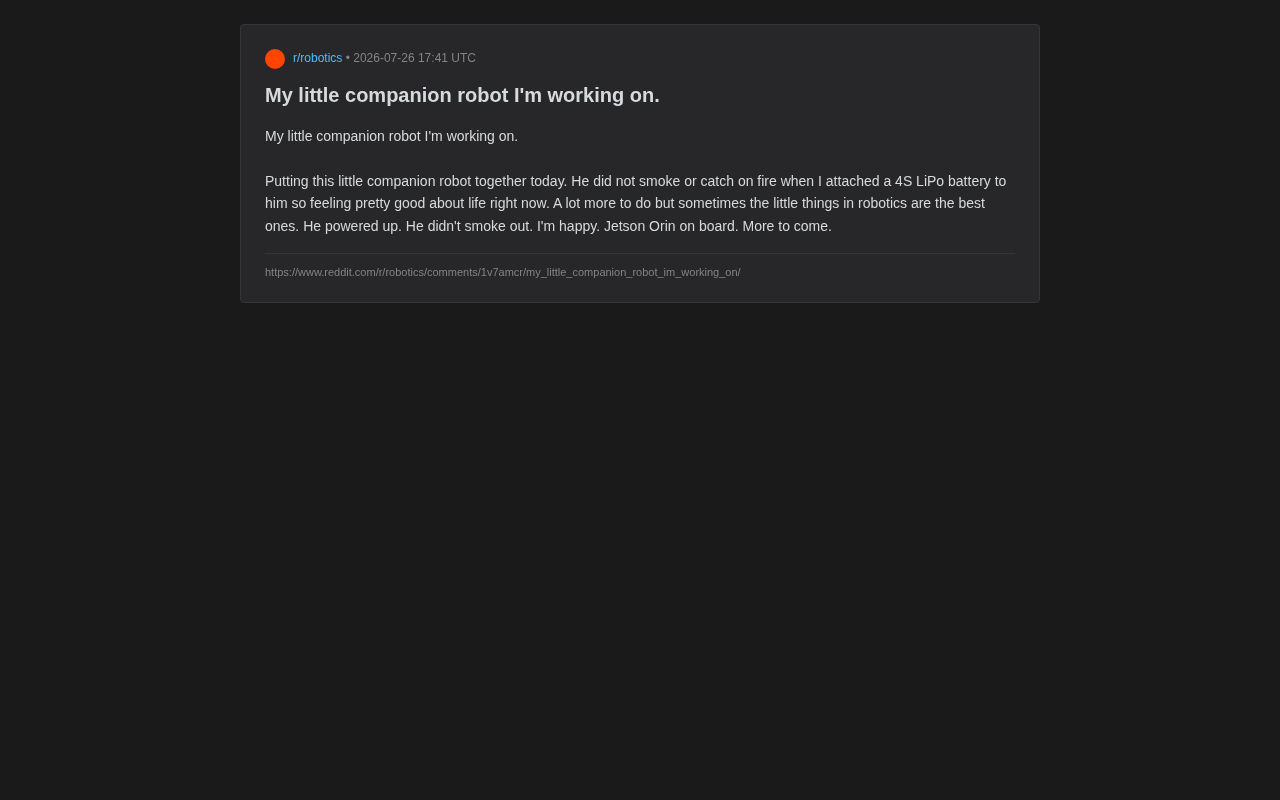
DIY Companion Robot: Building Your AI Desktop Buddy with Jetson Orin
A maker builds a DIY companion robot with NVIDIA Jetson Orin and 4S LiPo battery. Explore the full development journey from first power-up to AI interaction, including edge computing, power design, and companion robot trends.
Read more →

·5 min
Ollama Performance Degrades After Connecting to OpenWebUI? A Complete Troubleshooting Guide
Complete guide to troubleshooting Ollama performance degradation with OpenWebUI, covering num_ctx truncation, sampling parameter differences, GPU resource contention, and system prompt interference.
Read more →
·4 min
Hands-On Skill Writing and Agent Testing: A Guide to AI Testing Transformation
An in-depth look at AI testing challenges. Learn to write reusable Skill packs and master Agent testing and LLM evaluation—covering the SKILL.md six-dimensional rule, skill-creator, EvalScope, and dataset selection.
Read more →

·5 min
From Chat to Agent: Automating Your Entire Business Workflow with AI Agents
Veteran AI practitioner Remy breaks down the leap from chat models to AI agents: how agents work, the three pillars of context, tools, and skills, MCP connections, and hands-on architecture to make you a 100x employee.
Read more →

·3 min
Coze Agent Development in Practice: From Beginner to Multi-Agent Collaboration
Coze is ByteDance's homegrown agent-building platform. This article covers getting started with Coze, its comparison with Dify, skill system, workflow orchestration, and multi-agent collaboration.
Read more →
·2 min
Getting Started with ChatGPT Codex: A Practical Guide to the AI Coding Assistant
Codex is OpenAI's AI coding assistant that lets you write code using natural language. Learn its core features, use cases, and why programmers must master AI coding tools.
Read more →

·2 min
Getting Started with ChatGPT Codex: A Practical Guide to the AI Programming Assistant
Codex is OpenAI's AI programming assistant that lets you write code in natural language. This article breaks down Codex's core features, use cases, and why programmers must master AI coding tools.
Read more →

·3 min
Building AI Agents with Coze: From Beginner to Multi-Agent Collaboration
Coze is ByteDance's homegrown agent-building platform. This article explains getting started with Coze, comparison with Dify, its skill system, workflow orchestration, and multi-agent collaboration.
Read more →

·4 min
Getting Started with PiDeck: A Complete Guide to the Local AI Coding Workbench
PiDeck is a free, open-source local AI coding workbench that provides graphical management for CLI tools like Claude Code and Cursor. This guide covers installation, model authentication, project management, and advanced conversation tips.
Read more →
·4 min
Getting Started with PiDeck: A Complete Guide to the Local AI Coding Workbench
PiDeck is a free, open-source local AI coding workbench that provides graphical management for CLI tools like Claude Code and Cursor. This guide covers PiDeck installation, model auth, project management, and advanced conversation tips.
Read more →

·3 min
DeepSeek-OCR Deployment and Fine-Tuning: A Complete Hands-On Guide
Master the full DeepSeek-OCR deployment and fine-tuning workflow: vLLM inference deployment, efficient Unsloth fine-tuning, dataset preprocessing, LoRA training, validation, and RAG vector database integration.
Read more →

·4 min
Notion Co-founder: From Note-Taking Tool to AI Agent Workspace
Notion co-founder Simon Last shares Notion's journey from note-taking tool to AI agent workspace: from first tasting GPT-4 to personal and custom agents.
Read more →

·2 min
Getting Started with Claude Code: Installation, Switching to Chinese LLMs, and Git Workflows Explained
A complete guide to installing and configuring Claude Code, using CLI commands, switching to Chinese LLMs like DeepSeek via CC Switch, plus conversational Git workflows and automated code fixing.
Read more →

·2 min
Getting Started with Claude Code: Installation, Switching to Chinese LLMs, and Git Workflows Explained
A complete guide to installing and configuring Claude Code, using CLI commands, switching to Chinese LLMs like DeepSeek via CC Switch, and mastering conversational Git workflows and automated code fixes.
Read more →

·2 min
Claude Code From Zero to Production: Installation, Switching to Chinese LLMs, and Git Workflow Guide
A complete guide to Claude Code: Node.js setup, CLI install, switching to Chinese LLMs with CC Switch, core commands, and conversational Git workflows with automated bug fixing.
Read more →

·5 min
Why Are China's Open-Source AI Models Getting Stronger? A Deep Dive into Three Comeback Paths
Facing US chip bans and closed-source monopolies, how do China's open-source AI models keep striking back? A deep dive into three core paths: open-source pricing-power games, optical interconnect positioning, and edge-side use cases.
Read more →

·5 min
Why Are China's Open-Source AI Models Getting Stronger? A Deep Dive Into Three Comeback Strategies
Facing US chip bans and closed-source monopoly, how do China's open-source AI models keep fighting back? A deep dive into three core paths: open-source pricing games, optical interconnect positioning, and on-device scenarios.
Read more →

·3 min
Multi-Model AI Aggregator Platforms Explained: Access GPT, Claude, Gemini & More from One Chat Interface
AI aggregator platforms promise one interface for GPT, Claude, Gemini, DeepSeek & more. This deep-dive covers core features, real value, data security risks, and safer alternatives.
Read more →