#Claude Code code leak
551 related articles
 Product Reviews
·3 min
AI Coding Assistant System Prompts Collection: Open-Source Repository Featuring Claude Code, Cursor, and Other Leading Tools
The awesome-system-prompts open-source project collects system prompts and tool definitions from leading AI coding assistants like Claude Code, Cursor, Gemini, and Codex — an essential resource for prompt engineering and AI product design.
Read more →
 Tutorials
·3 min
Dissecting a 10K-Star Open Source Project: The Complete Practical Guide to Agent Context Engineering Skills
Deep dive into the 15K-star GitHub project Agent-Skills-for-Context-Engineering, covering context engineering fundamentals, multi-agent architecture patterns, and production-grade Agent system best practices.
Read more →
 Product Reviews
·3 min
Agnix: The First Linter for AI Coding Assistant Configuration Files, with LSP Real-Time Validation
Agnix is the first Linter and LSP tool for AI coding assistant config files like CLAUDE.md and AGENTS.md. Built in Rust, it offers real-time validation, auto-fix, and IDE integration.
Read more →
 Deep Dives
·3 min
Open-Source Replication of OpenAI Operator: Building a Computer-Controlling AI Agent in 48 Hours
A developer open-source replicated OpenAI's $200/month Operator in 48 hours using Anthropic Computer Use, building a full-stack Dockerized computer-controlling AI Agent with deep analysis of architecture and industry trends.
Read more →
 Deep Dives
·3 min
AI-Assistant Open Source Project Analysis: Building a Local AI Agent with the Anthropic API
Deep analysis of the open-source AI-Assistant project built on Anthropic Claude API for local AI Agents, covering architecture, use cases, security, and agentic AI trends.
Read more →
 Deep Dives
·2 min
Computer Agent: An Open-Source Rust AI Desktop Agent That Automatically Controls Mouse, Keyboard, and Browser
Computer Agent is an open-source AI desktop agent built in Rust that controls terminals, browsers, mice, and keyboards via natural language. Explore its features, architecture, and security.
Read more →
 Deep Dives
·2 min
OS AI Computer Use: A Cross-Platform Open-Source AI Desktop Automation Tool Explained
OS AI Computer Use is an open-source AI desktop automation tool supporting Windows, macOS, and Linux with OpenAI and Anthropic API compatibility. Learn about its features, architecture, and safety tips.
Read more →
 Product Reviews
·3 min
The Complete Guide to AnythingLLM: A Privacy-First AI Assistant for Local Deployment
Deep dive into AnythingLLM: a privacy-first, zero-config open-source local AI tool. Supports RAG, multi-model switching, and document chat. Nearly 60K GitHub Stars, ideal for enterprise and personal local deployment.
Read more →
 Tutorials
·2 min
Ollama Tutorial: One-Click Local Deployment of DeepSeek, Qwen, and Other LLMs
Complete guide to running LLMs locally with Ollama. Supports DeepSeek, Qwen, Kimi-K2.5 & more. Covers installation, model ecosystem, privacy benefits & enterprise deployment. 170K+ GitHub Stars.
Read more →
 Tutorials
·2 min
awesome-llm-skills: Cross-Platform AI Agent Skill Library Guide & Resource Collection
Explore awesome-llm-skills, an open-source curated list of AI Agent skills compatible with Claude Code, Codex, and Gemini CLI, with resources and best practices for Agent workflows.
Read more →
 Product Reviews
·3 min
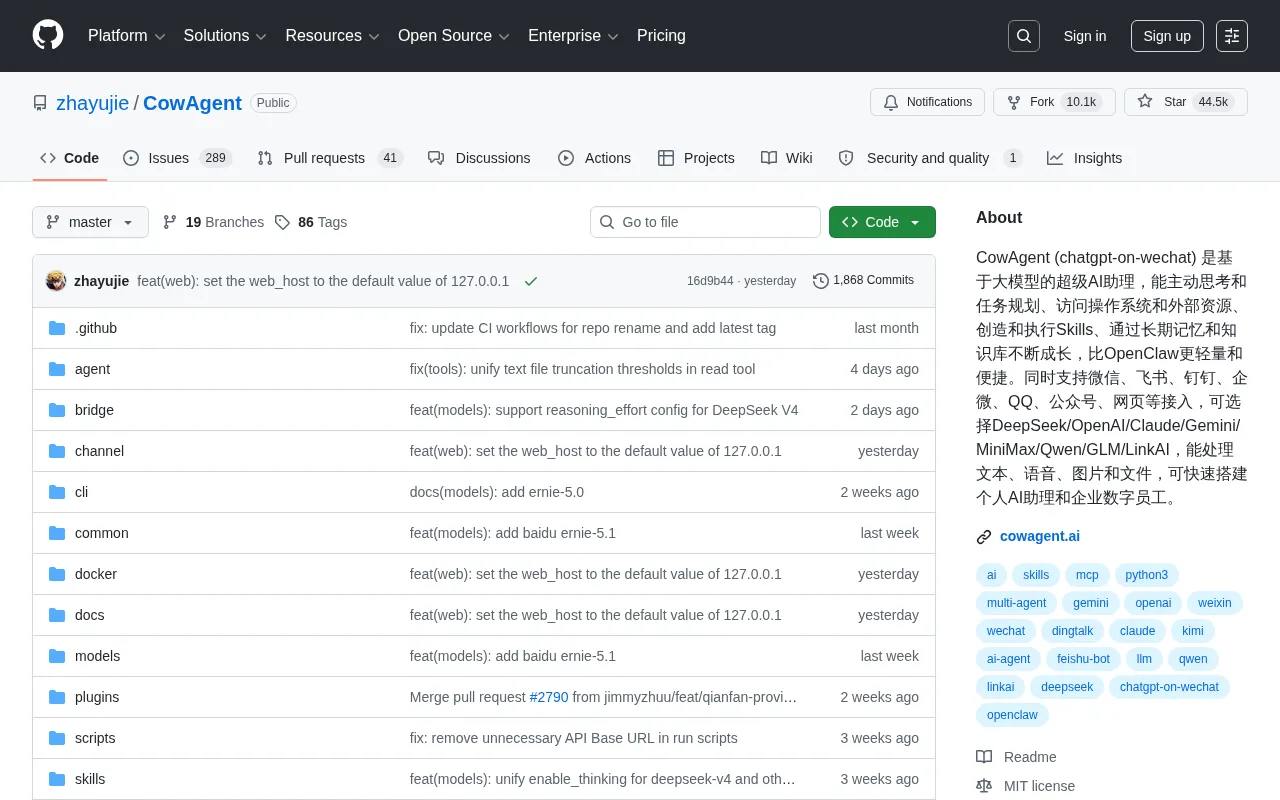
Deep Dive into CowAgent: The Open-Source AI Assistant with 44,000 Stars
Deep dive into CowAgent (formerly chatgpt-on-wechat), a 44K-star GitHub project offering Agent capabilities, multi-platform integration with WeChat/Feishu, and multi-model support including DeepSeek.
Read more →
 Product Reviews
·2 min
Agent Monitor: An AI Agent Session Monitoring Daemon Written in Rust
Agent Monitor is an open-source Rust daemon that unifies monitoring of AI coding agent sessions across Claude Code, Cursor, Aider, and custom agents for developers.
Read more →
 Product Reviews
·1 min
Codex: An Open-Source Coding Agent Tool with Multi-Model Support
Codex is an open-source coding agent built in Rust that supports OpenAI, Anthropic, and Gemini models, offering developers a flexible multi-model AI programming tool.
Read more →
 Product Reviews
·2 min
OpenYak: Open-Source Local AI Agent Supporting 100+ Models with Zero Telemetry Privacy
OpenYak is an open-source local AI agent supporting Windows/macOS/Linux. Access 100+ models via OpenRouter, MCP, and Ollama with BYOK zero-telemetry privacy — a strong alternative to Claude Code and OpenAI Codex.
Read more →
 Product Reviews
·3 min
LibreChat: A Complete Guide to the Open-Source Self-Hosted Multi-Model AI Chat Platform
Deep dive into LibreChat, an open-source self-hosted AI chat platform supporting GPT, Claude, Gemini multi-model switching, MCP protocol, Agents, code interpreter, and enterprise deployment.
Read more →
 Product Reviews
·2 min
OpenMemory: Local Persistent Memory Storage for Shared Context Across AI Tools
OpenMemory is an open-source local memory storage solution providing a unified memory layer for Claude Desktop, GitHub Copilot, and other LLM apps, enabling shared context while ensuring data privacy.
Read more →
 Product Reviews
·3 min
mcproc: A Deep Dive into the MCP-Based AI Agent Process Management Server
mcproc is a Rust-based MCP server that gives AI agents background process management capabilities. This article covers its architecture, use cases, and value in the AI toolchain ecosystem.
Read more →
 Product Reviews
·4 min
Chatbox Open-Source AI Client: A Deep Dive into the 40K-Star Cross-Platform AI Chat Tool
Deep dive into Chatbox, an open-source AI client with 40K GitHub Stars. Supports GPT-4, Claude, Gemini via direct API, covers all platforms, and stores data locally for privacy.
Read more →
 Product Reviews
·3 min
The Complete Guide to AnythingLLM: A Privacy-First AI Tool with 60K Stars on GitHub
In-depth guide to AnythingLLM, a privacy-first open-source AI tool covering local deployment, RAG document chat, multi-model support, and more for building a secure private AI workbench.
Read more →
 Product Reviews
·3 min
Chatbox Open-Source AI Client: A Complete Review of This Cross-Platform Desktop Tool with Multi-Model Support
In-depth review of Chatbox, an open-source AI client supporting GPT-4, Claude, Gemini and more. Covers core features, technical architecture, use cases, and comparisons with similar tools.
Read more →