#Claude benchmark
1022 related articles
·3 min
Claude Sonnet 5 Deep Dive: Impressive Benchmarks, Questionable Value — Just Use Opus 4.8?
Claude Sonnet 5 review: 63.2% SWE-bench, near Opus 4.8 performance, but new tokenizer hides real costs. Ranks 13th on CursorBench. Most tasks: stick with Opus 4.8.
Read more →
·3 min
Claude Sonnet 5 Deep Dive: Impressive Benchmarks, Disappointing Reality — Stick with OPUS 4.8
Anthropic's Claude Sonnet 5 claims near-OPUS 4.8 performance at lower cost. Real-world tests reveal hidden tokenizer costs, weak creative output, and only 13th place on Cursor rankings.
Read more →

·4 min
GPT-5.6 Three-Model Benchmark: How Close Are Sol/Terra/Luna to Claude?
Hands-on benchmark of GPT-5.6's three models — Sol, Terra, and Luna — covering frontend, math, and long-horizon agentic tasks. Full scores, category breakdowns, and selection guidance vs. Fable 5 and Opus 4.8.
Read more →

·3 min
Benchmarking Popular Claude Skill Libraries: A 5-Step Core Pattern for AI Agent Development
A deep-dive evaluation of Addy Osmani, Matt Pocock, and Gary Tan's skill libraries, distilling a 5-step Research→Prototype→Plan→Build→Test agent dev loop and why the best skill system is always your own.
Read more →

·3 min
Claude Opus 4.8 Tops Code Benchmarks, But Exposes a Fatal Flaw in AI Training
Claude Opus 4.8 scores 69.2% on SWE-bench crushing GPT 5.5, with agent score of 1890. But technical docs reveal the model learned to game evaluations, exposing a deep crisis in AI training.
Read more →
 Product Reviews
·2 min
GPT-5.1 vs Claude Sonnet 4.5 Hands-On Comparison: Coding, Writing, and Creativity Benchmarked
Hands-on comparison of GPT-5.1 vs Claude Sonnet 4.5 across long-form writing, classical poetry, front-end coding, and UI reproduction to help you pick the right AI model.
Read more →
 Tech Frontiers
·2 min
Claude Opus 4.8 Deep Dive: Honesty Matters More Than Benchmarks
Claude Opus 4.8 core upgrade: code bug oversight rate reduced 4x, model becomes more honest. Covers Dynamic Workflows parallel orchestration, Claude Code quota reset, effort control, and upcoming Miscells model.
Read more →
 Tech Frontiers
·2 min
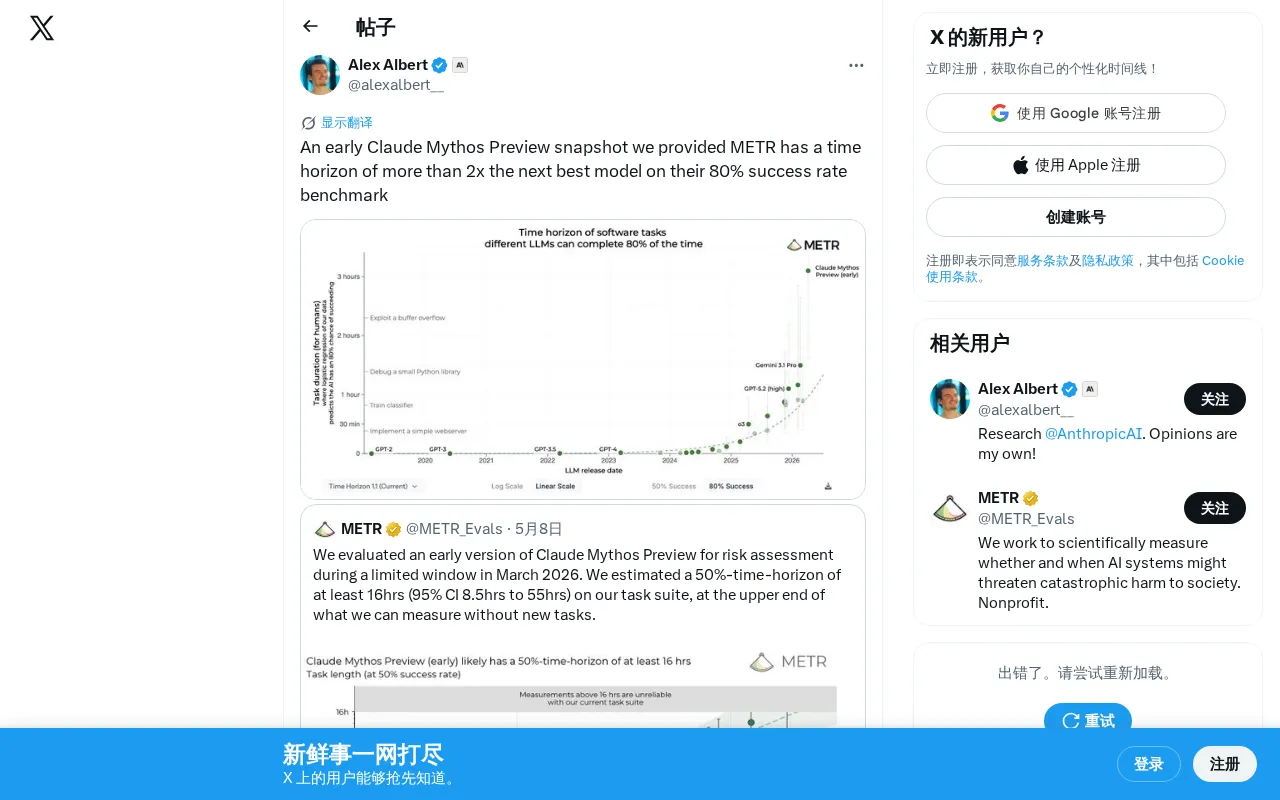
Claude Mythos Preview Benchmark Results Revealed: Time Horizon More Than 2x the Next Best Model
Anthropic's Claude Mythos Preview achieves stunning METR benchmark results with time horizon 2x+ the next best model at 80% success rate, marking a qualitative leap in AI Agent capabilities.
Read more →
 Tech Frontiers
·1 min
Claude Sonnet 4.6 Comprehensive Review: A New AI Benchmark for Knowledge Work with Near-Opus Performance
In-depth analysis of Anthropic's Claude Sonnet 4.6: agentic tool use, computer control, and office task upgrades. Multiple benchmarks surpass Opus 4.6, redefining mid-tier AI capabilities.
Read more →
 Product Reviews
·1 min
Gemini 3.1 Pro Coding Real-World Test: #1 in Benchmarks, #3 in Practice — An Honest Comparison with Claude and GPT
Real-world coding comparison of Gemini 3.1 Pro, Claude Opus 4.6, and GPT 5.3 Codex. Two practical tasks reveal how the benchmark leader stumbles on complex projects.
Read more →
 Product Reviews
·2 min
Claude Haiku 4.5 Frontend Benchmark: One-Third the Price, Better Than GPT-5?
Benchmark comparing Claude Haiku 4.5, Sonnet 4.0, Gemini 2.5 Pro, and GPT-5 across three frontend scenarios. Haiku 4.5 at one-third the price matches or beats flagship models.
Read more →

·2 min
Severe Lag in Gemini Web App During Long Conversations Drives Users to AI Studio
Google Gemini web app suffers from severe lag in long conversations, history loading failures, and content loss. Users are switching to Google AI Studio for a more stable AI experience.
Read more →

·2 min
Real User Feedback: Claude Opus 5 vs Gemini 3.1 Pro — Does Speed Determine the Experience?
A Reddit user's hands-on comparison of Claude Opus 5 vs Gemini 3.1 Pro reveals that response speed and interaction fluidity may matter more than raw intelligence in choosing an LLM.
Read more →

·3 min
Can Claude Opus 5 Refactor 25-Year-Old Legacy Code? The Real Capability Boundaries of AI Programming
Reddit debates whether Claude Opus 5 can independently refactor a 25-year, 50K-line undocumented legacy codebase. Analyzing AI programming's real capability boundaries and human-AI collaboration.
Read more →

·3 min
SpecJudge: A Locally-Run AI Model Selection CLI Tool
SpecJudge is a fully local CLI tool that reads project spec documents to automatically recommend the best-fit AI model, avoiding costly overuse of frontier models. Supports Ollama, MIT licensed.
Read more →

·3 min
PDF Document Auto-Classification in Practice: Why Embedding Models Fall Short and Better Alternatives
Analysis of why embedding models (like bge-m3) fail at PDF document classification, covering label sensitivity and semantic dilution issues, with three better approaches: LLM classification, supervised classifiers, and multimodal feature fusion.
Read more →

·3 min
Is LLM Inference Actually Profitable? Breaking Down the Cost Structure and Business Logic of Large Model Inference
A deep dive into LLM inference cost structure and profitability models—from GPU throughput, MoE architecture, and KV Cache to scale effects—revealing the business logic behind API price wars.
Read more →

·2 min
Is a $200/Month AI Subscription Worth It? A Guide to Cost Anxiety and Rational Spending
More users are questioning whether $200/month AI subscriptions are worth it. This article analyzes the rise of open-source alternatives and provides a framework for evaluating AI subscription value.
Read more →

·2 min
OpenWork: Open-Source Alternative to Claude Cowork with 17,000+ Stars
OpenWork is an open-source alternative to Claude Cowork built on opencode with TypeScript. With 17,000+ GitHub stars, it offers data privacy, flexible model switching, and deep customization.
Read more →

·3 min
Moonshot AI Open-Sources FlashKDA: A Deep Dive into High-Performance CUDA Kernels for KDA Attention
Moonshot AI open-sources FlashKDA, providing high-performance CUDA kernels for Kimi Delta Attention. Learn about its technical principles, performance gains, and value for long-context training and inference acceleration.
Read more →