#Django
208 related articles
 Tech Frontiers
·2 min
Claude Code Web Launch: Parallel Programming and Haiku 4.5 Multi-Model Collaboration in Practice
Anthropic launches Claude Code Web with browser and mobile coding, plus Haiku 4.5 at 1/3 the cost of flagship models. Parallel tasks, multi-model collaboration, and seamless cloud-to-local workflows.
Read more →
 Product Reviews
·3 min
Claude Haiku 4.5 Review: Sonnet 4-Level Coding at 1% of the Cost
In-depth review of Claude Haiku 4.5: 73.3% on SWE-bench rivaling Sonnet 4, input at just $1/million tokens. Covers code generation, agentic coding, SVG tests, and Sonnet+Haiku collaboration strategies.
Read more →
 Tech Frontiers
·2 min
Claude Haiku 4.5 Released: Double the Speed at One-Third the Price, Setting a New Cost-Efficiency Benchmark for AI Coding
Anthropic releases Claude Haiku 4.5, a distilled version of Sonnet 4.5 with near-flagship coding performance, double the speed, and one-third the cost. Scores 73.3 on SWE-Bench, ideal for developers seeking cost-efficiency.
Read more →
 Tech Frontiers
·2 min
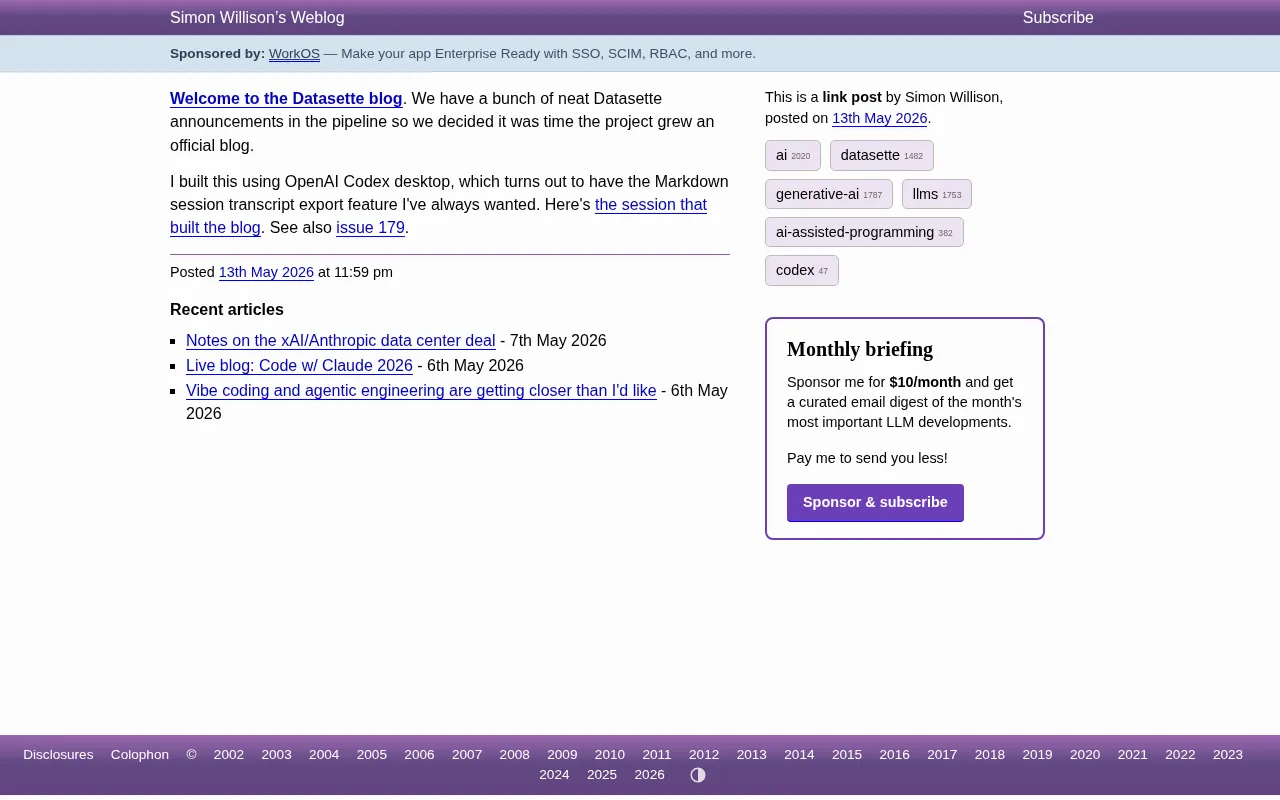
Datasette Launches Official Blog: Simon Willison Built It from Scratch with OpenAI Codex
Datasette founder Simon Willison launches official blog built with OpenAI Codex Desktop, sharing full AI session transcripts and demonstrating transparent AI-assisted development practices.
Read more →
 Tech Frontiers
·2 min
SWE-bench Opens Evaluation Environments and Training Recipes: Dramatically Lowering the Barrier to AI Coding Agent Development
SWE-bench opens evaluation environments, task sets, trajectories, and training recipes, dramatically lowering the barrier to AI coding agent development.
Read more →
 Expert Opinions
·3 min
The Blurring Line Between Vibe Coding and Agentic Engineering: Simon Willison's Deep Reflection
Django co-creator Simon Willison finds Vibe Coding and Agentic Engineering converging in practice. As AI tools grow reliable, where should engineers draw the line on trust and responsibility?
Read more →
 Tech Frontiers
·2 min
SWE-agent Multimodal Released: Image Viewing + Browser Debugging, A New Power Tool for Frontend AI Development
SWE-agent Multimodal officially released with image viewing and web browser debugging capabilities for automated frontend visual bug detection and fixes, plus the new SWE-bench Multimodal benchmark.
Read more →
 Tech Frontiers
·3 min
SWE-bench Official Blog Launches: AI Coding Evaluation Enters a New Phase
SWE-bench launches its official blog for in-depth content on AI coding evaluation, AI Agents, and toolchains—signaling a new phase of maturity and standardization in AI programming benchmarks.
Read more →
 Tech Frontiers
·2 min
Qwen Continues to Lead on SWE-bench: The Rise of Open-Source AI Coding Models
Qwen team leads open-source models on SWE-bench, demonstrating strong software engineering capabilities. This article analyzes SWE-bench standards, Qwen's progress, and the value of open-source AI coding tools.
Read more →
 Product Reviews
·3 min
AutoGPT: A Deep Dive into the Open-Source AI Agent Platform with 180K Stars
Deep dive into the AutoGPT open-source project, covering its autonomous AI agent architecture, core features, use cases, and future development. Learn how this 184K-Star GitHub project makes autonomous AI accessible to everyone.
Read more →
 Tutorials
·2 min
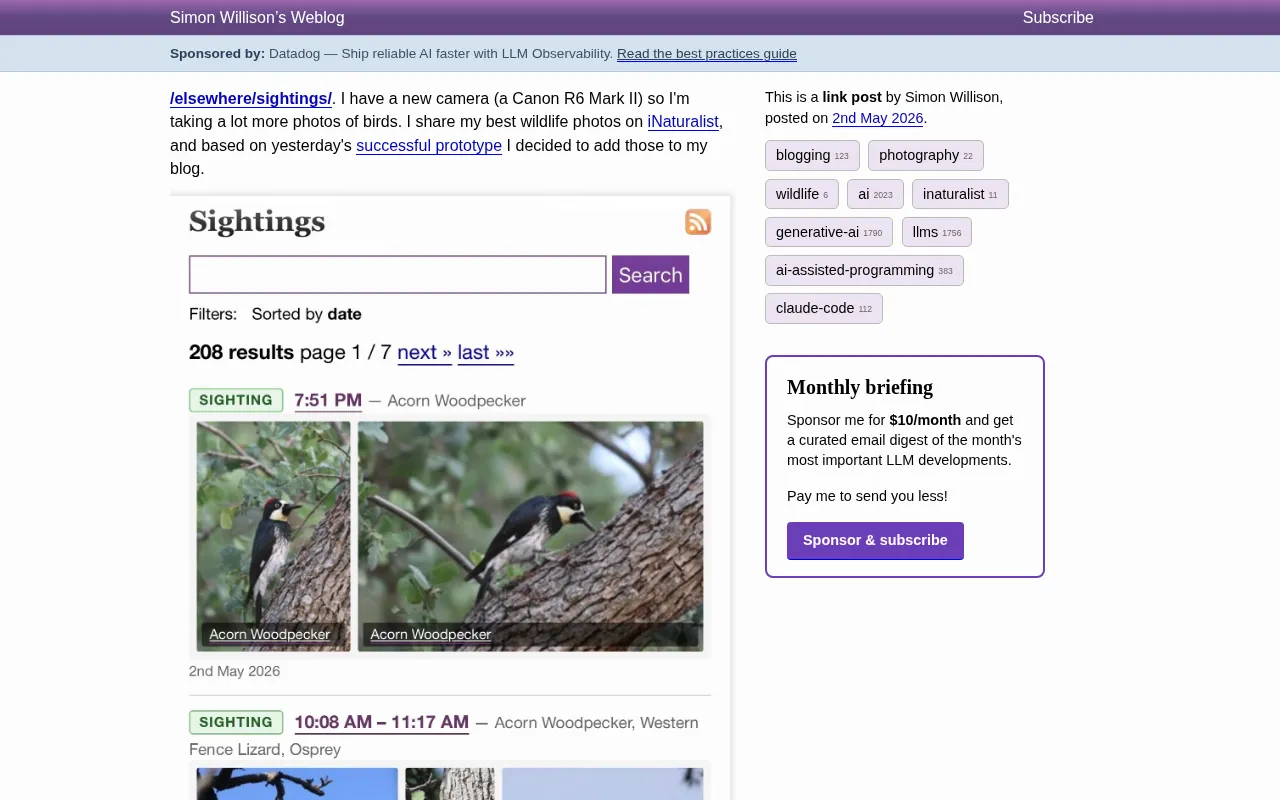
Simon Willison Built a Wildlife Sightings Feature for His Blog Using Claude Code on His Phone
Simon Willison used Claude Code for web on his phone to aggregate a decade of iNaturalist wildlife data into his blog. A look at the architecture, Beats system, and how AI is reshaping dev workflows.
Read more →
 Tutorials
·3 min
Phone + Claude Code: Building an iNaturalist Observation Display Tool While Camping
Simon Willison built a complete iNaturalist observation display tool using only his phone and Claude Code while camping. A breakdown of the three-layer architecture: Python CLI, Git Scraping automation, and pure frontend display.
Read more →
 Expert Opinions
·4 min
In the Vibe Coding Era, Why Do We Need RSS for Distributing Personal Apps?
Vibe Coding makes building apps as easy as writing blog posts, but personal tools lack good distribution channels. This article explores using RSS as a lightweight app distribution protocol.
Read more →
 Expert Opinions
·2 min
In the Vibe Coding Era, Using RSS to Share and Discover Personal Apps
AI-assisted programming makes building tools as easy as blogging, but how are these personal apps discovered? Matt Webb proposes RSS for vibe-coded apps, and Simon Willison quickly validates the idea.
Read more →
 Tutorials
·2 min
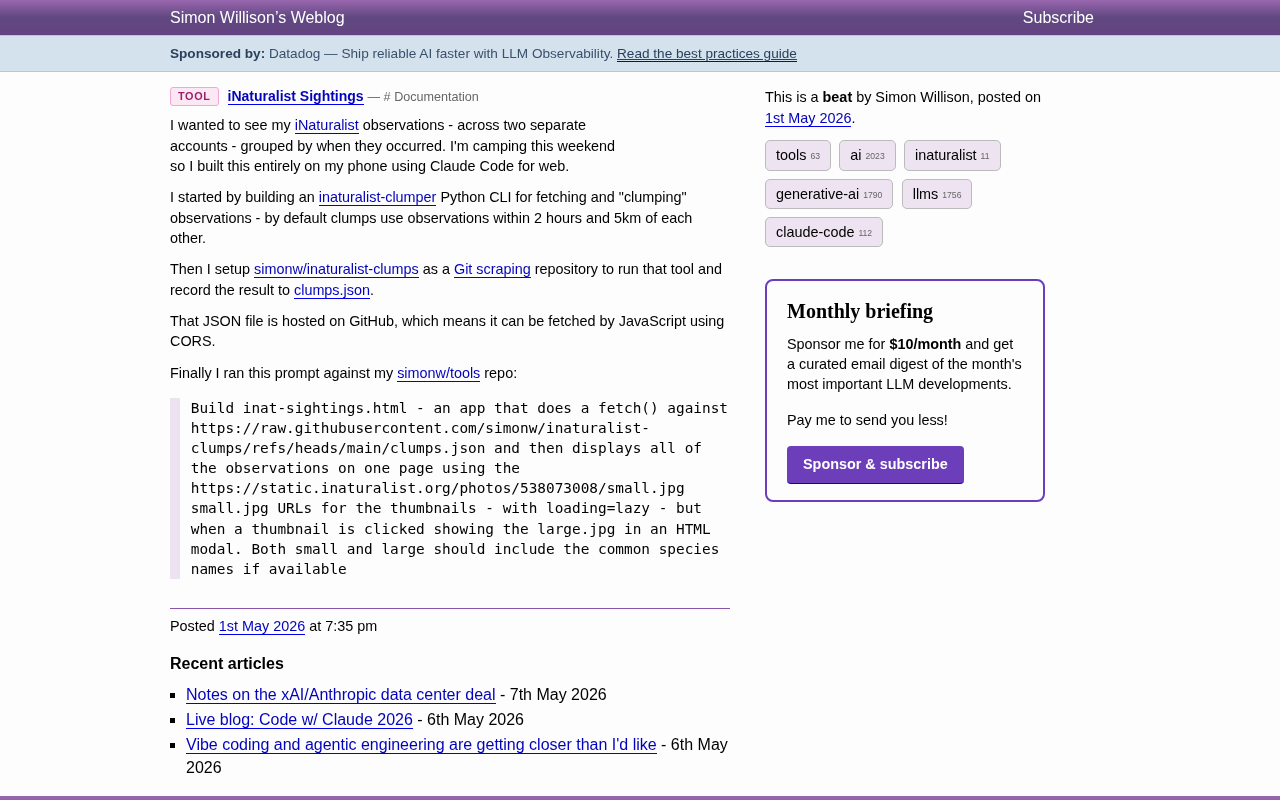
Building an iNaturalist Observation Display Tool Entirely on a Phone with Claude Code
Simon Willison built an iNaturalist observation display tool on his phone while camping using Claude Code, Git Scraping, and GitHub Actions with zero servers.
Read more →
 Expert Opinions
·3 min
In the Vibe Coding Era, Why We Need RSS to Share Personal Apps
AI programming makes building micro-apps as easy as blogging, but distribution is the new bottleneck. Matt Webb proposes RSS for sharing vibe-coded apps, and Simon Willison is already doing it.
Read more →
 Tech Frontiers
·2 min
LLM 0.32 Refactoring Deep Dive: Message Sequence Input and Streaming Multi-Type Response Design
Deep dive into LLM 0.32 alpha's two core refactorings: message sequence API aligned with OpenAI format, stream_events for typed streaming responses, serialization design, and backward compatibility.
Read more →
 Expert Opinions
·2 min
The Vibe Coding Era: Why We Need RSS to Share Personal Micro-Apps
Vibe coding makes AI programming as simple as blogging, driving an explosion of personal micro-apps. Matt Webb proposes RSS for sharing micro-apps, and Simon Willison has already implemented it.
Read more →
 Tutorials
·3 min
Phone + Claude Code: Building an iNaturalist Observation Tool with Zero Servers — Full Workflow
Simon Willison built a complete iNaturalist observation tool during camping using his phone and Claude Code. A deep dive into the three-layer architecture: Python CLI, Git Scraping, and AI-generated frontend — all on GitHub with zero servers.
Read more →
 Product Reviews
·3 min
Simon Willison's Complete Process of Building an iNaturalist Observation Gallery with Phone + Claude Code
Simon Willison built an iNaturalist observation gallery using only his phone and Claude Code while camping. A breakdown of the three-layer architecture: Python CLI clustering, Git Scraping automation, and AI-generated frontend.
Read more →