#Fable framework
160 related articles
·3 min
Musk Pledges Not to Cut Off Anthropic: The Trust Game in AI Cloud Infrastructure
Musk publicly pledges not to cut off Anthropic's compute access. We break down the $40B stakes, AI infrastructure coopetition, and how companies manage trust risk in a compute-concentrated era.
Read more →

·2 min
GLM-5.2 Spotted in Testing | Claude Fable 5 Launches: 4 Key AI Updates
GLM-5.2 spotted in testing, Anthropic launches Claude Fable 5, Moore Threads open-sources MusaCoder for domestic GPUs, and Google releases Gemini real-time translation.
Read more →

·7 min
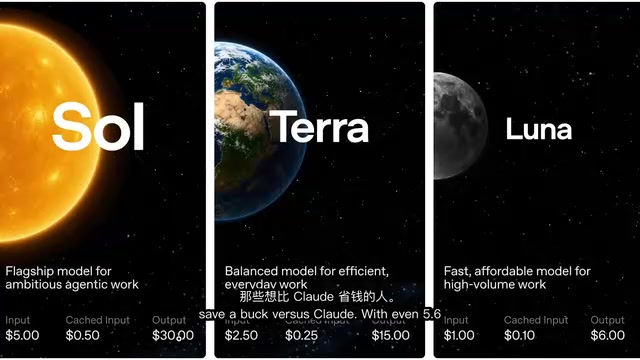
GPT-5.6 In-Depth Hands-On Review: How Do Soul, Tara, and Luna Really Perform?
OpenAI releases GPT-5.6 preview with three models: flagship Soul, balanced Tara, and lightweight Luna. Based on real KingBench 3 testing, this article breaks down each model's performance on math, front-end, and agentic tasks, and compares them with Anthropic Fable.
Read more →

·2 min
GLM-5.2 and the Media Panic: Open-Source AI Safety Controversy and Governance Dilemmas
Media coverage of open-source model GLM-5.2 sparked fear over its cybersecurity capabilities and low barriers to use. We unpack the real logic behind open-source AI threat narratives and the governance dilemmas ahead.
Read more →

·4 min
GPT-5.6 Three-Model Benchmark: How Close Are Sol/Terra/Luna to Claude?
Hands-on benchmark of GPT-5.6's three models — Sol, Terra, and Luna — covering frontend, math, and long-horizon agentic tasks. Full scores, category breakdowns, and selection guidance vs. Fable 5 and Opus 4.8.
Read more →

·6 min
Grok 4.5 Deep Dive: Coding on Par with Top Models, at a Fraction of the Cost
A senior developer's 24-hour deep test of Grok 4.5: a 1.5T-param MoE model at $2/M input tokens, with coding benchmarks rivaling GPT-5.5. Real performance, token efficiency, and limits explained.
Read more →

·3 min
Claude's Overzealous Safety Filters: How Anthropic's Classifiers Are Stifling Creative Writing
Anthropic's safety classifiers for Claude are generating too many false positives, blocking legitimate content on creative apps like Fable. A deep dive into classifier mechanics and the safety-usability tradeoff.
Read more →

·3 min
Building an AI Auto-Editing Workflow with n8n: Parallel Processing, Date Filtering, and Scheduled Triggers — A Full Dev Log
A complete walkthrough of building an AI auto-editing workflow in n8n: Merge node sync, Luxon date filtering, scheduled triggers, real bugs, and debugging tips for solo creators.
Read more →

·6 min
GPT-5.6 Three-Model Launch: Soul/Terra/Luna Tiered Strategy and the AI National Security Game
OpenAI previews the GPT-5.6 series — Soul, Terra, and Luna — with a massive 1.5M-token context. In-depth analysis of coding leaps, the Fable 5 national security game, the heating U.S.-China AI race, and workflow economics.
Read more →

·3 min
GPT-5.6 Three-Model Launch, SenseNova Open-Source Training Stack: A Day of Dense AI Industry Updates
OpenAI launches GPT-5.6 Sol/Terra/Luna, SenseNova open-sources its full multimodal training stack, Gemini adds free Study Notebooks, Apple M7 brings on-device AI to mainstream — a roundup of today's AI updates.
Read more →

·7 min
Fable AI Coding in Practice: Optimizing Reasoning Levels and Multi-Model Collaboration to Save Money
Hands-on guide: Use Anthropic's Fable model to optimize AI coding workflows — control reasoning levels, leverage Claude-Codex multi-model collaboration, and cut costs from thousands to $150.
Read more →

·7 min
Fable AI Coding in Practice: Optimizing Reasoning Levels and Multi-Model Collaboration to Cut Costs
How developer Theo used Anthropic's Fable model to rebuild his AI coding workflow — controlling reasoning levels, multi-model routing with Codex, and sub-agent orchestration to cut costs from thousands to $150.
Read more →

·6 min
The Complete Guide to GLM-5.2: Hands-On Review of an Open-Source Long-Context Model
An in-depth hands-on review of Zhipu AI's flagship GLM-5.2: 1M-token context, strong coding, mature agent workflows—at one-fifth the price of top frontier models. Covers website testing, Cursor integration, MCP tooling, and production migration.
Read more →

·8 min
Fable 5 Opens to All Paid Users: How AI Storytelling Tools Are Reshaping Content Production
Fable 5, an AI storytelling platform, opens to all paid users and sparks debate on Hacker News. We analyze AI creation tools' practicalization trend across product positioning, competition, and access strategy.
Read more →

·3 min
GPT Flagship Model Integrates with Codex: A Deep Dive into 750 Tokens/sec Inference Speed
OpenAI's top flagship model integrates with Codex, hitting 750 tokens/sec on Cerebras wafer chips. We break down MoE architecture, subscription changes, and open-source advances from Hunyuan and Longcat 2.0.
Read more →

·5 min
GPT-5.6 Launches: Three Product Lines + Government Approval — The Rules of the AI Industry Are Being Rewritten
OpenAI releases GPT-5.6 with three models — Sol, Terra, Luna — bringing major gains in coding and cybersecurity. More critically: the U.S. government now reviews AI model releases, making frontier AI regulation the new industry norm.
Read more →

·4 min
From Claude Code to Claude Tag: How AI Programming Tools Break Out of Engineering Teams
Anthropic's Boris Cherny and Cat Wu discuss how Claude Code expanded from engineering teams company-wide, the Claude Tag platform strategy, and the launch of Claude Fable 5.
Read more →
·7 min
GPT-5.6 Sol vs. Fable 5: Can Half the Price Match the Flagship?
OpenAI launches GPT-5.6 Sol at half the price of Anthropic's Fable 5. We compare both models on HealthBench, cybersecurity and more using hard system-card data, analyzing Sol's cost-effectiveness and shifts in AI power.
Read more →

·6 min
Fable 5 vs GPT-5.6 Sol: Cost-Efficiency Redefines the Frontier AI Landscape
An in-depth analysis of the head-to-head between Anthropic's Fable 5 and OpenAI's GPT-5.6 Sol: the performance gap, the logic behind pricing strategies, and the concentration-of-power concerns raised by U.S. government involvement.
Read more →

·6 min
Fable 5 vs. GPT-5.6 Sol: Benchmarks, Pricing, and the AI Power Struggle Explained
An in-depth comparison of Fable 5 and GPT-5.6 Sol: benchmarks across Terminal Bench, HealthBench, and ExploitBench, plus pricing strategy, OpenAI's government equity controversy, and shifting AI power dynamics.
Read more →