#Fable model
243 related articles

·5 min
Between Faith and Doubt: A Deep Philosophical Dialogue on the Existence of God
A deep dialogue on God, the nature of faith, and the politicization of religion: Is faith "bad science"? Can divine experience be proven? Exploring the gray area between faith, doubt, and cynicism.
Read more →

·2 min
From Claude to Sol5.6: One Developer's Journey of Switching AI Coding Assistants
A developer's Reddit post bidding farewell to Claude in favor of Sol5.6 reveals the fragile loyalty dynamics in AI coding tools — and what vendors must do to keep users.
Read more →

·3 min
Beware of 'Free GPT 5.6' Scams: A Complete Breakdown of Fake AI Tutorials
A Bilibili video promoting 'free unlimited ChatGPT 5.6' is full of fake model names, stolen account pools, and phishing links. Here's a full breakdown of the scam.
Read more →

·6 min
OpenAI Merges ChatGPT and Codex: The Super App for the AI Agent Era Is Here
OpenAI merges ChatGPT and Codex into a super app and releases three new GPT-5.6 models: Sol, Terra, and Luna. A deep dive into four hands-on workflows—Computer Use, Loops, and multi-threading—for the AI agent era.
Read more →
Anthropic's Repeated Extensions of Cla…
·2 min
Anthropic's Repeated Extensions of Claude Fable 5 Access: How Uncertainty Became Its Biggest Competitive Liability
Anthropic keeps extending Claude Fable 5 access while OpenAI pledges no restrictions on GPT-5.6. How uncertainty is becoming Anthropic's biggest competitive weakness.
Read more →

·2 min
Anthropic's Repeated Fable Delays: Compute Bottleneck or Marketing Tactics?
Anthropic's Fable model keeps getting last-minute access extensions, sparking Reddit backlash. We break down the compute constraints, competitive pressure, and scarcity marketing at play.
Read more →
Fable Extended to July 19: Challenges …
·2 min
Fable Extended to July 19: Challenges and Lessons from AI Interactive Narrative Products
An in-depth look at what Fable's delay reveals about AI narrative products: technical bottlenecks in LLM coherence, cost sustainability, and content safety challenges.
Read more →

·2 min
Paying $200/Month but Can't Access the Flagship Model? Claude's Subscription Dilemma and the Token Multiplier Solution
A $200/month Anthropic subscriber can't access the latest flagship model. We analyze AI subscription pricing tensions and explore how token multipliers could solve the fixed-fee vs. variable-cost mismatch.
Read more →

·2 min
GPT-5.6 Three-Tier Model Breakdown: How Sol/Terra/Luna Rewrite the Agent Cost Structure
OpenAI releases GPT-5.6 with three tiers: flagship Sol, balanced Terra, and budget Luna. Sol leads competitors by 13 points on Agent benchmarks at one-quarter the cost, rewriting Agent economics.
Read more →

·3 min
GitHub Daily · July 13: Rust Rewrite of Postgres Ignites the Community, Claude Ecosystem and Local-First Wave Surge Together
GitHub Daily July 13: pgrust rewrites Postgres in Rust and passes 100% regression tests, surging 789 stars in a day. Claude cookbooks and local-first Home Assistant also trend.
Read more →

·3 min
In-Depth Review of GPT 5.6 Soul: Sub-Agent Systems, Government Review, and Competitor Comparison
In-depth analysis of GPT 5.6 Soul: multi-sub-agent parallel architecture, Ultra Mode coding in practice, the controversy behind its 91.9% Terminal Bench score, and the trend of frontier AI entering government review.
Read more →

·4 min
Hands-On with GPT-5.6: A Single Prompt Builds a Real-Time Voice Anime App
Hands-on with GPT-5.6 Sol: auto-generate real-time voice anime characters from one prompt, write physics engines from scratch, and build unfamiliar toolchains autonomously. In-depth review of coding, agentic tasks, benchmarks, and its hallucination weakness.
Read more →
GPT-5.6 Trio Launches: Luna, Terra, an…
·3 min
GPT-5.6 Trio Launches: Luna, Terra, and Sol Built for Long-Running Agentic Tasks
OpenAI officially launches the GPT-5.6 family: Luna, Terra, and Sol, with 1M token context and a focus on long-running agentic performance. A deep dive into three-tier pricing, Agents' Last Exam results, the SWE-Bench Pro controversy, and new API features like programmatic tool calling and native multi-agent support.
Read more →

·2 min
Burning $200K Testing GPT-5.6: Where Are the Real Limits of Agent Capability?
A developer got early access to GPT-5.6 and ran extreme tests over 1.5 months across 67 projects, burning ~$200K in inference. Here's how it performed on code refactoring, React Native rewrites, GRUB boot repair, and more.
Read more →

·6 min
GPT-5.6 vs Grok 4.5 on the Same Day: A Packed Week of Flagship AI Model Launches
OpenAI's GPT-5.6 launches with Sawa, Terra, and Luna sub-models the same day as Musk's Grok 4.5, while Anthropic, Meta, and NVIDIA make their moves. A packed week of flagship AI launches.
Read more →
·3 min
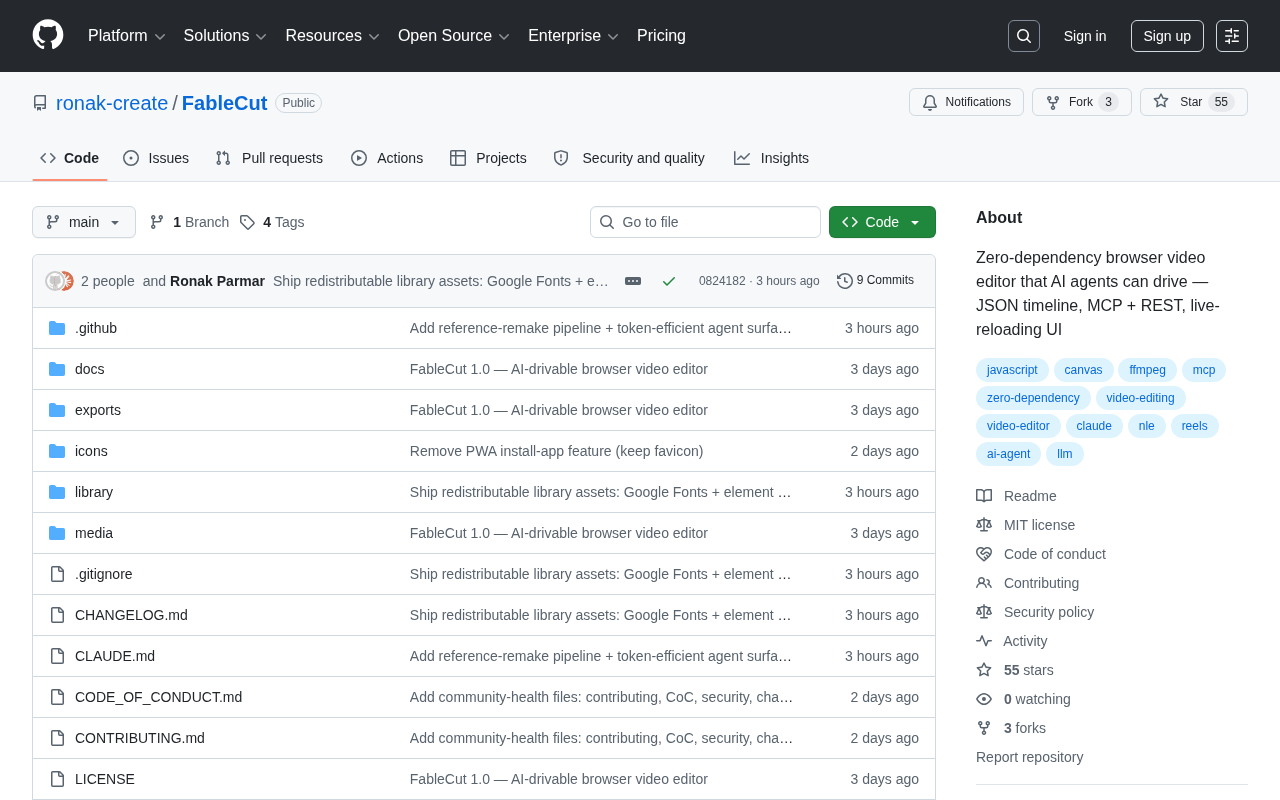
FableCut: A Zero-Dependency Browser Video Editor Built for AI Agents
FableCut is an open-source browser video editor built on a zero-dependency architecture and programmable AI-agent-driven design. A deep dive for AI automation developers.
Read more →

·3 min
30 Cents vs $27: Open-Source Models Face Off in Coding, With DeepSeek Leading at 100x Cost-Efficiency
A hands-on comparison of AI models—Fable 5, DeepSeek V4 Flash, GLM 5.2, Qwen 3.6—building a sales CRM. The priciest cost $27.69, the cheapest just 30 cents. A deep dive into open-source LLM coding value.
Read more →
·3 min
Tencent Hunyuan HY3 In-Depth Review: How a Small Open-Source Model Punches Above Its Weight
In-depth analysis of Tencent's open-source reasoning model Hunyuan HY3: MoE architecture, 295B total params, Apache 2.0 license, coding & front-end rivaling DeepSeek V4 Pro at 1/35 the cost.
Read more →

·1 min
GPT-5.6 Released: ChatGPT Merges with Codex, Evolving into an AI Workbench
OpenAI releases GPT-5.6, officially merging ChatGPT with the coding tool Codex to build a complete AI workbench. New Soul, Terra, and Nuna tiers cover coding, task automation, and web deployment.
Read more →

·5 min
Can a Mixture of Experts Beat a Single Large Model? A Deep Dive into the Hermes 2.0 Architecture
A hands-on analysis of the Hermes 2.0 hybrid multi-agent system: can multi-model collaboration beat a single top-tier LLM? We break down how the Mixture of Experts (MoE) architecture works, AgentOS features, and model-agnostic design.
Read more →