#GPT Work
5809 related articles
OpenAI's First Enterprise AI Report: H…
·2 min
OpenAI's First Enterprise AI Report: How ChatGPT Is Changing the Way Organizations Work
OpenAI's first enterprise AI report reveals three key traits of ChatGPT Enterprise adoption: the shift from novelty to necessity, writing and coding as top use cases, and data governance as a core prerequisite.
Read more →

·2 min
ChatGPT Work in Practice: How AI Generates Board-Level Financial Report Audits
Deep dive into how ChatGPT Work connects Google Drive and NetSuite to cross-reference quarterly financial reports, automatically detect data inconsistencies, and guide step-by-step remediation for board-level audit workflows.
Read more →

·2 min
Samsung Support Agent Accidentally Pastes ChatGPT Prompt, Exposing How AI Customer Service Really Works Behind the Scenes
A Samsung support agent accidentally pasted a ChatGPT prompt into a customer chat, revealing how enterprise AI customer service really operates behind the scenes.
Read more →

·2 min
Virgin Atlantic Uses ChatGPT: Weeks of Work Compressed to Hours
Virgin Atlantic deploys ChatGPT Enterprise, using Codex to build custom dashboards, integrate multi-source data, and compress weeks of analysis into hours, accelerating product development and CX decisions.
Read more →

·2 min
ChatGPT Voice Upgrade: Driving Complete Workflows Through Natural Conversation
OpenAI demos ChatGPT voice on desktop driving full workflows — blog drafting, code debugging, and team collaboration through natural conversation.
Read more →

·2 min
How Enterprises Are Reshaping Work with ChatGPT: Boosting Efficiency and Automating Workflows
Discover how Zapier, Shopify, and others use ChatGPT to automate workflows, multiply individual output by 4-5x, and achieve real cost and time savings.
Read more →

·3 min
ChatGPT Plugins Get a Major Upgrade: From Conversational Tool to Workflow Hub
Deep dive into ChatGPT's plugin upgrade: how AI connects email, docs, calendars & more to transform from a chatbot into a workflow hub with cross-app aggregation.
Read more →

·3 min
ChatGPT Plugins Get a Major Upgrade: From Conversational Tool to Workflow Hub
Deep dive into ChatGPT's plugin directory upgrade—how AI connects email, docs, calendars and more to transform from a chat tool into a workflow hub platform.
Read more →

·4 min
OpenAI Merges Codex and ChatGPT: Deep Dive into Three New Models + Agent Workflows
OpenAI merges Codex and ChatGPT into a unified platform while launching three new models: SOUL, TERRA, and LUNA. Deep dive into Computer Use, loop workflows, multi-threading, and the Agent Native strategy.
Read more →

·3 min
OpenAI Releases GPT-5.6 and ChatGPT Work: The Era of Autonomous AI Has Arrived
OpenAI launches GPT-5.6 (Sol, Terra, Luna), ChatGPT Work, a new desktop app, and Sites hosting. AI evolves from a Q&A tool into an autonomous work partner for finance, file management, and more.
Read more →
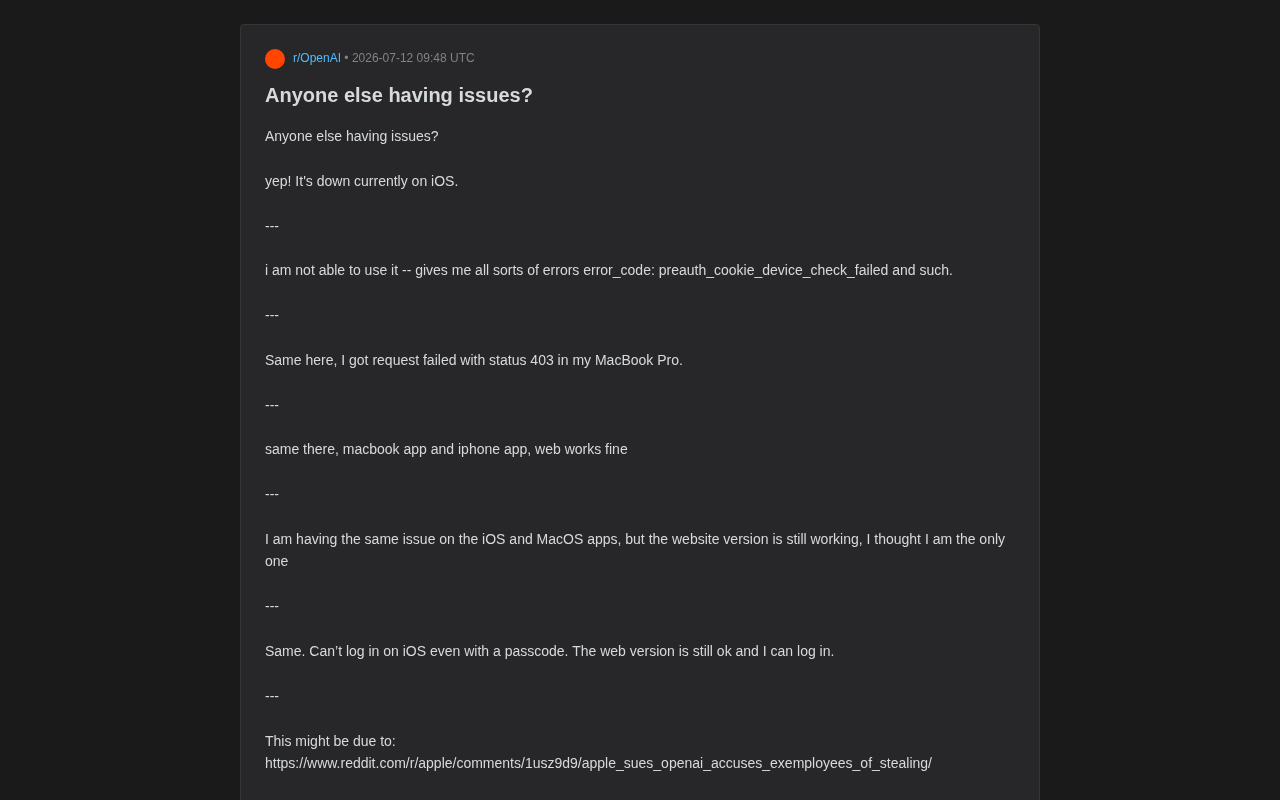
·3 min
ChatGPT Client Widespread Outage: Why the App Fails While the Web Version Works
ChatGPT's iOS and macOS clients suffered a global outage with preauth_cookie_device_check_failed and 403 errors, while the web version worked fine. Here's why.
Read more →
ChatGPT Work Deep Dive: The Cloud-Loca…
·3 min
ChatGPT Work Deep Dive: The Cloud-Local Split and What It Means for Users
ChatGPT Work runs in the cloud on web/mobile but accesses local files on desktop — and they don't sync. A deep dive into the split design, UX tradeoffs, and broader AI agent challenges.
Read more →

·3 min
GPT-5.6 Released: How Multi-Agent Workflows Are Ending the Chat Box Era
OpenAI releases GPT-5.6 with Sol, Terra, and Luna models plus ChatGPT Work execution environment, shifting AI from chatbots to autonomous multi-agent workflows that directly operate local files and business systems.
Read more →

·2 min
ChatGPT's Three Modes Explained: How to Use Chat, Work, and Codex Without Burning Your Quota
ChatGPT now has three modes: Chat, Work, and Codex. Learn how each works, how the quota pools are calculated, and how to avoid burning tokens unnecessarily.
Read more →

·2 min
GPT-5.6 Three-Model Showdown: How Luna, Terra, and SOL Divide the Work to Save You Money
Is your $20/month ChatGPT Plus worth it? We test GPT-5.6's three models—Luna, Terra, and SOL—to show how to assign tasks smartly and get the most value.
Read more →

·3 min
ChatGPT Integrates Codex: A Full Hands-On Breakdown of Work and Codex on Desktop
ChatGPT desktop gets a major upgrade, integrating Codex into new Work and Codex modules. Hands-on tests cover auto PPT generation and full AI video production pipelines.
Read more →

·2 min
GPT-5.6 Deep Dive: Tiered Models + Multi-Agent Architecture, LLMs Evolve into Workflow Engines
GPT-5.6 isn't just a capability upgrade — it's an architectural shift: tiered models, programmatic tool calling, and multi-agent collaboration turn LLMs into workflow engines for production systems.
Read more →

·2 min
One Vague Prompt, Full Anime Animation: A GPT + Blender + Seedance Workflow Breakdown
One vague prompt triggers GPT to write a storyboard, drive Blender MCP to build a 3D layout, and hand it to Seedance 2.0 for anime stylization. Here's how the pipeline works.
Read more →

·2 min
Codex Isn't Gone! OpenAI Quietly Upgrades It Into ChatGPT Work — A Full-Featured AI Assistant
OpenAI quietly upgraded its Codex client into ChatGPT Work, unifying Chat, Codex, and Work into one desktop app. A deep dive into the product strategy and how it stacks up against Claude Code.
Read more →

·3 min
GPT-5.6 and ChatGPT Work Launch: AI Evolves from Conversational Assistant to Task Executor
OpenAI launches the GPT-5.6 family (Sol/Terra/Luna), ChatGPT Work, a new desktop app, and Hosted Sites — marking AI's evolution from Q&A assistant to autonomous task executor.
Read more →