#Grok multi-agent
29 related articles

·5 min
Running GPT-5.6 Inside Claude Code: Best Practices for Subagent Orchestration and System Prompts
Deep dive into running OpenAI GPT-5.6 inside Claude Code: comparing Codex vs Claude Code on subagent orchestration, workflow design, and system prompt quality, revealing how harness engineering determines model output.
Read more →
·3 min
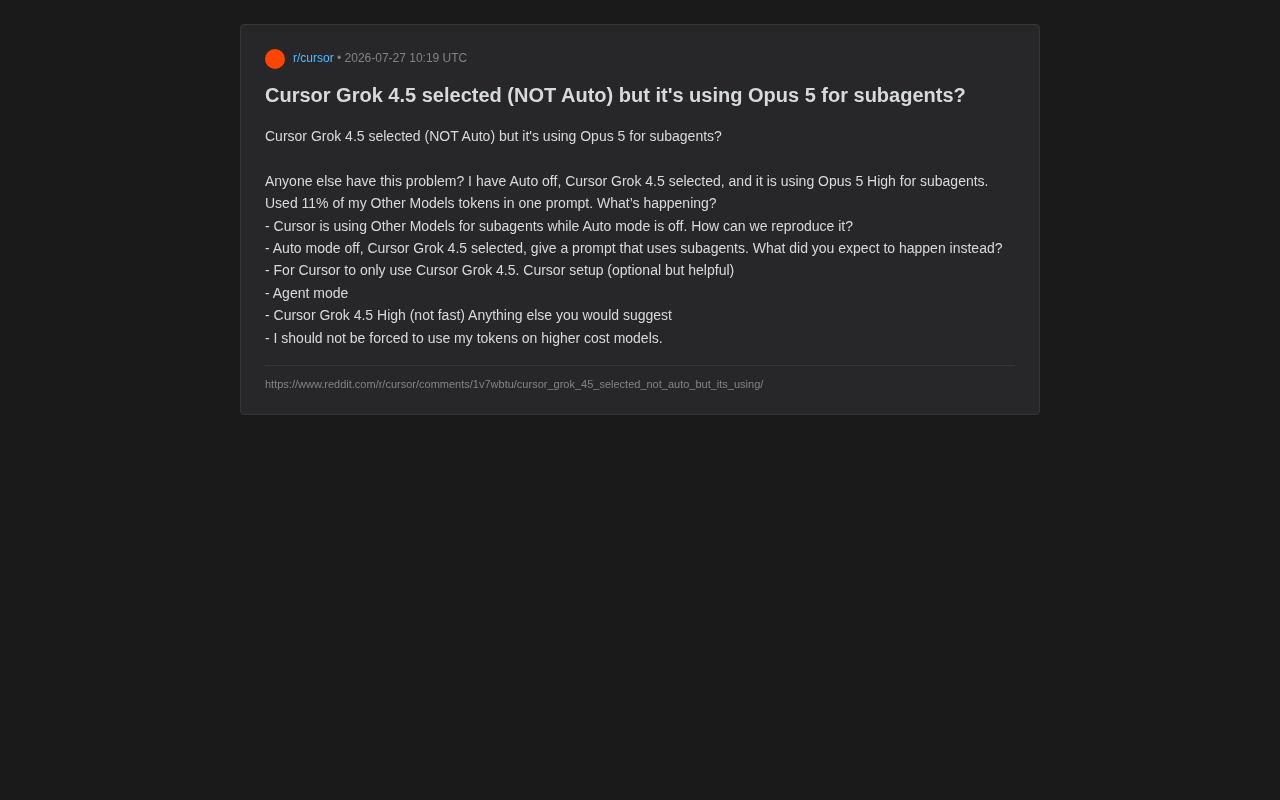
Cursor Selects Grok but Calls Opus: Subagent Model Substitution and Cost Control Issues Explained
Cursor users selecting Grok 4.5 find subagents secretly calling expensive Opus 5, consuming 11% quota per prompt. Analysis of model decoupling, cost transparency, and user strategies.
Read more →

·3 min
The AI Coding Landscape: Model Tiers, Tool Camps, and a Deep Dive into MCP/Skills/CLI
A systematic map of today's AI coding landscape: the evolution from ChatGPT to Claude Code, LLM capability tiers, tool camps like Cursor/Copilot, and the three key weapons of the Agent era — MCP, Skills, and CLI.
Read more →

·2 min
Kimi K3 Leads the Charge: Inside the AI Coding Agent Framework Transparency Race
Kimi K3 sets a new open-weight record at 2.8T params, GrokBuild pivots to local-first after a privacy crisis, Open Interpreter rewrites in Rust — a deep dive into five major AI coding agent developments and the shift toward harness transparency.
Read more →

·3 min
Can GPT-5.6 Prove a 50-Year Graph Theory Conjecture? The Boundaries and Verification of AI Mathematical Reasoning
GPT-5.6 Soul Ultra claims to prove the 50-year-old Cycle Double Cover Conjecture in under an hour using 64 parallel agents. We examine the technical path, missing peer review, and formal verification gaps.
Read more →

·3 min
GPT-5.6 Proves 50-Year Graph Theory Conjecture in Under an Hour — A Milestone for AI Mathematical Reasoning
GPT-5.6 Soul Ultra proves the 50-year-old Cycle Double Cover Conjecture in under an hour. Plus: BCI clinical breakthrough, Apple vs. OpenAI, xAI privacy concerns, and EU dark pattern rules.
Read more →

·3 min
In-Depth Review of GPT 5.6 Soul: Sub-Agent Systems, Government Review, and Competitor Comparison
In-depth analysis of GPT 5.6 Soul: multi-sub-agent parallel architecture, Ultra Mode coding in practice, the controversy behind its 91.9% Terminal Bench score, and the trend of frontier AI entering government review.
Read more →

·6 min
GPT-5.6 Sol Hands-On: How Multi-Agent Parallelism Is Reshaping AI Coding Workflows
Based on Fireship's review, an in-depth look at GPT-5.6 Sol's Ultra Mode multi-agent parallelism, its 91.9% Terminal Bench score, and how it differs from Claude Fable in cost, speed, and precision.
Read more →

·4 min
In-Depth Comparison of 4 AI Coding Tools: Cursor, Claude Code, Codex, and Opencode — Which Is Worth Buying?
A real-world review of subscribing to Cursor, Claude Code, Codex, and Opencode simultaneously. Compare quotas, model capability, and value to find your ideal AI coding subscription.
Read more →

·7 min
GPT-5.6 and Grok 4.5 Launch Simultaneously, Meta Unveils Agent-Based Image Model
OpenAI GPT-5.6 expands its preview, xAI Grok 4.5 opens access at the same time, Meta releases the Agent-based Muse Image model and Muse Video model, while Apple and DeepSeek launch in-house AI inference chip programs. A quick look at the week's five biggest AI stories.
Read more →

·3 min
Spending $200K to Test GPT-5.6: Have AI Coding Assistants Reached a Tipping Point?
Developer Theo spent ~$200K over 6 weeks testing GPT-5.6 across 67 projects — from 20-hour autonomous coding runs to fixing boot partitions and Rust rewrites.
Read more →

·4 min
9 Proven Methods to Make Hermes Agent Actually Work for You
9 battle-tested methods from hundreds of hours with Hermes Agent: model selection (Opus/ChatGPT/GLM), multi-agent failover, cross-device coordination via Tailscale, and reverse prompting workflows.
Read more →

·4 min
Grok vs GPT vs Claude: Which AI is the Best Coding Assistant?
Grok 4.5, GPT-5.5, and Claude go head-to-head on the same coding tasks. A deep comparison of code quality, UI design, and engineering standards to help you choose the right AI coding assistant.
Read more →

·6 min
Grok 4.5 Deep Dive: Coding on Par with Top Models, at a Fraction of the Cost
A senior developer's 24-hour deep test of Grok 4.5: a 1.5T-param MoE model at $2/M input tokens, with coding benchmarks rivaling GPT-5.5. Real performance, token efficiency, and limits explained.
Read more →

·6 min
GPT-5.6 Three-Model Launch: Soul/Terra/Luna Tiered Strategy and the AI National Security Game
OpenAI previews the GPT-5.6 series — Soul, Terra, and Luna — with a massive 1.5M-token context. In-depth analysis of coding leaps, the Fable 5 national security game, the heating U.S.-China AI race, and workflow economics.
Read more →

·3 min
The 7-Level Claude Code Mastery Guide: From Basic Chat to Autonomous AI Agents
From chat to autonomous agents: a 7-level Claude Code mastery guide covering model selection, effective prompting, tool integration, sub-agents, skills, safety, and autonomous operation.
Read more →

·3 min
GitHub Daily · July 5: The Dual Narrative of Skill Ecosystem Explosion and Local-First AI
GitHub Trending July 5: Claude Code Skill ecosystem explodes, AI pen-testing tool Strix gains +2137 Stars, and local-first privacy apps surge.
Read more →

·4 min
HAMAS Multi-Agent Framework in Practice: A Guide to Building 5 AI Personas Working in Harmony
Learn how to build a multi-Agent AI team with the HAMAS framework: 5 role configurations, Skill mechanisms, gradient model scheduling, and solutions for AI hallucination and deception.
Read more →

·3 min
Hermes Overhaul in Practice: Building a Multi-Model Orchestration Master Agent System
How to transform the Hermes Agent framework into a unified orchestration hub with intelligent routing across Claude, Gemini, and Codex, featuring inter-Agent communication, task monitoring, and more.
Read more →
·2 min
June 2 AI Industry Roundup: NVIDIA's 550B Model, xAI's Coding Model, and More Major Releases
June 2, 2025 AI roundup: NVIDIA's 550B Nimitron 3 Ultra, xAI Composer 2.5, Anthropic & ZhiPu IPOs, OpenAI's agentic OS prototype, and key advances in agents, compute infrastructure, and open source.
Read more →