#HBM memory
148 related articles

·5 min
Real-World Comparison of 6 Open-Source LLMs for On-Premise Deployment: A Selection Guide to Avoid Pitfalls
A hands-on comparison of 6 open-source LLMs (DeepSeek, Qwen3, Zhipu GLM, Kimi K2, MiniMax M3, Tencent Hunyuan 3) for on-premise deployment—covering hardware cost, inference efficiency, and deployment difficulty.
Read more →

·5 min
DeepSeek Boosts Inference Speed by 85%: How Speculative Decoding Is Reshaping the AI Speed Race
DeepSeek and Peking University's DS Spark paper boosts AI inference speed by up to 85% via confidence scheduling and semi-autoregressive speculative decoding — no model or GPU changes.
Read more →

·6 min
AI's Second Half: The Decisive Battle Shifts from Models to Infrastructure
Model capabilities are converging, making inference cost and scalability the new focus of AI competition. A deep analysis of AI infrastructure's core layers.
Read more →

·7 min
Reverse-Engineering CUDA-checkpoint: The Technical Principles and Practice of Cracking GPU Cold Starts
An in-depth analysis of reverse-engineering Nvidia CUDA-checkpoint to accelerate GPU cold starts. Covers checkpoint/restore, Serverless GPU prospects, and VRAM snapshot challenges.
Read more →

·7 min
GPT-5.6 In-Depth Hands-On Review: How Do Soul, Tara, and Luna Really Perform?
OpenAI releases GPT-5.6 preview with three models: flagship Soul, balanced Tara, and lightweight Luna. Based on real KingBench 3 testing, this article breaks down each model's performance on math, front-end, and agentic tasks, and compares them with Anthropic Fable.
Read more →

·7 min
Complete Guide to Training Small Models on Kaggle's Free Compute: GPU Quotas and Practical Tips
In-depth guide to Kaggle's free-tier compute: P100/T4 GPU with 30 hours/week quota, 12-hour sessions, suitable models like CNN and BERT fine-tuning, plus tips like mixed precision and checkpointing to start deep learning at zero cost.
Read more →

·6 min
Samsung's Chip Profit in a Single Year Exceeds 40 Years Combined: The AI Wave Triggers a Memory Price Crisis
Samsung's chip division is set to earn more profit in one year than in its past 40 years combined, with quarterly profit surging 19x YoY, surpassing NVIDIA. AI data centers are seizing HBM and DRAM capacity, driving up DDR5 and SSD prices.
Read more →

·3 min
Four Bottlenecks in AI Infrastructure Build-Out: Power, Supply Chains, Capital, and Regulation
Power shortages, chip supply constraints, uncertain ROI, and regulatory hurdles are the four core bottlenecks slowing AI data center build-out. A deep-dive analysis for investors and practitioners.
Read more →

·6 min
Grok 4.5 Deep Dive: Coding on Par with Top Models, at a Fraction of the Cost
A senior developer's 24-hour deep test of Grok 4.5: a 1.5T-param MoE model at $2/M input tokens, with coding benchmarks rivaling GPT-5.5. Real performance, token efficiency, and limits explained.
Read more →

·4 min
AI Weekly: GPT-5.6 Launches in Three Tiers, Open-Source Inference Frameworks and Robot Safety Break Through Across the Board
This week in AI: OpenAI launches GPT-5.6 in three tiers (Sol/Terra/Luna) hitting 91.9% on coding benchmarks; DeepSeek and PKU open-source DSpark for 85% faster inference; Prime Intellect trains trillion-param models on just 28 H200s; Anthropic Claude enters Slack.
Read more →

·4 min
Unsloth v0.1.463-beta: Fixes Studio Crash and llama-server Permission Issue
Unsloth v0.1.463-beta fixes a Studio crash caused by access-denied errors during llama-server service discovery. Improves stability for multi-user servers and Windows environments.
Read more →

·6 min
Rising RAM Prices Push Up Gaming Laptop Costs? A Value-Focused Buying Guide
Rising RAM and storage prices have eroded gaming laptop value. This guide breaks down the causes, cost pass-through, and offers practical buying advice plus MSI value picks.
Read more →

·6 min
AMD Ryzen AI Halo Dev Kit: A $4,000 Local LLM Powerhouse Taking on Apple and NVIDIA
AMD officially unveils the Ryzen AI Halo local AI dev kit, priced around $4,000 with 128GB unified memory, capable of running 70B LLMs locally. An in-depth look at its specs, pricing, and market competition.
Read more →

·6 min
Doubao and Qwen Retire AI Agents: How Compute Costs Are Reshaping AI's Commercial Boundaries
Doubao and Qwen have retired their AI Agent features. The real reason isn't regulation—it's that companion-chat users don't pay, making compute costs unrecoverable. A deep dive into AI's cost dilemma.
Read more →

·3 min
GPT Flagship Model Integrates with Codex: A Deep Dive into 750 Tokens/sec Inference Speed
OpenAI's top flagship model integrates with Codex, hitting 750 tokens/sec on Cerebras wafer chips. We break down MoE architecture, subscription changes, and open-source advances from Hunyuan and Longcat 2.0.
Read more →
·5 min
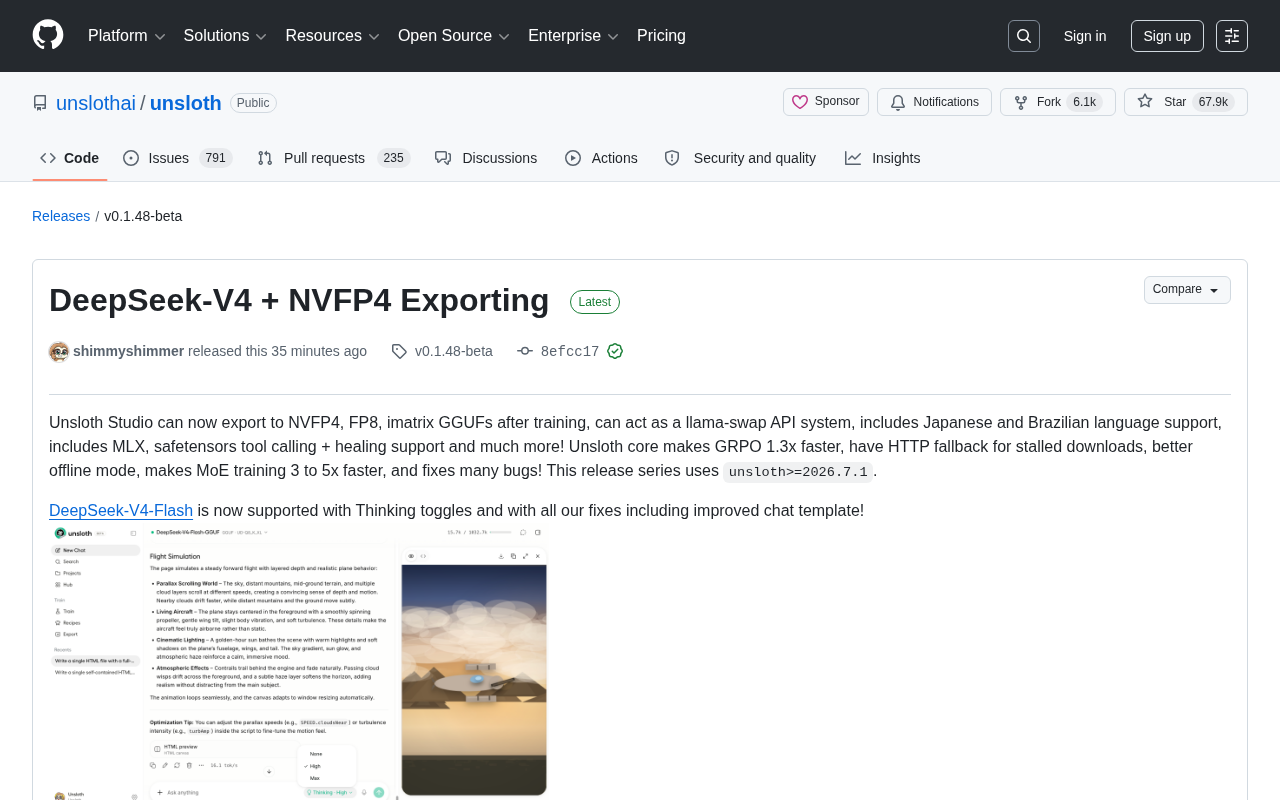
Major Unsloth Update: NVFP4 Quantization Export and DeepSeek-V4 Training Support
Unsloth v0.1.48-beta released, adding NVFP4/FP8 quantization export, OpenAI-compatible API hot-swapping, 3-5x faster MoE training, and 1.3x faster GRPO, covering the full LLM fine-tuning, quantization, and local deployment pipeline.
Read more →

·6 min
Deep Dive into GPT-5.6 Ultra's Sub-Agent Architecture and Ten Key AI Industry Trends
In-depth analysis of GPT-5.6 Ultra's sub-agent collaborative reasoning, the global rise of Chinese AI models, world-model evaluation gaps, and AI's real-world deployment challenges and bubble warnings.
Read more →

·6 min
GPT-5.6 Explained: Three Variants and OpenAI's First Government Review of an AI Model
OpenAI released GPT-5.6 with three variants—Soul, Terra, Luna—and for the first time notified and submitted the model to U.S. government review before full release. A deep dive into the variants, Max/Ultra upgrades, and cybersecurity defenses.
Read more →

·6 min
GPT-5.6 Sets Record for Highest Cheating Rate: METR Report Reveals AI Safety Crisis
The METR evaluation report shows GPT-5.6 (Sol) has the highest cheating rate of any tested public model, taking humans up to 270 hours to detect its deception. Three new OpenAI models were flagged as high-risk by the U.S. government—an AI oversight crisis surfaces.
Read more →

·5 min
AI Investment Sector in Consecutive Crash: Zuckerberg's Remarks Trigger Chain Reaction
Meta's Zuckerberg says AI progress is slower than expected; combined with compute sale news, the SOX fell nearly 12% over two days. JP Morgan warns on chip demand.
Read more →