#KV Cache Offload
39 related articles

·3 min
Dual RTX 3060 Running DeepSeek V4 Flash: IQ2_M Quantized Inference Benchmarked at 3.5 tok/s
Benchmarking DeepSeek V4 Flash on dual RTX 3060 GPUs with 96GB RAM at IQ2_M quantization achieving 3.5 tokens/sec. Covers hardware choices, 2-bit quantization techniques, and local LLM deployment optimization.
Read more →

·3 min
20W Home Server: Unraid Self-Hosting and Usenet Streaming in Practice
A six-year Unraid user shares a 20W ultra-low-power home server using Intel N100, hot/cold data separation, and NZBDAV Usenet streaming to replace 30TB of local hard drives.
Read more →

·3 min
LLM Inference Speed Formula: Memory Bandwidth Determines Your tokens/sec
Why memory bandwidth (GB/s), not VRAM size, determines local LLM inference speed. Includes tokens/sec formula, GPU bandwidth comparison, and a practical card selection framework.
Read more →

·3 min
LLM Inference Speed Formula: Memory Bandwidth Determines Your tokens/sec
Learn why memory bandwidth (GB/s)—not VRAM size—determines local LLM inference speed. Get the tokens/sec formula, GPU bandwidth comparisons, and a practical card selection hierarchy.
Read more →

·3 min
Self-Hosting Kimi K3: Is Spending 20% More on Hardware Worth a 20% Improvement in Task Performance?
Analysis of whether spending 20% more on hardware for self-hosting Kimi K3 to gain 20% task performance improvement is worthwhile, covering inference precision, VRAM optimization, and tiered deployment.
Read more →

·3 min
Local LLM Agent Lagging? Lowering num_gpu Is the Key
Local LLM crashing in Agent frameworks? The issue may be num_gpu set too high. Learn what num_gpu really controls (GPU layer offloading, not GPU count) and how to tune it for stable Agent performance.
Read more →

·4 min
GPT-5.6 Value Maxing Practical Guide: From Token Stacking to Output Optimization Methodology
Deep dive into OpenAI GPT-5.6 Value Maxing strategies covering Sol/Terra/Luna model selection, KV cache optimization, Prompt compression, and programmatic tool calling to help developers achieve more output with fewer Tokens.
Read more →
·3 min
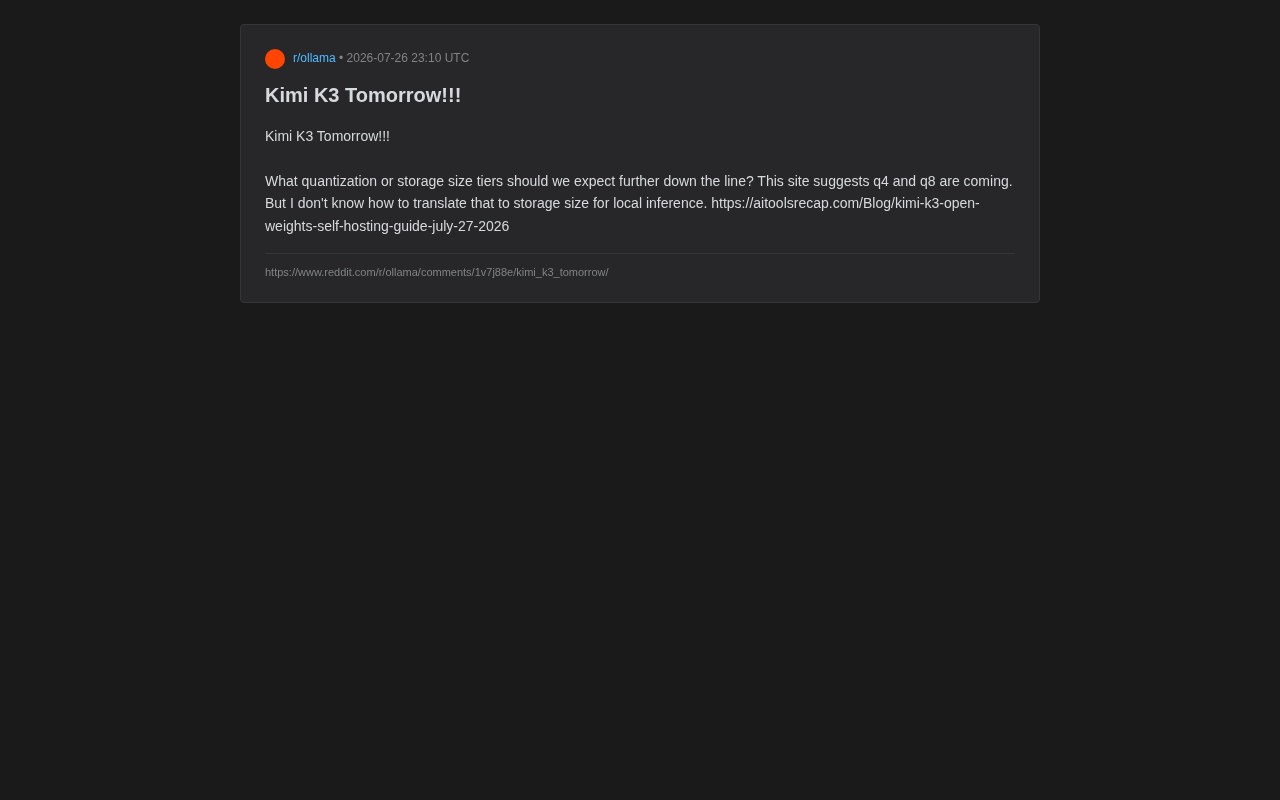
Kimi K3 Local Deployment Guide: Storage Requirements for q4 and q8 Quantization Explained
Detailed analysis of Kimi K3 quantization deployment options, comparing q4 vs q8 storage requirements, precision trade-offs, and hardware configurations for local self-hosting.
Read more →

·5 min
Ollama Performance Degrades After Connecting to OpenWebUI? A Complete Troubleshooting Guide
Complete guide to troubleshooting Ollama performance degradation with OpenWebUI, covering num_ctx truncation, sampling parameter differences, GPU resource contention, and system prompt interference.
Read more →

·2 min
MiniMax M3 Local Deployment: 23B Active Parameters ≠ 23GB VRAM — A Complete Guide to MoE Architecture
MiniMax M3 is a 428B MoE model. Its 23B active parameters reflect per-token compute, not VRAM needs. Learn the MoE trade-offs, quantization options, and deployment paths to avoid the most common misconception.
Read more →
GitHub Daily · July 19: The Dual Advan…
·3 min
GitHub Daily · July 19: The Dual Advance of Heterogeneous Inference and Agent Toolchains
GitHub Trending July 19: ktransformers tops the list with heterogeneous inference optimization, while jcode, cua, and AstrBot signal a maturing Agent ecosystem.
Read more →

·2 min
Running Qwen 122B on 8GB VRAM: A Complete Guide to Quantized Local Deployment
A Bilibili creator ran Qwen 122B with 256K context on just 8GB VRAM + 64GB RAM using llama.cpp. Full breakdown of quantization, deployment params, performance, and cost-effective alternatives.
Read more →

·2 min
How Large a Local LLM Can You Run on a Laptop with 8GB VRAM? A Configuration Guide
Complete guide to running local LLMs on a laptop with 8GB VRAM: real usable memory, quantization estimation, Q4 7B/8B model recommendations, Ollama setup, GPU offloading, and agent development tips.
Read more →
Running Gemma LLM in Godot with GDScri…
·2 min
Running Gemma LLM in Godot with GDScript and Vulkan: An Experimental Deep Dive
A developer runs the Gemma LLM inside Godot 4 using only GDScript and Vulkan compute shaders — no llama.cpp or external dependencies. A technical breakdown of how it works.
Read more →
How Fixing Three Bugs Made Qwen3.5-122…
·3 min
How Fixing Three Bugs Made Qwen3.5-122B Run Reliably on Mac Studio
A developer fixed three critical bugs to make Qwen3.5-122B run reliably as a daily driver on Mac Studio. Explore memory management, inference stability, and quantization precision.
Read more →

·4 min
Zhipu GLM-5.2 Released: China's First Open-Source Model to Cross the 'Primary Model' Threshold
Zhipu releases GLM-5.2 with 1M token context, matching GPT-5.x and Claude. Zcode 3.0 offers 3M free daily calls with one-click migration from Claude Code and Codex.
Read more →

·5 min
The Five Unsolved Challenges of Production MLOps: A Deep Dive into GPU Scheduling, Fault-Tolerant Training, and Model Observability
A deep dive into the five genuinely tough challenges of production MLOps: fault-tolerant training on Spot instances, cross-team GPU scheduling, data reproducibility, model observability, and inference cost optimization.
Read more →

·4 min
AMD Ryzen AI Halo Hands-On: Can x86 Architecture Challenge NVIDIA's DGX Spark?
In-depth review of the AMD Ryzen AI Halo mini AI box: powered by the Ryzen AI Max Plus 395 (Strix Halo) chip with 128GB unified memory, priced at $4,000. Compared against NVIDIA's DGX Spark across token generation, prefill speed, and x86 advantages.
Read more →

·3 min
TB/s Memory Tier Accelerates SGLang: How X-Mem Reduces TTFT by 6.7x
Netpreme integrates X-Mem™ MPU into SGLang HiCache, achieving up to 6.7× TTFT reduction and 33–50% TPS gains at 98% prefix cache hit rates. Here's the technical breakdown.
Read more →

·3 min
Connecting Codex to Ollama: A Complete Guide to Deploying AI Large Models Locally
A step-by-step guide to combining Codex with Ollama to deploy open-source AI large models locally. Private data, no subscription, offline operation, no VPN needed. Includes hardware selection and setup.
Read more →