#Luna
153 related articles

·2 min
GPT-5.6 Sol Continues Optimization, Luna Opens to Free Users: Decoding the Model Tiering Strategy
OpenAI releases dual GPT-5.6 updates: Sol continues optimizing reasoning capabilities while Luna opens to free users. Analysis of the model tiering strategy and its industry implications.
Read more →

·3 min
GPT-5.6 Released: A Deep Dive into the Sol and Luna Dual-Model System
OpenAI launches GPT-5.6 dual-model system: Sol delivers instant response and deep reasoning for paid users, while Luna offers unlimited text chat for free users. A detailed breakdown of capabilities, tiering strategy, and real-world impact.
Read more →

·2 min
GPT-5.6 Luna Price Cut by 80%: A Full Breakdown of OpenAI's Latest Pricing Strategy
OpenAI announces major GPT-5.6 price cuts: Luna down 80%, Terra down 20%, Sol gets faster API options. Full analysis of strategy and developer impact.
Read more →

·2 min
GPT-5.6 Luna High vs Composer 2.5: A Comprehensive Comparison of Coding Performance and Credit Costs
In-depth comparison of GPT-5.6 Luna High and Composer 2.5 for coding performance, credit costs, and value in Cursor, with practical model selection strategies for developers.
Read more →

·3 min
GPT-5.6 Luna Review: Outperforms Google's Flagship at a Lower Price
GPT-5.6 Luna tops Google's flagship on the Artificial Analysis Intelligence Index while priced below Google's entry-level model. A deep dive into what this performance-cost breakthrough means.
Read more →

·2 min
GPT 5.6 Luna: Outperforms Google's Best Model at a Price Lower Than Google's Cheapest
GPT 5.6 Luna reportedly tops Google's flagship on the Artificial Analysis Intelligence Index while costing less than Google's cheapest model. A deep dive into the tech trends, industry impact, and developer implications.
Read more →

·2 min
GPT-5.6 Three-Model Showdown: Sol vs Terra vs Luna — Which One Should You Pick?
OpenAI GPT-5.6 launches Sol, Terra, and Luna simultaneously. We compare benchmarks and real-world coding tests to help you choose the right model for your needs.
Read more →

·2 min
GPT-5.6 Codex Three-Model Showdown: Sol/Terra/Luna Tested on Classic Candy Logic Puzzle
We tested GPT-5.6 Codex models Sol, Terra, and Luna on a classic candy logic puzzle. Sol scored near-perfect across HIGH and XH modes; Terra and Luna nearly failed. Here's what it means for developers.
Read more →

·2 min
GPT-5.6 Three-Model Showdown: How Luna, Terra, and SOL Divide the Work to Save You Money
Is your $20/month ChatGPT Plus worth it? We test GPT-5.6's three models—Luna, Terra, and SOL—to show how to assign tasks smartly and get the most value.
Read more →

·2 min
Exposing the GPT-5.6 Marketing Scam: Are the Sol/Terra/Luna Sub-Models Real Releases or Just a Trap?
Is "GPT-5.6" with Sol, Terra, and Luna sub-models a real OpenAI release? We debunk the viral claims, expose third-party top-up risks, and show how to spot AI scams.
Read more →
·2 min
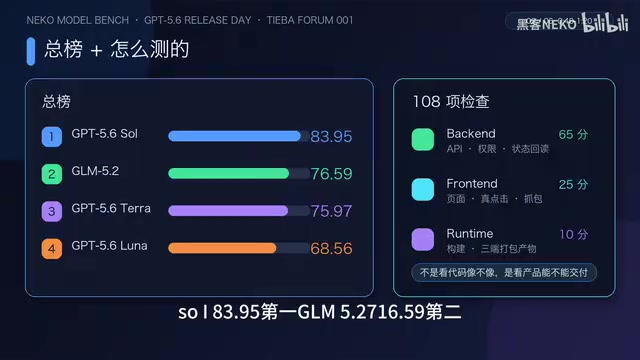
GPT 5.6 Three-Version Benchmark: What Makes Sol, Terra, and Luna Worth the Price Difference?
GPT 5.6's Sol, Terra, and Luna tested across 108 engineering checks. Backend scores tie between Sol and Terra — the real gap is in frontend and packaging delivery.
Read more →

·3 min
Codex Merges into ChatGPT: GPT-5.6's Three Tiers Explained — Sol, Terra, and Luna
Codex merges into ChatGPT with a new Work Mode. GPT-5.6 splits into Sol (flagship), Terra (balanced), and Luna (lightweight). Full breakdown of capabilities, costs, and how to choose.
Read more →

·2 min
GPT-5.6 Three-Tier Model Breakdown: How Sol/Terra/Luna Rewrite the Agent Cost Structure
OpenAI releases GPT-5.6 with three tiers: flagship Sol, balanced Terra, and budget Luna. Sol leads competitors by 13 points on Agent benchmarks at one-quarter the cost, rewriting Agent economics.
Read more →
GPT-5.6 Trio Launches: Luna, Terra, an…
·3 min
GPT-5.6 Trio Launches: Luna, Terra, and Sol Built for Long-Running Agentic Tasks
OpenAI officially launches the GPT-5.6 family: Luna, Terra, and Sol, with 1M token context and a focus on long-running agentic performance. A deep dive into three-tier pricing, Agents' Last Exam results, the SWE-Bench Pro controversy, and new API features like programmatic tool calling and native multi-agent support.
Read more →

·3 min
In-Depth Testing of GPT-5.6's Three Models: A Full Analysis of Soul/Terra/Luna Capabilities and Experience
GPT-5.6 launched three models at once—Soul, Terra, and Luna. Flagship Soul dazzled with a Vision Pro drum kit and reviving an old tablet, but the new Work app's frequent errors and export failures dragged down the experience.
Read more →

·3 min
GPT-5.6 Launches with Three Models: Sol/Terra/Luna and ChatGPT Work Reshape How We Work
OpenAI launches the GPT-5.6 family—Sol, Terra, and Luna—alongside ChatGPT Work, a new desktop app, and Sites. AI evolves from a chat tool into a true productivity partner, completing financial analysis, presentations, and cross-platform collaboration in one operation.
Read more →

·3 min
GPT-5.6 Three-Model Hands-On Test: A Complete Comparison of Sol, Terra, and Luna
An in-depth hands-on test of the GPT-5.6 series' three models—Sol, Terra, Luna—compared with Fable and Sonnet 5. Sol wins overall at nearly half the price. Full analysis of prototyping, code debugging, and browser use.
Read more →

·3 min
GPT-5.6 Released: Sol/Terra/Luna Three-Tier Model Family Takes On Claude Head-On
OpenAI officially releases GPT-5.6 with a three-tier model family—Sol, Terra, and Luna. Flagship Sol beats Claude on coding benchmarks: twice as fast, a third cheaper.
Read more →

·2 min
GPT-5.6 Officially Released: A Deep Dive into the Sol/Terra/Luna Variants and Major Improvements in Agentic Coding
GPT-5.6 launches with three variants—Sol, Terra, and Luna—focused on agentic coding and computer use. A deep dive into their positioning, a comparison with Anthropic's Fable 5, and a Fable 5 orchestration + GPT-5.6 execution workflow.
Read more →

·5 min
Hands-On Test of GPT-5.6's Three Models Sol/Terra/Luna: How Good Are Their Coding Skills?
OpenAI released three GPT-5.6 models—Sol, Terra, Luna—and merged ChatGPT with Codex to launch Work mode. This hands-on review tests coding, game dev, and PPT creation, revealing one-click deployment wins alongside aesthetic and efficiency flaws.
Read more →