#Multi-Agent
1375 related articles

·4 min
Claude Code vs. Codex vs. Cursor: A Deep Comparison of Three AI Coding Tools
Claude Code, Codex, or Cursor? This in-depth comparison covers each tool's positioning, ideal users, and how to combine them for maximum productivity in your AI coding workflow.
Read more →

·3 min
In-Depth Review of GPT 5.6 Soul: Sub-Agent Systems, Government Review, and Competitor Comparison
In-depth analysis of GPT 5.6 Soul: multi-sub-agent parallel architecture, Ultra Mode coding in practice, the controversy behind its 91.9% Terminal Bench score, and the trend of frontier AI entering government review.
Read more →

·4 min
Hands-On with GPT-5.6: A Single Prompt Builds a Real-Time Voice Anime App
Hands-on with GPT-5.6 Sol: auto-generate real-time voice anime characters from one prompt, write physics engines from scratch, and build unfamiliar toolchains autonomously. In-depth review of coding, agentic tasks, benchmarks, and its hallucination weakness.
Read more →
GPT-5.6 Trio Launches: Luna, Terra, an…
·3 min
GPT-5.6 Trio Launches: Luna, Terra, and Sol Built for Long-Running Agentic Tasks
OpenAI officially launches the GPT-5.6 family: Luna, Terra, and Sol, with 1M token context and a focus on long-running agentic performance. A deep dive into three-tier pricing, Agents' Last Exam results, the SWE-Bench Pro controversy, and new API features like programmatic tool calling and native multi-agent support.
Read more →

·4 min
Codex Plans, DeepSeek Executes: A Practical Guide to Multi-Model Collaboration for Saving Tokens
AI programming burning through Tokens too fast? This guide covers the open-source Hand of Labor project's multi-model approach: Codex plans, DeepSeek executes—cutting AI coding costs while boosting output quality.
Read more →

·3 min
Generate a Mini-Game from a Single Prompt? Testing the Cocos AI Agent Plugin
Deep dive into the Cocos Creator AI Agent Plugin: three-level context compression, tool approval, multi-agent parallelism, and DeepSeek-powered Mario scene building — all in one test.
Read more →

·4 min
A Deep Dive into Claude Cookbooks: A Guide to the Official 47K-Star Hands-On Code Repository
Anthropic's open-source Claude Cookbooks project offers runnable Jupyter Notebook examples covering RAG, Tool Use, multimodal processing, and more—helping developers master Claude API best practices.
Read more →
·3 min
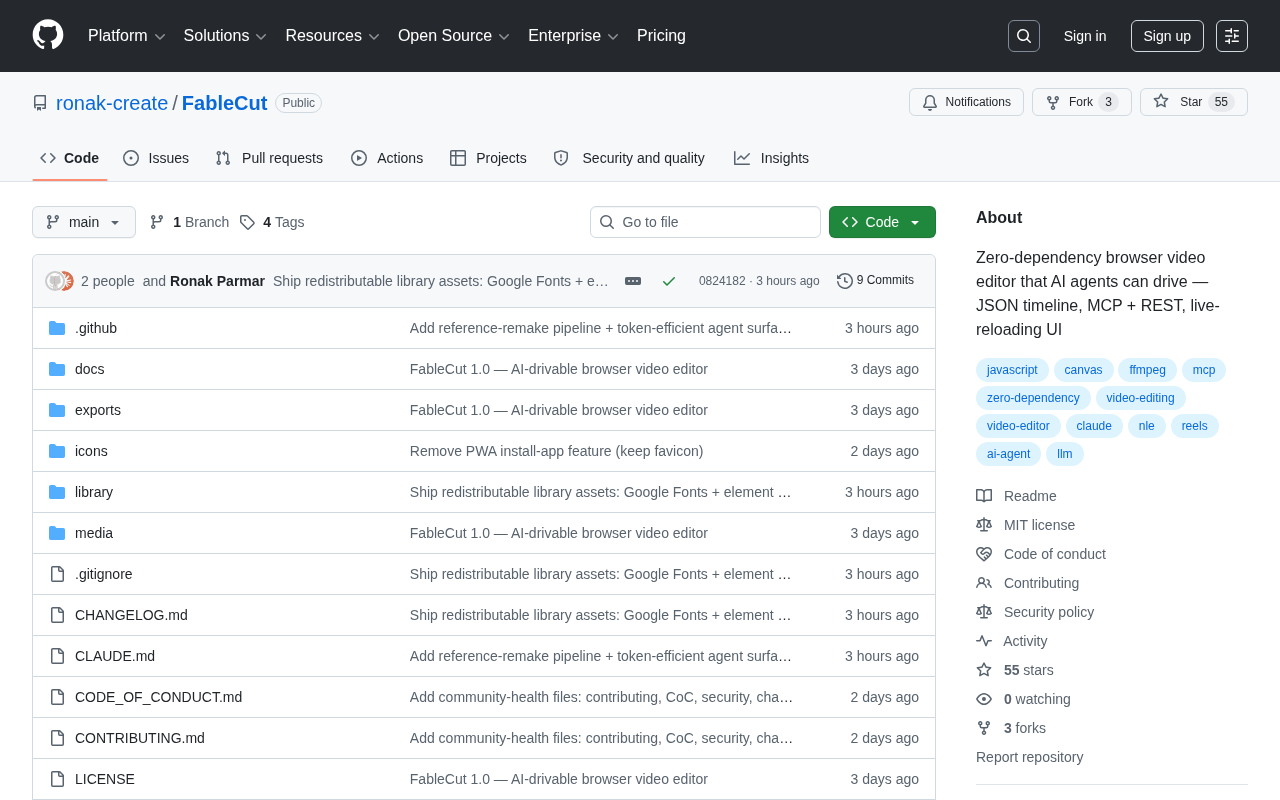
FableCut: A Zero-Dependency Browser Video Editor Built for AI Agents
FableCut is an open-source browser video editor built on a zero-dependency architecture and programmable AI-agent-driven design. A deep dive for AI automation developers.
Read more →

·5 min
Maximizing Codex Weekly Quota: A Complete Guide to Goal Commands and Long-Running Agent Configuration
Master Codex's Goal command mechanism. Use five standard project settings—agents.md, context.md, active-context and more—to solve context forgetting and hallucination in long-running Agents and maximize your weekly quota.
Read more →

·2 min
Testing the Claude Code Job Hunting Agent: A Deep Dive into AI Job Search, the 20K-Star Open Source Project
AI Job Search is an open source, Claude Code-powered job search automation tool with over 20K GitHub stars. It offers resume tailoring, cover letter generation, dual-Agent QA, and keeps humans in control of submission.
Read more →

·3 min
30 Cents vs $27: Open-Source Models Face Off in Coding, With DeepSeek Leading at 100x Cost-Efficiency
A hands-on comparison of AI models—Fable 5, DeepSeek V4 Flash, GLM 5.2, Qwen 3.6—building a sales CRM. The priciest cost $27.69, the cheapest just 30 cents. A deep dive into open-source LLM coding value.
Read more →

·5 min
How Can Working IT Professionals Learn AI Efficiently? A Practical Learning Path from Zero to Real-World Projects
Limited time but want to learn AI systematically? This guide maps out a practical learning path for working IT pros—from AI application engineering and prompt engineering to RAG and Agents.
Read more →

·4 min
AI + Automated Testing: Building an Engine-Agnostic Quality System with Skill + CLI
An in-depth analysis of the AI-driven software testing paradigm: with Skill and CLI as the core hub, supporting both platformized management and digital employees, helping testing teams transform from script writers into capability builders.
Read more →

·5 min
Can a Mixture of Experts Beat a Single Large Model? A Deep Dive into the Hermes 2.0 Architecture
A hands-on analysis of the Hermes 2.0 hybrid multi-agent system: can multi-model collaboration beat a single top-tier LLM? We break down how the Mixture of Experts (MoE) architecture works, AgentOS features, and model-agnostic design.
Read more →

·3 min
GPT 5.6 + Codex In-Depth Review: Three-Tier Models and Ultra Mode Fully Explained
GPT 5.6 updates Codex with Sol/Terra/Luna model tiers, Ultra thinking mode, 350K context, and stronger autonomous loops. Full hands-on review of all core upgrades.
Read more →

·2 min
AI Agent Learning Path: Mastering Intelligent Agent Development from 0 to 1
Many people learn tons of fragmented content yet remain confused. This article maps out the complete AI Agent knowledge landscape—from LLM and prompt basics, tool calling, and RAG to LangChain and multi-agent collaboration—with a clear learning order.
Read more →

·2 min
4-Step Roadmap to Becoming an AI Agent Engineer: From Zero to a $50K LLM Role
A proven 4-step roadmap to becoming an AI Agent engineer: stable LLM calls, tool use (RAG + Function Calling), production engineering, and resume optimization.
Read more →

·3 min
Getting Started with AI Agent Development: A Three-Step Practical Path with Python + LangChain
Learning AI Agent development is no longer daunting! This article outlines the simplest practical path: master just enough Python, grasp core LLM concepts, then build your first Agent with LangChain.
Read more →

·4 min
GPT-5.6 In-Depth Analysis: Model Architecture, Performance Benchmarks, and a Complete Guide to the Agentic Era
A comprehensive analysis of GPT-5.6: the Sol/Terra/Luna product-line positioning, MoE architecture, 1.5M token context, coding agent benchmarks, and the shift from Chatbot to Agent.
Read more →

·3 min
Langchain.js Agent Development: A Guide to Deconstructing the OpenClaw Engine Architecture
An in-depth analysis of AI agent development based on Langchain.js—comparing workflow agents and Agent Loops, deconstructing the TypeScript implementation path of an OpenClaw-like engine, covering structured output, MCP, and LangGraph.
Read more →