#Ollama optimization
230 related articles

·3 min
Self-Hosting a Code Review AI Agent: From Architecture Design to Engineering Implementation
A deep dive into building and self-hosting a code review AI Agent from scratch, covering architecture design, context management, model selection, and noise control.
Read more →

·3 min
Practical Guide to Setting Up a Local AI Coding Environment on MacBook Pro M4
Complete guide to setting up a local AI coding environment on MacBook Pro M4, covering Ollama, MLX, Continue, Qwen3-Coder 30B configuration, and performance optimization strategies for 32GB RAM.
Read more →

·2 min
DeepSeek V4 Flash Weights Open-Sourced: A New Option for Lightweight LLM Deployment
DeepSeek V4 Flash model weights reportedly open-sourced. This article analyzes its lightweight positioning, open-weight value, comparisons with closed-source models, and deployment guidance.
Read more →

·3 min
Local LLM Agent Lagging? Lowering num_gpu Is the Key
Local LLM crashing in Agent frameworks? The issue may be num_gpu set too high. Learn what num_gpu really controls (GPU layer offloading, not GPU count) and how to tune it for stable Agent performance.
Read more →

·3 min
Ollama API Key Proxy: Multi-Key Rotation to Solve Rate Limiting Issues
Learn how Ollama API Key Proxy solves cloud LLM rate limiting through reverse proxy with round-robin key rotation, 429 auto-cooldown, and smart retry logic.
Read more →

·3 min
Is Perplexity Still Worth Renewing? Analyzing the Optimal Multi-Model Subscription Strategy
Deep analysis of whether Perplexity Pro remains the best multi-model subscription choice, comparing Poe, You.com, API solutions and more, with a decision framework to find your optimal AI subscription.
Read more →
·3 min
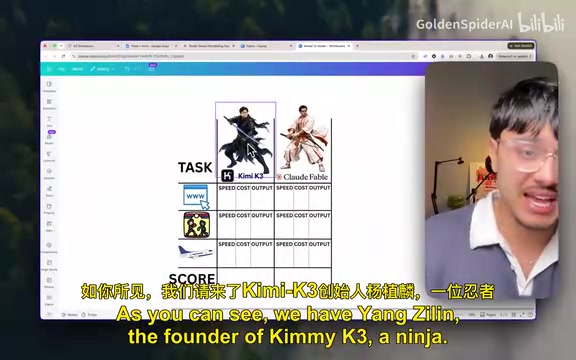
Kimi K3 vs Claude Real-World Test: Near-Equal Performance at 1/8 the Price
Real-world comparison of Kimi K3 vs Claude flagship across e-commerce pages, 3D fighting games, and flight simulators. Kimi K3 delivers 90% output quality at 1/8 the price with faster speeds and local deployment support.
Read more →

·3 min
Claude Code vs Codex: Hands-On Comparison and Installation Guide for AI Programming Tools
In-depth comparison of Claude Code and Codex AI programming tools covering accuracy, installation, and network setup tips to help developers choose the best solution.
Read more →

·3 min
Spring AI Explained: Unified API, RAG, and Enterprise AI Development Guide
Deep dive into Spring AI framework's core features including provider-agnostic unified API abstraction, RAG retrieval-augmented generation, and structured output to help Java developers build enterprise AI apps.
Read more →

·3 min
Spring AI Explained: Unified API, RAG, and Enterprise AI Development Practical Guide
Deep dive into Spring AI framework's core features including provider-agnostic unified API abstraction, RAG retrieval-augmented generation, and structured output to help Java developers build enterprise AI apps.
Read more →

·4 min
Spring AI 2.0 in Practice: Building an Enterprise RAG Knowledge Base Q&A System with Cursor
Build an enterprise RAG knowledge base Q&A system using Spring AI 2.0, Cursor AI programming, Ollama local deployment, and Redis vector storage. Runs on just 4GB VRAM.
Read more →

·4 min
Getting Started with AI Agent Development: A Complete Guide from Concept to Practice
A comprehensive guide to AI Agent architecture and development, covering automated marketing, intelligent customer service, and investment analysis scenarios with single and multi-agent collaboration.
Read more →
·3 min
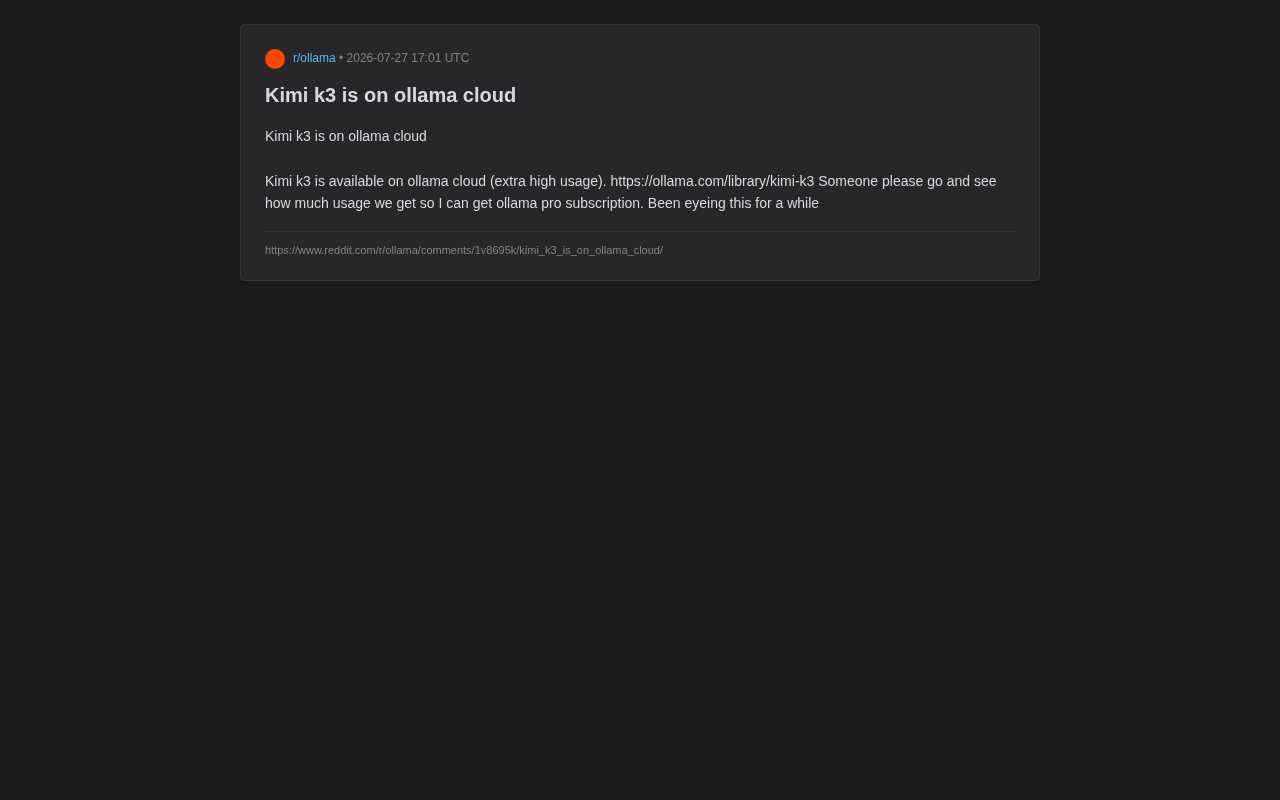
Kimi K3 Launches on Ollama Cloud: Free Tier, User Experience, and Developer Guide
Kimi K3 officially launches on Ollama Cloud as an "extra high usage" model. This guide covers free tier quotas, cloud inference experience, technical advantages, and how developers can seamlessly call this high-performance LLM.
Read more →

·2 min
RX 9060 XT vs RTX 5060 Ti: Which GPU to Pick for Local AI?
RX 9060 XT vs RTX 5060 Ti — both 16GB VRAM, but which is better for local AI? We compare CUDA ecosystem, ROCm compatibility, LLM inference, and real-world usability.
Read more →

·2 min
RX 9060 XT vs RTX 5060 Ti: How to Choose a GPU for Local AI
RX 9060 XT vs RTX 5060 Ti both offer 16GB VRAM — which is better for local AI inference? A full comparison of CUDA ecosystem, ROCm compatibility, LLM performance, and real-world usability.
Read more →
·3 min
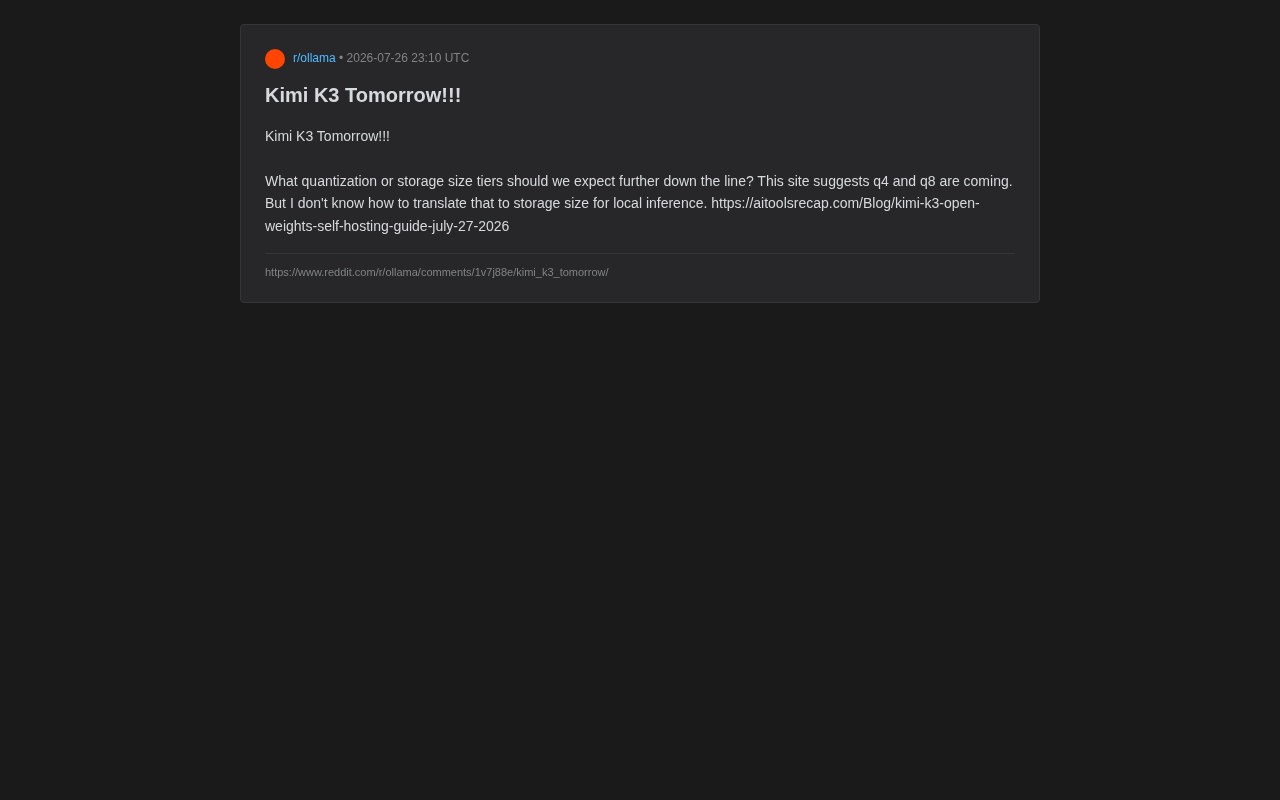
Kimi K3 Local Deployment Guide: Storage Requirements for q4 and q8 Quantization Explained
Detailed analysis of Kimi K3 quantization deployment options, comparing q4 vs q8 storage requirements, precision trade-offs, and hardware configurations for local self-hosting.
Read more →

·3 min
Build RAG and AI Agent Projects at Zero Cost: A Practical Guide to Open-Source Tools
Build high-quality AI projects on a budget. Learn how to use Ollama, Groq, Chroma, and other free open-source tools to build RAG systems and multi-Agent workflows from scratch.
Read more →
·3 min
Build RAG and AI Agent Projects at Zero Cost: A Practical Guide to Open-Source Tools
Build high-quality AI projects on a budget. Learn how to use Ollama, Groq, Chroma, and other free open-source tools to build RAG systems and multi-Agent workflows from scratch.
Read more →

·6 min
How the Creator of Redis Squeezed a 284-Billion-Parameter DeepSeek Into an Ordinary Laptop
Redis author antirez built the pure-C inference engine DS4 "Dwarf Star," compressing DeepSeek V4 Flash from 500GB to 80.8GB via asymmetric quantization for local deployment on 128GB unified memory at 26.7 tokens/sec.
Read more →

·6 min
How the Creator of Redis Squeezed a 284B-Parameter DeepSeek into an Ordinary Laptop
Redis creator antirez built DS4 "Dwarf Star," a pure-C inference engine, using asymmetric quantization to compress DeepSeek V4 Flash from 500GB to 80.8GB for local 128GB unified-memory deployment at 26.7 tokens/sec.
Read more →